Nancie Atwell on Choice, Pleasure and the Reading Life


Nancie Atwell, 2015 Global Teacher Prize winner, on giving children choice as readers and writers, the underground curriculum and 40 years in the classroom.
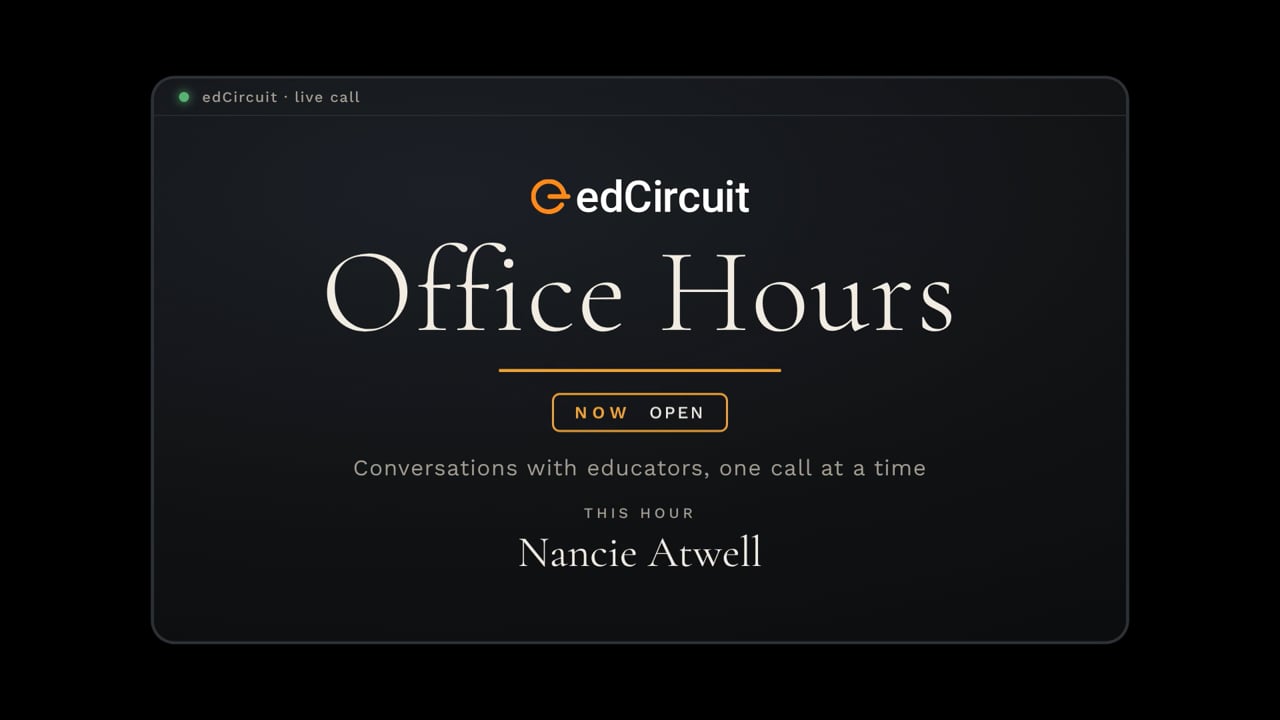
Nancie Atwell, teacher, author and winner of the 2015 Global Teacher Prize, talks with edCircuit about how she became a teacher almost by accident, why she gives children real choice as writers and readers, and what has kept her in the classroom for 40 years.
About this episode
In this Office Hours conversation, Atwell describes a school where the classroom libraries are chosen by teachers, the reading is for pleasure and the writing grows out of what students already care about. She explains why she thinks American schools resist that kind of choice, what she calls the underground curriculum, how her students learn to find good information, and why she still sees herself as a guerrilla fighter for teachers and children.
A teacher who never wanted to teach
Atwell says she was not fond of teachers and never meant to become one. She finished a BA in English at the State University College at Buffalo without knowing what to do with it, stayed on for a semester of student teaching, and knew from her first day of talking with children about books and writing that she had found her place. As a student she wrote parody with her friends and read Fitzgerald and all of Orwell at home, while bluffing her way through the assigned books. That experience shapes her teaching: she wants students to bring the reading and writing they love into school, because the students who become teachers, and she has lost count of how many from her school have, are the ones who got to taste the real thing.
Teachers who love knowledge
Asked whether schools should look for teachers who love a subject, Atwell points to curiosity. A child apprenticing to an adult, she says, wants that adult to know things worth knowing and to be able to lead the way into expertise. The teachers at her school who teach the younger grades have strong backgrounds across the disciplines precisely because they are so curious and well informed. Their first impulse, in her view, is intellectual, and the nurturing follows.
Why schools are afraid of choice
Atwell sees two unhealthy sources of the resistance to letting children choose what they read. The first is a lack of trust in children and teachers, a fear that classrooms will fill with worthless books, when her school’s libraries are carefully curated collections of fine children’s literature from kindergarten to eighth grade. The second is a snobbery about what children ought to read. Beneath both, she argues, is a national discomfort with pleasure: a feeling that reading for enjoyment needs hurdles. Yet stamina, fluency and vocabulary come only from reading a great deal, and her students easily reach Malcolm Gladwell’s 10,000 hours because they enjoy it.
Experience, not age
Children do not stop wanting to read at a particular age, Atwell says; it depends on what they have experienced. Students arrive at her school at seven or at thirteen saying they have not read a book in a year and have no favourite authors, often after years of one textbook and questions at the end of each selection. The easiest students to work with are those who have kept reading on their own, like a prospective third grader who knew everything about his collection of Star Wars chapter books.
The underground curriculum
Atwell defines the underground curriculum as what children talk about, read and write about outside the classroom. Her seventh and eighth graders, her speciality, are natural parodists, so they study satire and parody in the writing workshop. They write memoirs about growing up, free verse poems about the people and things they love, and persuasive essays for causes such as animal shelters and the Red Cross. Students learn a full range of real genres, she explains, and stay engaged because they choose what to write about. Many of her former students, she adds, find that choice again only in college, after what she calls a wasteland between eighth and twelfth grade.
Finding good information
Just as the books are curated, so are the websites. Every student at her school has a laptop, but the teachers select the sources students can reach. Atwell describes a Model United Nations conference at the University of Southern Maine where her students argued in character from position papers their coach, her daughter Anne, had researched. Phones go into the pockets of an old shoe bag each morning and come home at the end of the day, because the work is meant to be real scholarly research.
Forty years of pushing back
Atwell says she is prepared to remain a guerrilla warrior for the rest of her life. She regards the years from No Child Left Behind to Race to the Top as a disaster for education and the Common Core as a disaster for literacy, and she sees publishers and testing companies holding a stranglehold on classrooms. Even so, she is hopeful: teachers keep buying her books, which she describes as blueprints for giving children choice, and many teachers, including her own former students, push hard against mandates to do right by their students.
What keeps her going
Her energy, she says, has always come from students: a writing conference in which a student transformed a poem, a lunchtime conversation that became a persuasive essay about a food program for families, the right book placed in the hands of a reader who struggles to find one. That influence, she says, is better than any prize. When someone introduces her at a keynote, the only thing she wants the audience of teachers to know is that she taught the day before and has come to talk about what that looked like.
The full conversation is in the player above, part of edCircuit’s Office Hours series.
Related reading
More on Office Hours