 EdCircuit Staff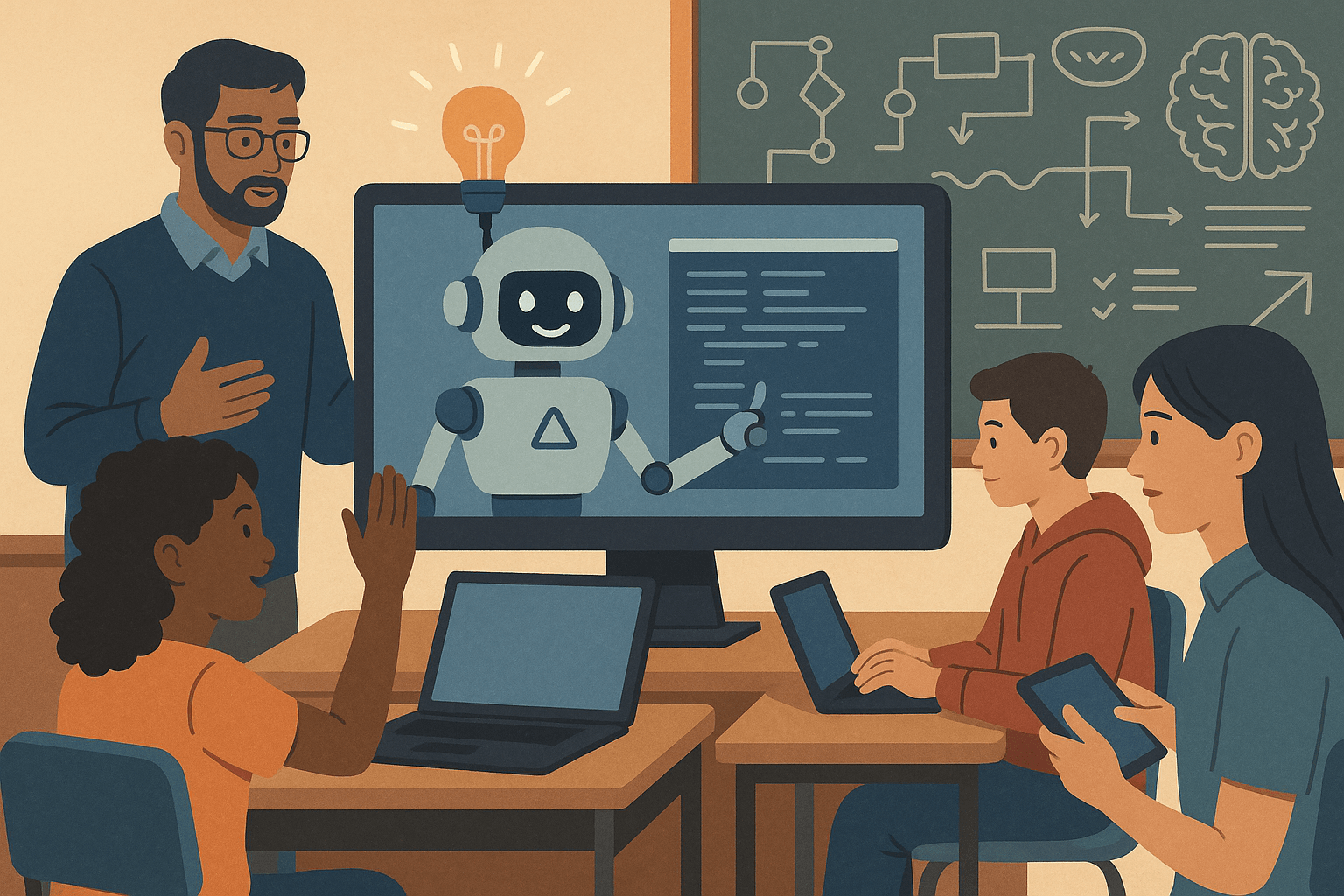
Table of Contents
By the time students reach high school, Generative AI is no longer a novelty—it’s an expectation. What began in elementary school as playful exploration and evolved in middle school into collaboration now becomes a lesson in accountability, authorship, and advanced digital literacy.
From Exploration to Expectation
In Generative AI in Elementary Schools: Creative Curiosity Meets Classroom Innovation, teachers introduced young learners to AI’s creative potential. In Generative AI in Middle School: Collaboration, Curiosity, and Classroom Impact, students began using AI as a partner in learning and problem-solving.
Now, in high school, the challenge shifts: preparing students not just to use AI, but to understand it—its mechanics, its limits, and its moral implications.
Generative AI refers to artificial intelligence systems capable of producing new content—text, images, audio, or code—based on the data they’ve been trained on. Unlike predictive or analytical AI, generative models create new material in response to user prompts. For high school educators, this technology is as much about ethics as it is about efficiency.
AI as a Research and Writing Partner
High school students are using AI to brainstorm, outline, and edit essays—but the best classrooms don’t stop there. Teachers guide students to analyze AI-generated text, comparing its accuracy, tone, and bias against credible sources.
English departments are creating AI writing labs, where students refine prompts to study how language choice shapes results. The exercise reinforces vocabulary, argument structure, and digital discernment.
“Students are realizing that AI can write quickly—but not always well,” said a high school English teacher in Illinois. “The lesson isn’t how to make AI write for you; it’s how to make it think with you.”
By embedding AI into writing workshops and journalism classes, schools are helping students become critical editors of machine output, not passive consumers of content.
AI in STEM and Design
STEM and computer science classrooms are where generative AI shines as both a creative and analytical partner. Students use AI to simulate lab experiments, visualize molecular structures, or generate Python code for robotics projects.
Design and art students are exploring AI-assisted creativity, combining tools like Adobe Firefly, Runway ML, or ChatGPT’s image capabilities to produce concept art or 3D models. Teachers use these projects to teach students about intellectual property, emphasizing that creativity involves both innovation and ethical responsibility.
When AI-generated art wins a digital design contest or AI-written essays outperform human drafts, these moments become starting points for discussion—not controversy. Students debate originality, credit, and authorship in a way that mirrors the professional world they’re entering.
Digital Citizenship and Ethical Understanding
At the high school level, educators are shifting from “how” students use AI to why they use it. AI literacy now includes topics like bias detection, misinformation, data privacy, and copyright awareness.
Schools are implementing AI Use Policies similar to plagiarism codes, requiring students to cite AI-generated material, disclose assistance, and explain how AI contributed to their final work. Some districts have even added AI ethics to their digital citizenship graduation requirements, aligning with broader initiatives from organizations like CoSN and ISTE.
In class discussions, students examine real-world scenarios AI in hiring, college admissions, or journalism and evaluate where ethical lines blur. These debates foster empathy, logic, and leadership, the cornerstones of modern digital citizenship.
Preparing for College and Career Readiness
Colleges and employers are increasingly looking for students who can leverage AI thoughtfully, not avoid it. Some universities now offer AI writing and ethics seminars as part of freshman orientation, and K–12 systems are responding by embedding those principles earlier.
Career and Technical Education (CTE) programs are introducing AI literacy microcredentials—verifying skills like prompt engineering, bias analysis, and responsible data use. Students who can demonstrate these competencies gain a competitive edge in a rapidly changing workforce.
“AI is no longer the future of learning—it’s the framework of it,” said one district innovation director. “High school students who learn to use it responsibly will become the thought leaders of tomorrow’s workforce.”
Supporting Teachers and Administrators
Educators at the high school level face both opportunity and complexity. They are asked to uphold academic integrity while encouraging innovation, a balance that demands professional learning and administrative support.
Districts are forming AI Advisory Committees that include teachers, students, parents, and IT professionals to create ethical use guidelines. Professional development now focuses on AI fluency, helping teachers understand generative systems well enough to mentor students who often adopt new tools first.
When teachers model curiosity, skepticism, and transparency, students follow. The classroom becomes a testing ground for digital maturity—a space where ethics, creativity, and learning intersect.
edCircuit’s Feature Series: Generative AI in K–12
edCircuit is proud to present its feature series, “Generative AI in K–12: Teaching, Learning, and Leading Through Change.”
In Part 1, we explored curiosity and creativity in elementary classrooms.
In Part 2, we examined how middle school students are learning with AI through collaboration and experimentation.
Now, in this third and final article, we focus on high school educators guiding students to master AI responsibly—preparing them for college, career, and citizenship in an AI-driven world.
Each article in this series highlights real classroom innovation, ethical practices, and leadership insights shaping the national conversation on AI in education.
Looking Ahead: The Future of AI in Education
As generative AI continues to evolve, one truth has become clear across K–12: the goal isn’t to outpace technology—it’s to outthink it. The educators shaping this new frontier are not teaching about AI; they’re teaching through it.
From curiosity in kindergarten to responsibility in senior year, the journey of AI in K–12 mirrors the evolution of learning itself—human-centered, adaptive, and endlessly creative.
And as edCircuit continues to chronicle that evolution, the conversation is only just beginning.

PBS NewsHour – How one school is using AI to give their students feedback
Subscribe to edCircuit to stay up to date on all of our shows, podcasts, news, and thought leadership articles.