

 EdCircuit Staff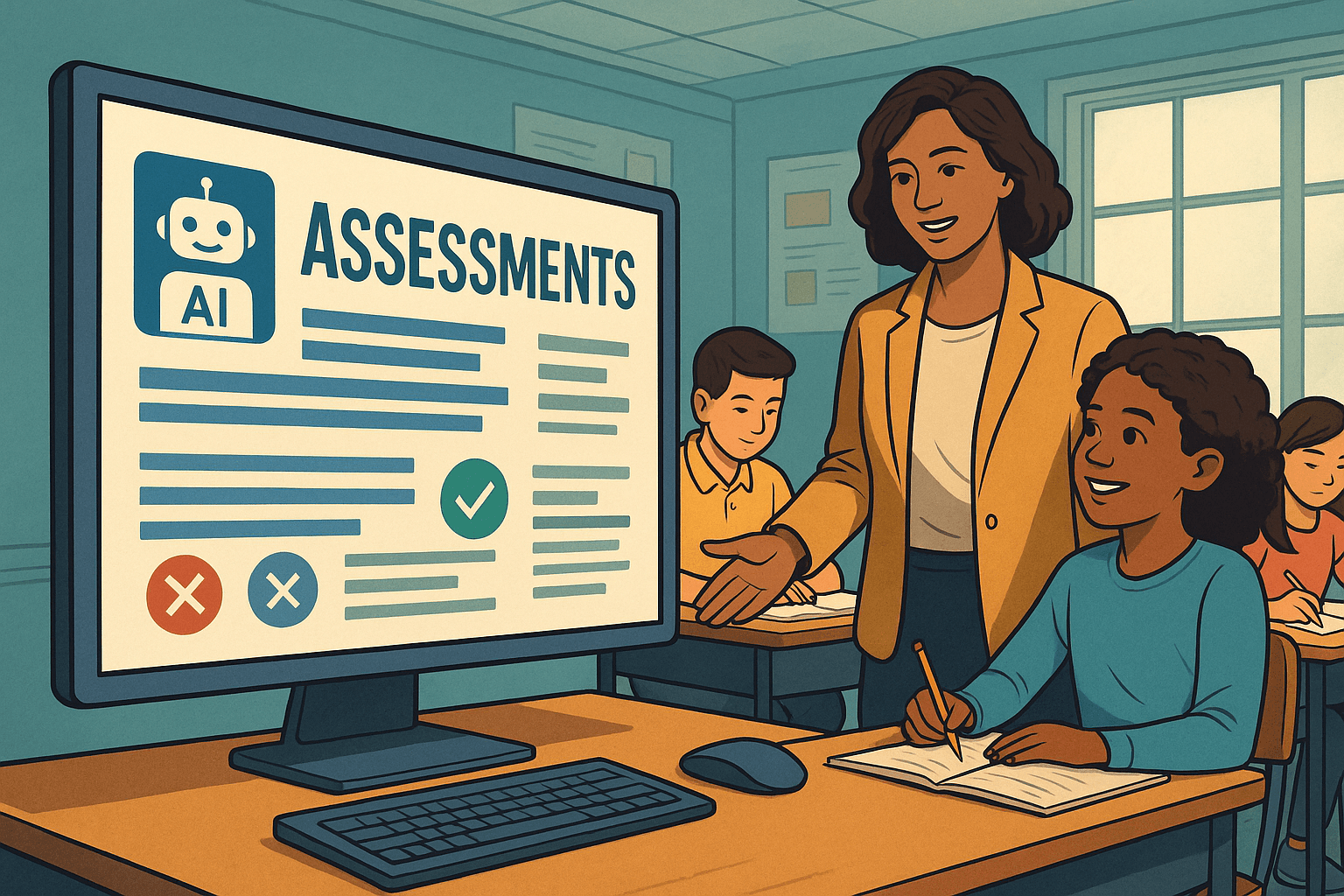
Table of Contents
Assessments are foundational in education—guiding instruction, identifying gaps, and informing curriculum planning. However, traditional methods can be slow, labor-intensive, and limited in scope. Today’s AI-powered assessments promise to streamline grading while enhancing learning through adaptive feedback, data-driven personalization, and real-time insight.
For educators, policymakers, administrators, and families, understanding the capabilities and caveats of AI in assessment is increasingly essential.
What Are AI Assessments?
AI assessments use machine learning and natural language processing to evaluate student work, interpret open‑ended responses, provide suggestions for improvement, and adapt question difficulty in real time. These tools go beyond binary scoring—delivering richer insight into student thinking and progress.
Benefits: Speed, Precision, and Personalization
1. Faster Feedback Loops
Students receive near‑instant feedback, which supports formative learning through reflection and revision. Teachers gain dashboards that highlight class trends, learning gaps, and targeted next steps—enabling instructional pivots and interventions within days or even hours.
2. Freeing Up Teacher Time
AI handles routine grading and analytics, allowing educators to invest more time in teaching, coaching, and connecting. Teachers can focus on one-to-one support, personalized goal-setting, and professional collaboration—reinforcing that AI is an amplifier, not a replacement.
3. Differentiated Instruction and Equity
Tools adapt to each student’s level—challenging advanced learners while offering scaffolded support to those who need it. For students with individualized education plans or language accommodations, AI can adjust pacing, format, and scaffolding for better accessibility.
District Highlights: Cited Examples
Hacienda La Puente Unified (California)
In early 2024, fifth graders at Baldwin Academy used Microsoft Reading Coach, featuring generative AI to create custom stories and practice reading aloud. The tool tracks fluency and accuracy, and teachers access individual metrics to guide instruction more effectively—helping differentiate across a classroom of nearly 40 students.
Gwinnett County Public Schools (Georgia)
Serving over 177,000 students, GCPS launched the nation’s first AI-focused high school (Seckinger), embedding AI principles across K–12 subjects. It also implemented a diagnostic assessment tool (developed with ISTE in 2025) to measure AI-readiness in areas such as data science, ethics, and creative problem-solving—a 10–15-minute adaptive instrument that helps teachers target growth and guide resources.
Los Angeles Unified School District (California)
In March 2024, LAUSD launched “Ed”, an AI-powered student and parent chatbot intended to serve half a million K–12 users. Designed to deliver personalized academic plans, grades, attendance data, and multilingual support (about 100 languages), it aimed to accelerate recovery post-COVID. However, after contractor AllHere Education folded in June 2024, the project was shut down. Officials later committed to revisiting AI design with stronger governance.
Concerns: Equity, Transparency, and the Human Touch
Despite their promise, AI tools must be handled responsibly. Concerns remain around algorithmic bias, student privacy, and over-reliance on automation.
Human Oversight Is Essential
AI can spot patterns or flag keywords—but it cannot grasp student anxiety, cultural nuance, or growth arcs. A teacher’s empathy, intuition, and expertise remain crucial for interpreting feedback and fostering deeper reflection.
Fairness and Transparency
Tools must be trained on representative data sets, and assessment outcomes must be contextualized. Districts and parents should ask:
-
Who developed the AI?
-
How is data stored and governed?
-
Are results interpreted alongside human insights?
Blending AI with Authentic Learning
While AI handles auto-scored tasks efficiently, human-graded projects—such as presentations, collaborative work, and creative outputs—remain vital for holistic assessment.
What Parents Should Know
Some fear AI reduces teacher interaction or increases screen time. In practice, it can reduce test stress, offer revision opportunities, and empower students with autonomous insight.
Tips for parents:
-
Ask how AI tools are used in your child’s classroom.
-
Review dashboards together and discuss feedback.
-
Advocate for balance—ensuring human connection alongside digital tools.
Implementation Best Practices
For success, districts should invest in training, infrastructure, and ethical guidelines:
-
Engage educators in selecting and piloting AI tools.
-
Mix AI with authentic assessments—student portfolios, discussions, and group tasks.
-
Establish clear data privacy and security protocols.
-
Adopt policies that ensure transparency and human oversight.
Innovation Anchored in Intention
AI assessments offer transformative opportunities for speed, personalization, and efficiency—but only when integrated thoughtfully. They thrive best when they work with educators and are guided by pedagogical expertise, empathy, and equity.
The future of effective assessment lies not in choosing between AI or humans—but in orchestration: where AI accelerates insight, and human teachers cultivate understanding, growth, and connection.

Subscribe to edCircuit to stay up to date on all of our shows, podcasts, news, and thought leadership articles.