


edcircuit
Banner for the CoSN 2026 Ed Tech Conference, reading โ€œBuilding Whatโ€™s Next, Together,โ€ April 13โ€“15 at Sheraton Grand Chicago Riverwalk. Includes a city skyline graphic and the website www.CoSN.org/CoSN2026.
Square graphic with a purple background featuring CoSN Leading Education Innovation THE PODCAST above a microphone icon. Text below reads Produced in partnership with edCircuit. Thin green border outlines the image.
Home PodcastAuthor Chats Four Questions That Transform History Teaching
2 minutes read

Four Questions That Transform History Teaching

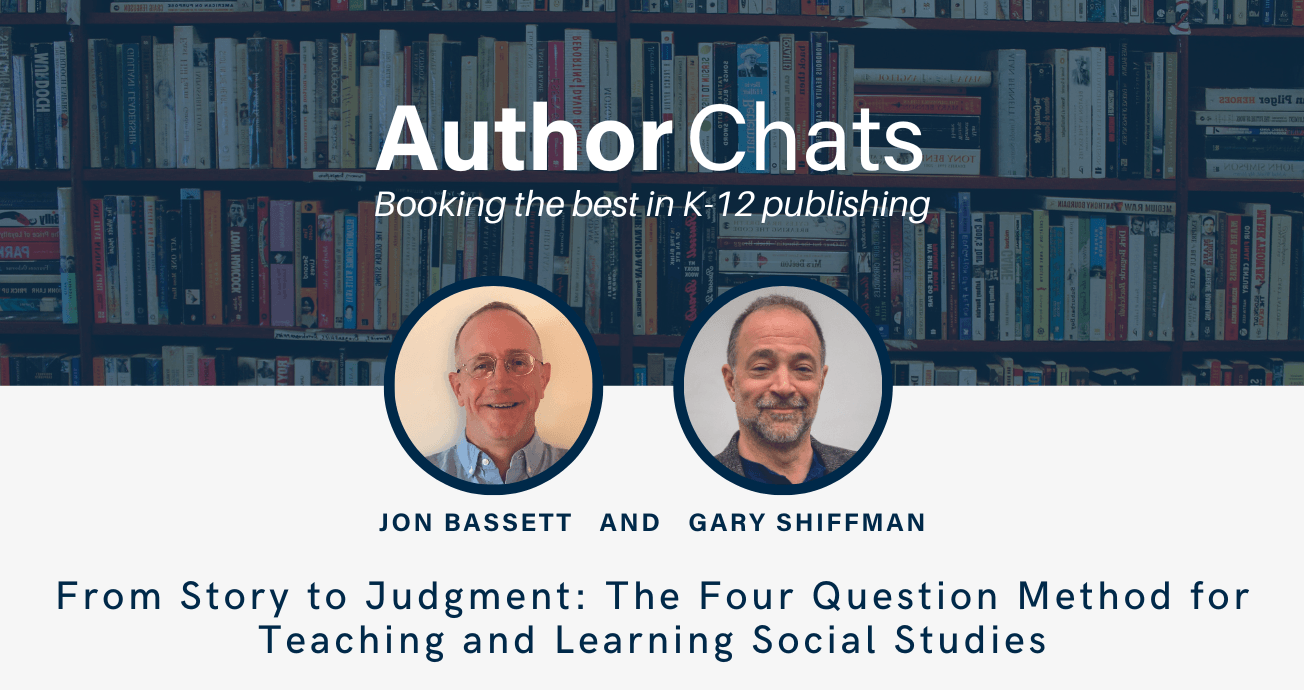
Jon Bassett and Gary Shiffman discuss their new book, From Story to Judgment: The Four Question Method for Teaching and Learning Social Studies

Social studies and history teachers Jon Bassett and Gary Shiffman join Author Chats to discuss their new book, From Story to Judgment: The Four Question Method for Teaching and Learning Social Studies (John Catt Educational). Bassett and Shiffman have collaborated for two decades to develop and refine their four key questions that lead to better history and social studies teaching and learning.

The book is broken down into sections centered on narration, interpretation, explanation, and judgment. By forming lessons around historical stories that clearly define the โ€œwhatโ€ and adding the motivations behind the โ€œcharactersโ€ at a particular time and place, students are then encouraged to draw their personal interpretations and connections. This inquiry method leaves a lasting impression on students and leads to deeper understanding of historical events and the associated social context.

Bassett is a believer in setting the foundation of the story first to allow context for the interpretation that follows. โ€œWe have to know what happened before we can do some deeper thinking about it,โ€ he explains. Shiffman builds on the concept, explaining that many history classes miss the mark by losing the thread of the story and the carryover meaning. โ€œKids are most engaged when they have an anticipation of what happens next,โ€ he adds.ย 

Through a combination of building from the โ€œwhatโ€ toward โ€œwhat happens next,โ€ teachers can set the stage for students to dive deeper into meaning. โ€œWe have to teach them how to understand and recognize patterns,โ€ says Shiffman. โ€œTo better explain why things happen the way they do.โ€ According to Shiffman, the ultimate goal as an educator should be to teach students how to be citizens and make judgments based on high-quality knowledge combined with their personal values.ย 

As you listen to the interview, think through the following questions, and consider how using the authorsโ€™ Four Question Method might improve teaching and learning in your school:

1. How have you collaborated with teaching colleagues to improve and refine your instructional approach?ย 

2. When you think about the organizational arc of narration, interpretation, explanation, and judgment, how does this compare or contrast with what youโ€™ve done in the classroom? What areas would you most like to explore with your students?

3. Have you tried similar questions to those used in the Four Question Method? How did they engage your students? Can you see questions like these adding richness to classroom discussions?

4. Consider the way you teach about current events, in comparison to how you teach about historical events. Are there conscious similarities? Areas that are by nature different?

5. What other questions do you like to ask your students when evaluating historical (or literary) content?

Listen to more episodes ofย Author Chats.

  • edCircuit is a mission-based organization entirely focused on the K-20 EdTech Industry and emPowering the voices that can provide guidance and expertise in facilitating the appropriate usage of digital technology in education. Our goal is to elevate the voices of todayโ€™s innovative thought leaders and edtech experts. Subscribe to receive notifications in your inbox

    View all posts
  • Dr. Jonathan Bassett is a veteran history teacher and the co-author with Gary Shiffman, of From Story to Judgment: The Four Question Method for Teaching and Learning Social Studies.ย  He holds a BA in history from Columbia University, a Master's in Teaching History from Brown University, and an EdD in Curriculum and Teaching from Boston University. He has taught all high school grades and ability levels in a wide range of settings, urban and suburban, Catholic, district, and charter schools. Bassett and Shiffman developed the Four Question Method to make social studies teaching and learning accessible, engaging, and meaningful. You can learn more about it and about them at their website, 4qmteaching.net.

    View all posts
  • After graduating from the State University of New York at Binghamton with a BA in political science, Gary Shiffman taught elementary and middle school in New York City and Maalot, Israel. Well chastened, he attended graduate school at the University of Michigan, where he studied political theory. He then taught for eight years at the University of California, San Diego. Chastened again, he became a high school teacher in 2002, when his current partner and then department chair hired him to teach history at Newton North High School in Massachusetts. Four years later, he became Social Studies Curriculum Coordinator at nearby Brookline High School, where he teaches one class and supervises and evaluates teachers. He co-founded 4QM Teaching in 2017. You can find out more about 4QM Teaching at our website, www.4qmteaching.net.

    View all posts
Promotional graphic with the text โ€œRegister Today for the EdTech Conference of the Year! www.CoSN.org/CoSN2026.โ€ Below is a skyline and Ferris wheel graphic with โ€œCoSN 2026.โ€ Blue gradient background.

Join Thousands of Other Subscribers

This field is for validation purposes and should be left unchanged.

Participate in the COmmunity

Square graphic with a purple background featuring CoSN Leading Education Innovation THE PODCAST above a microphone icon. Text below reads Produced in partnership with edCircuit. Thin green border outlines the image.
Share Your Voice on edCircuit

Use EdCircuit as a Resource

Would you like to use an EdCircuit article as a resource. We encourage you to link back directly to the url of the article and give EdCircuit or the Author credit.

MORE FROM EDCIRCUIT

edCircuit emPowers the voices of education, with hundreds of  trusted contributors, change-makers and industry-leading innovators.

YOUTUBE CHANNEL

@edcircuit

Copyright ยฉ 2014-2025, edCircuit Media – emPowering the Voices of Education. ย 

This website uses cookies to improve your experience. We'll assume you're ok with this, but you can opt-out if you wish. Accept

-
00:00
00:00
Update Required Flash plugin
-
00:00
00:00