
Effective assessment for student ownership and success by Laura Greenstein
Definition:
 Nudge: Touch or push lightly; gently prod or urge into action; get someone’s attention. As in: She nudged him towards the teacher’s desk; He nudged his teammates to run a little faster; it took a little nudge from my mother to finish my homework.
Etymology:
1600s (Verb) Scandinavian: nugge, nyggje to jostle. Icelandic: nugga to rub
1800s Yiddish: stem of nudyen to bore or weary. Polish: nudzić, nudnik, a pest
Current Nudge (verb) to pester or nag or give a push. Noodge/Nudge (noun) someone who pesters or whines: What a nudge they are! She gave my leg a nudge under the table.
2000s Nudge Theory: In behavioral science and economics it means using suggestion and positive feedback to achieve non-forced compliance that changes short-term behavior in support of long-term goals.
Nudging Assessment
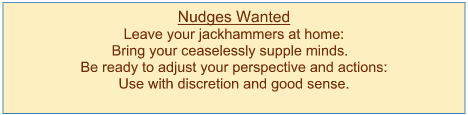
 Effective assessment means that students understand the learning intentions and how their learning will be appraised. They have multiple ways to show what they have learned and take increasing responsibility for their learning outcomes. In these settings, assessments are supportive of students, focus on visible and achievable expectations, engage learners, are consistent, reasonable, and emphasize improvement over final scores. Rather than a jackhammer, consider a velvet mallet, or a gentle nudge under the desk.
Nudging assessment means providing opportunities for student ownership and success. It is an essential element of restorative assessment. As Richard Thaler and Cass Sunstein (2008) explain “Putting fruit at eye level counts as a nudge, banning junk food does not.”
Five ways to use assessment to nudge student’s success
- Encourage students to annotate selected choice questions: Misunderstandings become more visible when they elaborate on their thinking. Honoré says, “I know the meaning of the word in the first part of the question, but not sure about the second. If lack of exercise means the same as sedentary, then the statement is true.”
- Incorporate choice in extended response questions: In social studies, students choose which president’s actions to summarize, critique, or compare during a specific era. In health, they decide the nutrients they want to encourage others to be sure to include in their diet. In science, they select, analyze, and contrast properties of gases using a table or graphic organizer.
 Give students a role in constructing test and assessments. They can write questions and use them in a game-format class review. Include some of the questions in the test: Watch for their delight when they see ones they wrote or know the answers to others. Confidence is a morale booster that encourages students to push the boundaries of their learning.
- Review using material that will be included in the assessment, just in a different format. For example, in the review ask students to match cloud formations with weather predictions. Then, on the test, they label three cloud formations and explain which one is most likely to result in rain before long. Repetition and reinforcement is another essential element in remembering and recalling learning.
- Rely on respectful nudging, meaning offering guidance on solutions and supportive interventions. If students are providing peer feedback, suggest sentence starters that are respectful and empathetic. For example, “Your work made me understand…, but I’m still wondering….” Help them motivate others through constructive feedback such as “Your opening sentence really grabbed me; can you also explain how the character’s actions led to the outcome.” Model ways to use words of encouragement to strengthen learning as in: “You have so many creative ideas: Which one do you want to dig into more deeply?”
Keep in mind that parents can be the best nudges when done right. My parents would tell stories about how someone in our extended family got accepted to college because they were hard-working. Rather than a jackhammer, they relied on stories, examples, and parables, for life’s lessons.
 To summarize, nudges are most effective when they have a track record such as those that build confidence or strengthen ownership. The best ones are:
- Aligned with and responsive to the learning intentions
- Feasible in the moment
- No or low cost
- Designed with options and choices
- Presented developed and displayed through multiple channels: words, voice, images, and examples
Learn more at:
Small Nudges Can Push Students in the Right Direction, Sarah Sparks, EdWeek
Thaler, R, and Sunstein, C. (2008) Nudge: Improving decisions about health, wealth, and happiness. Penguin Books
Nudge Theory at https://en.wikipedia.org/wiki/Nudge_theory
Author
Laura Greenstein has been an educator for over 30 years serving as a teacher, department chair, program manager, and school leader in multiple grades and subjects. In addition, she teaches Measurement, Evaluation, and Assessment, as well as Teaching, Learning, and Assessing in the Digital Era to graduate and undergraduate students at the University of New Haven and the University of Connecticut.
She is the author of numerous books and articles on assessment, including What Teachers Really Need to Know about Formative Assessment from ASCD, Assessing 21st Century Skills with Corwin, Sticky Assessment from Routledge, and soon to be published Restorative Assessment with Corwin. Laura is the founder of the Assessment Network, a respected resource for straightforward information, resources, and perspectives. You can find Laura on MyEdExpert.com
You can connect with her on Twitter or Facebook
Further Reading
- Edutopia – Encouraging Students to Own Their Work
- Teach.com – Motivating Students
- The Teaching Center – Increasing Student Participation

 In the
 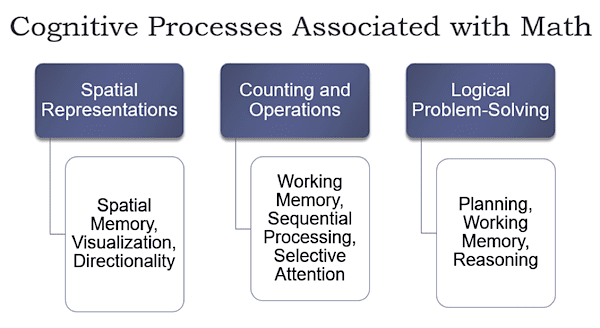 The relationship of math success to visual-spatial abilities is strongly supported by research, and the correlation actually appears to increase as the complexity of the mathematical task increases. The important aspect of visual-spatial processing is not just remembering the shape, size, color and number of objects, but their relationships to each other in space. It turns out that visual memory by itself (what things are) is somewhat error-prone, but spatial memory (where things are) is associated with correct answers, and is thus an important aspect of mathematical problem-solving. Within visual-spatial processing, we can distinguish cognitive skills such as the following:
 Finally, math is problem-solving. There are other types of problem-solving, of course, but problems with numbers almost always call for mathematical thinking and logic. In the discussion above, we have already highlighted some of the cognitive skills we use for problem-solving, but higher-order cognitive processes are often required to be successful in math. And here we can start with Planning: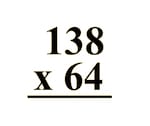
 As we observed in the previous article on reading, there is significant overlap in the cognitive skills needed for reading and math. It bears repeating that we don’t have two brains; we just have one, of course, and we use it for reading and math and everything else we do. As we acknowledge how critical these skills are to learning, it raises the question of how we can support our students in developing these skills so that they can be effective learners. In the next article in our series, we will look at how cognitive skills develop and how they can be strengthened in ways that contribute to improved academic performance.











 Danny Wagner is Senior Editor, Education Reviews at
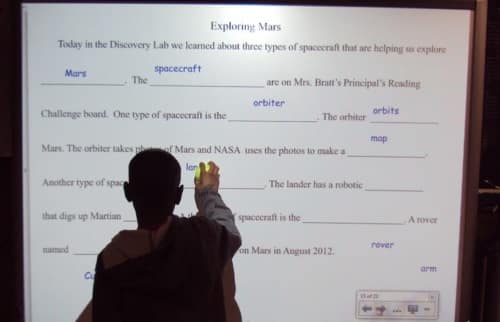 As someone who did not grow up with English as my first language, I always found it particularly difficult to read science articles and textbooks. Usually, the text included so much technical vocabulary and jargon that I was overwhelmed by the number of new words I had to stop and look up; oftentimes I would have trouble understanding entire sentences if they contained multiple unknown words or phrases. Looking back, reading would have been much easier if I had the skills to break down sentence structures in order to identify the key nouns and verbs. Sentence diagramming is a pedagogical approach that guides students through complex sentences, breaking them up into more manageable pieces that help students understand the meaning of specific words. In science courses, much of the vocabulary is unfamiliar as most people do not encounter it in their day-to-day interactions, which could lead to higher levels of confusion and misunderstanding, especially for English Language Learners (ELL).
 In order for students in Texas to graduate, they are required to pass a biology end-of-course exam. Throughout this course, students study living organisms which includes subjects like anatomy, behavior, and interaction. The amount of reading required to learn this information is staggering, and test questions are often long sentences describing different scenarios the students would have to navigate through to provide a correct answer. For students not yet proficient in the English language or content, this can act as a roadblock and hinder their success.
 Students encounter similar comprehension issues in other science courses, including physics, geology, aquatic science, and astronomy. Upon learning a long list of new vocabulary words, they must read and understand articles using these new terms. Too often, students give up as soon as they see test questions in paragraph form because the process of making sense of it all is too discouraging. If we were to teach them how to break down each question in order to get to the main point, it would make the process more tolerable for those who struggle with the English language and could lead to higher success rates. As previously stated, sentence diagramming is an approach to teaching and learning that helps readers overcome literacy challenges by understanding the main point each sentence is trying to convey, especially in vocabulary-riddled text.
 Joy Lin attended the
 Something I recommend in my work with schools and districts is to leverage social media to their advantage as a professional development tool. When I ask a group of educators how many are using Twitter, either personally or professionally, I am frequently saddened by the lack of hands I see raised. Many teachers think of Twitter as a waste of time – something with no value in the education realm. After all, how much content can you receive in 280 characters. Just the opposite is true.
 Once you get involved in Twitter as a way to grow professionally, the possibilities are almost limitless. Gather research for an article or blog post by posting questions to your PLN. Receive constructive criticism on a lesson plan, presentation, or idea from other educators. Share tips and get advice on things like parent/teacher conferences and open houses. Collaborate with others to solve a specific issue at your school. Once you get started, you just might become an evangelist. I know I did.
 There are challenges facing colleges and universities in adopting and implementing game-based learning into the higher ed environment. Three of the industry leaders, Karl Kapp,
 Jim Kiggens has over two decades of experience in producing and developing game-based learning for higher education, middle and secondary school, and corporate training. In addition to shipping 24 Serious Game titles at Course Games, Jim also has over 20 years of experience in instructional design, program development, and teaching digital animation and game development at several colleges and universities.
 Karl Kapp, Gamification, is an analyst, published author and assistant director and faculty member at Bloomsburg University’s Institute for Interactive Technologies (IIT).
 André Thomas has over 20 years experience in CGI production, he has worked around the world on legendary video games, live action feature films and gripping commercials. He served as Head of Graphics for EA Sports Football (including NCAA, Head Coach, NFL Tour and Madden, the longest running and most successful sports franchise in this history of the games industry.)