
 EdCircuit Staff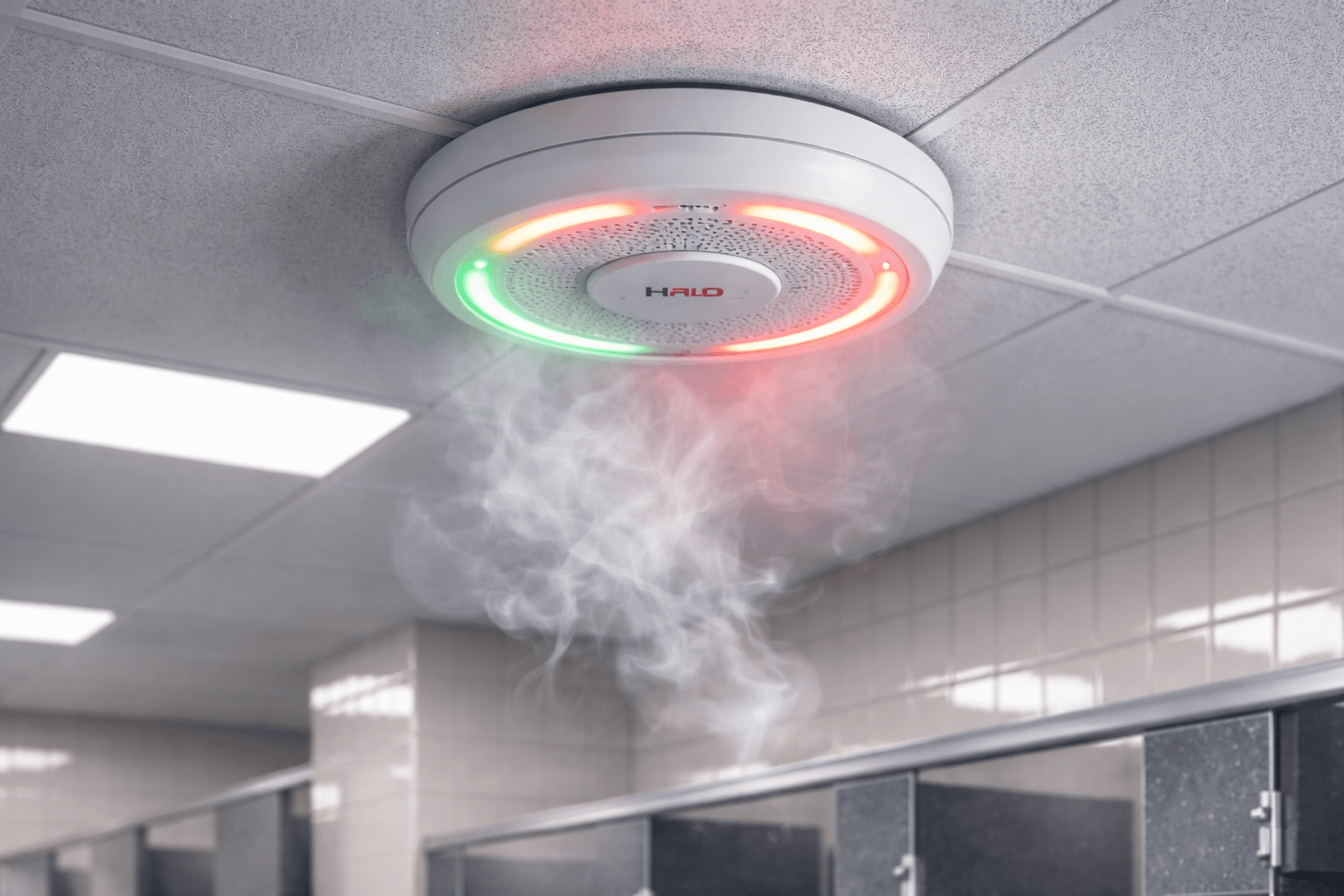
Table of Contents
AI vape detectors in schools are turning ceilings into real-time safety systems, closing long-standing supervision gaps while redefining how districts protect student health and privacy.
An assistant principal glances at a phone during third period.
A notification appears: elevated vape aerosol levels detected — second-floor east bathroom.
No cameras.
No audio.
No staff member is stationed outside the door.
But within seconds, the school knows:
-
where the incident is happening
-
how many students are inside
-
whether the space shows signs of unusual activity
That moment captures a growing national shift. AI is no longer confined to dashboards, learning platforms, or cybersecurity filters. It is moving into the physical infrastructure of schools — transforming air, space, and motion into actionable intelligence.
In Hillsborough County Public Schools, the large-scale deployment of AI-powered Halo environmental sensors in every high school bathroom represents one of the clearest examples yet of the intelligent campus becoming reality.
From blind spots to responsive environments
Bathrooms have always been one of the most difficult areas for schools to supervise.
They are also where many of today’s most persistent student safety and wellness challenges converge:
-
vaping and THC use
-
bullying and fights
-
class avoidance
-
vandalism
Traditional strategies — hall passes, periodic checks, locked access — have relied on adult availability and physical presence. In an era of staffing shortages and expanded safety expectations, that model is increasingly unsustainable.
Environmental AI changes the equation by shifting supervision from people to place.
Instead of assigning someone to monitor the space, the space itself becomes aware.
How the technology works — and why that matters
The sensors installed in Hillsborough County operate without cameras or microphones. They do not record conversations or capture images.
Instead, they analyze:
-
airborne chemical signatures linked to nicotine and THC
-
masking agents designed to hide vaping
-
air quality and particulate levels
-
humidity and temperature
-
occupancy counts
-
motion pattern anomalies
Over time, the system uses machine learning to understand what “normal” looks like in each specific room — how air flows, how long students typically stay, and how many people are usually present.
When those patterns change, administrators receive instant alerts with precise location data.
This distinction is critical. The technology is not identifying individuals — it is identifying environmental events.
That is why many districts view it as a privacy-conscious alternative to video surveillance in sensitive spaces.
Student health: the real driver behind adoption
While the technology is impressive, the primary motivation is not discipline — it is health.
Youth vaping remains one of the most difficult challenges facing middle and high schools. The speed at which nicotine addiction can develop, combined with the rise of THC use and synthetic products, has shifted the issue from rule enforcement to public health response.
With real-time detection, schools can:
-
intervene immediately
-
identify patterns of repeated use
-
connect students to counseling or support services faster
That moves the conversation from punishment to prevention — and aligns directly with whole-child and MTSS frameworks many districts are already building.
A new operational model for school leaders
For principals and district administrators, the impact goes far beyond bathrooms.
Real-time environmental alerts allow schools to:
-
respond faster to fights
-
reduce vandalism and property damage
-
monitor overcrowding
-
deploy staff more efficiently
Instead of assigning personnel to constantly check spaces, administrators can respond only when needed.
In a time of:
-
budget constraints
-
staffing shortages
-
increased safety expectations
That shift from routine supervision to targeted response is operationally significant.
The rise of the intelligent school campus
What is happening in Hillsborough County is part of a much larger transformation.
AI in K–12 is moving from software to infrastructure.
Districts are already implementing:
-
AI-powered weapons detection
-
smart access control systems
-
intelligent camera analytics
-
predictive cybersecurity monitoring
-
energy and air-quality optimization
Environmental vape detection fits into this broader ecosystem.
The result is the emergence of a responsive school building — one that senses risk, communicates in real time, and supports faster decision-making.
This is the intelligent campus model that higher education, healthcare, and corporate environments have been moving toward for years.
K–12 is now entering that phase.
The privacy paradox
Even without cameras or audio recording, these systems change how students experience space.
They know the environment is monitored.
That creates a new behavioral dynamic: awareness without direct surveillance.
For district leaders, the key questions are no longer whether to use AI, but:
-
What data is collected?
-
Who has access to it?
-
How long is it stored?
-
How is it used to support — not simply punish — students?
The success of these systems will depend on policy, transparency, and clear communication with families and students.
Turning incidents into actionable intelligence
One of the most powerful long-term impacts is not the alert itself — it is the data over time.
Districts can begin to see:
-
when incidents are most likely to occur
-
which locations need redesign or increased access
-
how scheduling affects behavior
-
where wellness interventions are most needed
That turns isolated discipline events into strategic planning insight.
A cultural shift for students
For today’s students, intelligent environments are becoming normal.
They already live in:
-
smart homes
-
AI-curated digital platforms
-
sensor-driven public spaces
Schools are now reflecting that same reality.
The lesson is not just behavioral — it is societal.
Students are learning what it means to exist in AI-enabled environments and how those systems are used to support safety and health.
Leadership implications for districts
For superintendents, CTOs, and facilities leaders, this is not a vaping solution.
It is an infrastructure decision.
It signals:
-
a move toward data-informed operations
-
integration of safety, health, and facilities systems
-
a new definition of supervision
And it raises a defining leadership question:
If the building can sense risk in real time, how should the human response change?
Conclusion: the ceiling is the new dashboard
The most important shift is not the detection of vape aerosols.
It is the transformation of the school building into a real-time partner in student safety.
For decades, supervision depended on line of sight.
Today, it depends on environmental awareness.
The ceiling is becoming a dashboard.
The air is becoming data.
The building is becoming responsive.
And in that transformation lies the future of K–12 campus safety — not as surveillance, but as intelligent, privacy-conscious care that allows schools to intervene earlier, support students faster, and design environments where harmful behaviors are harder to hide and easier to address.

WFLA News Channel 8 – Vaping detectors are being installed in Hillsborough County High Schools
Subscribe to edCircuit to stay up to date on all of our shows, podcasts, news, and thought leadership articles.