
 Larry Jacobs
Using football as a wide-ranging multi-subject learning tool Years ago a friend and I were watching pro football when they announced a play as “one of the most unusual plays in NFL history.” My buddy turned to me and said, “NFL history! Is that a two or three credit course and at what university?” Yes, we laughed. But at this joyous time of year as we build to The Super Bowl, regardless of whether you took “NFL History 101’ at Yale, football allows for some great interdisciplinary engagement that’s both fun and serious, whether you like the game or not ( the ‘nots’ include my wife). Yeah, yeah, you can do all kinds of math fun with statistics and measurements etc., but it can go a lot deeper than that!
One hot area that immediately comes to my mind is Social Emotional Learning (SEL). A guest on Education Talk Radio, a fellow from Ohio who helps place kids after 12th grade into jobs, tells schools this simple thought when talking to them about creating a world of career-ready people, “Invariably people get hired for their hard skills and invariably they get fired for their lack of soft skills.” That’s why SEL is so darn important
And the best way to illustrate that is to follow two New England Patriots, the first being Rob Gronkowski who during a Buffalo Bills game, when a ref didn’t call a Pass Interference call against the Buffalo player, decided to take matters into his own hands and leap on the Buffalo player’s head while that player was on the ground and then hitting him in the head with his elbow. This resulted in serious injury to that Bill. Yo, Gronk… didn’t you know that even in your world, there are rules and one must learn to control oneself? Is there a lesson in this?
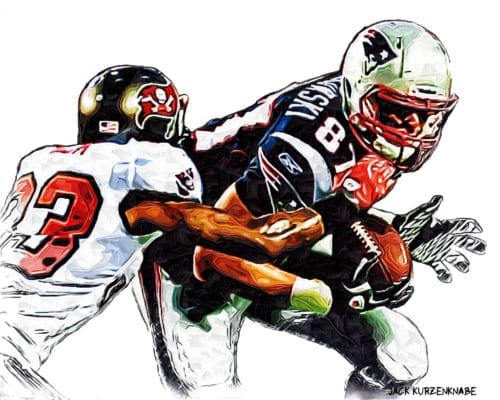 Yes, there is. In this case, the suspension cost Gronk a $250k game check, a $31,250 game-day roster bonus, and will make it that much tougher for him to reach his $5.5 million incentive level. OK, he makes a lot of money, but to put it into perspective, think how aggravated you’d be if they removed 1/16th of your salary. If you’re making 50 G’s, that’s $3125.00. That’s not chump change. It’s a good lesson for kids to learn that losing your temper and bullying, not playing by the rules, not accepting what a ref… or a boss… or a teacher says can cost you. It can cost you dollars and it can cost you prestige. That’s a life lesson, so take that example and run with it as we deal with the social emotional side in your classroom.
Football also brings out another American quality; it’s something spoken about all the time in schools all over the country as an important component to social emotional learning, and that is RESILIENCE. Down 21-3, the Titans, playing away against the Chiefs, won their playoff game a few weeks ago. In last year’s Super Bowl, the Pats were down 28-3 at halftime, came back, scored 31 unanswered points and won the game and the championship.( Sorry Atlanta readers for bringing that back up. I know it’s painful.) Alabama came back from 13-0 to win this year’s college football championship in a great game against Georgia. The US came back after December 7, 1941 after we lost our Pacific Fleet at Pearl Harbor and we came back again after 9/11. That’s RESILIENCE, a key component of learning these days. Teach your kids that they can do it too by using these lessons. No great player gives up! I’ll take that a step further.
 Ask any math teacher and they’ll tell you how much they hate the phrase from students, “I stink at math,” which they hear all too often. That’s an “I’m giving up” phrase and for some reason, acceptable by society. But my wife remembers a different outlook from when she was an ELL teacher and her Asian students always put it differently by saying, “I have to work harder to get better in math.” That’s resilience… so apply that ‘never give up’ attitude through the use of sports with your students and suddenly they may change their perspective on math and anything else they’re having trouble with.
Am I forgetting some group – a group that may not like football as learning? Many females (not to stereotype, of course) and a lot of guys just don’t like football. Talk about resilience; years ago, when I was a weekend host on WRKO radio in Boston our show ran 7-11p on Sunday night. And, guess what, we had to do a show on Super Bowl night and the Pats were playing. We knew the audience might be a little, shall we say, slimmer than usual. How do we build an audience for 4 hours and get folks to call in from the Boston area during a Pats Super Bowl. Simple, our topic was “Why I Hate Football.” The phones rang off the hook from everyone who wasn’t watching. Hey English teachers, wanna get some fun essays written, try that! We had to work harder to make it work.
Want to teach some science with all this? The other Pats player I mentioned is sadly an ex-player now… and actually an ex-alive person; by coincidence another Tight End named Aaron Hernandez, who was a popular player and a tough guy, was found guilty of First Degree murder, sentenced to life imprisonment in Massachusetts and then hanged himself in his cell at age 27. Wow, what caused a young millionaire with talent to do all that? The answer is CTE . Chronic Traumatic Encephalopathy, the progressive degenerative disease of the brain found in people with a history of repetitive brain trauma (often athletes), including symptomatic concussions as well as asymptomatic subconcussive hits to the head that do not cause symptoms.
If you haven’t seen Will Smith’s movie “Concussion” on this, watch it… and let your kids watch it. Will Smith (who I proudly state went to the same high school that I attended, Overbrook in Philly…please note his production company is Overbrook Productions, nicely done in orange and black, our school colors) magnificently plays Dr. Bennet Omalu, the Nigerian-American physician who discovered it and had trouble getting football to believe he was on to something. Everybody’s watching football these next few weeks, but CTE is the down side and it’s a science and sociology lesson. CTE made Hernandez nuts, but we don’t know it exists until post mortem. CTE is the cause of many player’s suicides as they lose control as the damage progresses. Can you find a lesson in that? In Science class? In Social Studies class?
Social Studies class? Am I kidding? No, I am not. Football is the most popular American sport, unless you’re a Chiefs fan this year or an Atlanta fan after last year’s Super Bowl. Stadiums are packed and TV covers every game. Yet everyone knows how dangerous the game is. By the way, I love football, but I see the dark side. My son played through college and my wife was happiest as we attended games when he sat on the bench. It’s a dangerous game, bloodthirsty to some degree as we all applaud hard hits yet it’s a quintessentially American sport, born and raised in the USA. Why do we applaud violence? What’s in the American psyche? It’s an interesting look at the culture of the USA and well worth some thought in class. So, are you ready for some football?
Subscribe to edCircuit to stay up to date on all of our shows, podcasts, news, and thought leadership articles.