 Ian Egan
Effective assessment for student ownership and success by Laura Greenstein
Definition:

Etymology:
1600s (Verb) Scandinavian: nugge, nyggje to jostle. Icelandic: nugga to rub
1800s Yiddish: stem of nudyen to bore or weary. Polish: nudzić, nudnik, a pest
Current Nudge (verb) to pester or nag or give a push. Noodge/Nudge (noun) someone who pesters or whines: What a nudge they are! She gave my leg a nudge under the table.
2000s Nudge Theory: In behavioral science and economics it means using suggestion and positive feedback to achieve non-forced compliance that changes short-term behavior in support of long-term goals.
Nudging Assessment
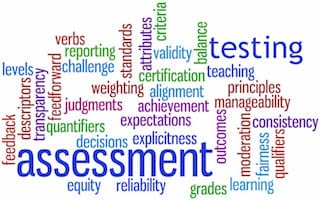
Nudging assessment means providing opportunities for student ownership and success. It is an essential element of restorative assessment. As Richard Thaler and Cass Sunstein (2008) explain “Putting fruit at eye level counts as a nudge, banning junk food does not.”
Five ways to use assessment to nudge student’s success
- Encourage students to annotate selected choice questions: Misunderstandings become more visible when they elaborate on their thinking. Honoré says, “I know the meaning of the word in the first part of the question, but not sure about the second. If lack of exercise means the same as sedentary, then the statement is true.”
- Incorporate choice in extended response questions: In social studies, students choose which president’s actions to summarize, critique, or compare during a specific era. In health, they decide the nutrients they want to encourage others to be sure to include in their diet. In science, they select, analyze, and contrast properties of gases using a table or graphic organizer.
- Review using material that will be included in the assessment, just in a different format. For example, in the review ask students to match cloud formations with weather predictions. Then, on the test, they label three cloud formations and explain which one is most likely to result in rain before long. Repetition and reinforcement is another essential element in remembering and recalling learning.
- Rely on respectful nudging, meaning offering guidance on solutions and supportive interventions. If students are providing peer feedback, suggest sentence starters that are respectful and empathetic. For example, “Your work made me understand…, but I’m still wondering….” Help them motivate others through constructive feedback such as “Your opening sentence really grabbed me; can you also explain how the character’s actions led to the outcome.” Model ways to use words of encouragement to strengthen learning as in: “You have so many creative ideas: Which one do you want to dig into more deeply?”
Keep in mind that parents can be the best nudges when done right. My parents would tell stories about how someone in our extended family got accepted to college because they were hard-working. Rather than a jackhammer, they relied on stories, examples, and parables, for life’s lessons.

- Aligned with and responsive to the learning intentions
- Feasible in the moment
- No or low cost
- Designed with options and choices
- Presented developed and displayed through multiple channels: words, voice, images, and examples
Learn more at:
Small Nudges Can Push Students in the Right Direction, Sarah Sparks, EdWeek
Thaler, R, and Sunstein, C. (2008) Nudge: Improving decisions about health, wealth, and happiness. Penguin Books
Nudge Theory at https://en.wikipedia.org/wiki/Nudge_theory
Author
Laura Greenstein has been an educator for over 30 years serving as a teacher, department chair, program manager, and school leader in multiple grades and subjects. In addition, she teaches Measurement, Evaluation, and Assessment, as well as Teaching, Learning, and Assessing in the Digital Era to graduate and undergraduate students at the University of New Haven and the University of Connecticut.
She is the author of numerous books and articles on assessment, including What Teachers Really Need to Know about Formative Assessment from ASCD, Assessing 21st Century Skills with Corwin, Sticky Assessment from Routledge, and soon to be published Restorative Assessment with Corwin. Laura is the founder of the Assessment Network, a respected resource for straightforward information, resources, and perspectives. You can find Laura on MyEdExpert.com
You can connect with her on Twitter or Facebook
Further Reading
- Edutopia – Encouraging Students to Own Their Work
- Teach.com – Motivating Students
- The Teaching Center – Increasing Student Participation