 EdCircuit Staff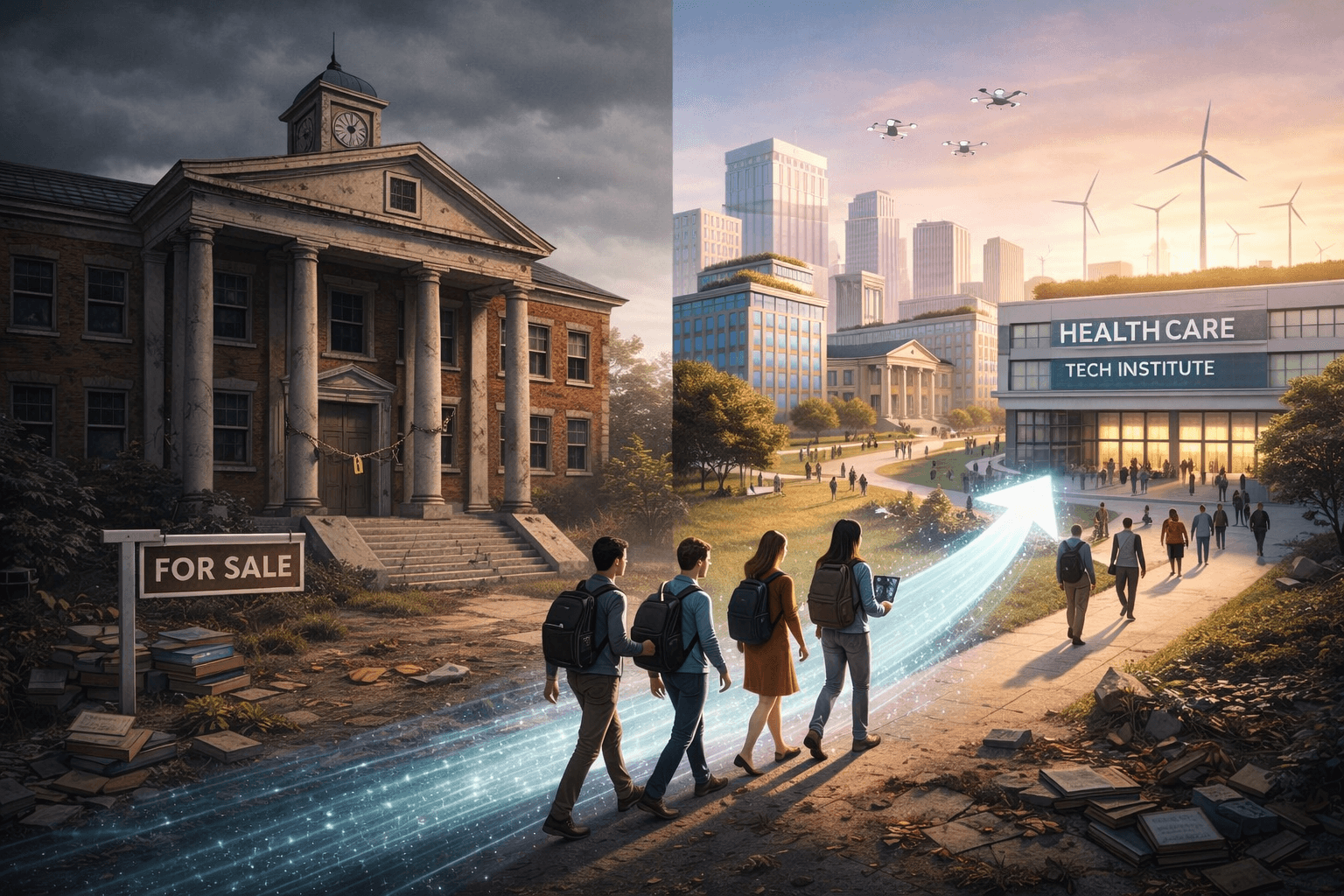
Table of Contents
Higher education closures rarely begin with a headline. They begin with small, quiet signals — a hiring freeze that isn’t lifted, residence halls that no longer fill, emergency fundraising emails that grow more urgent, a commencement ceremony where faculty and families realize it may be the last.
When Bacone College ended its 145-year run, when Limestone University’s final campaign fell short, when Trinity Christian College and others announced their teach-outs, the immediate story was institutional. But taken together, these closures — along with mergers in New Jersey, North Carolina, and Missouri and acquisition talks in California — reveal something far larger.
This is not a cycle.
This is a structural redesign of American higher education.
A Pattern That Can No Longer Be Dismissed
Over the past two years, closures, pauses, and consolidations have touched nearly every institutional category: private liberal arts colleges, faith-based campuses, minority-serving institutions, regional publics, and specialized professional schools.
Martin University’s short-lived operational pause turned into a permanent closure.
Sterling College in Vermont is shutting down despite a distinctive environmental mission.
Lourdes University in Ohio is announcing its closure in a region already facing demographic contraction.
Labouré College of Healthcare is being absorbed to preserve its nursing pipeline.
Washington University is acquiring a pharmacy school to expand strategically rather than build from scratch.
Individually, each decision has its own financial and governance story.
Collectively, they point to a system realigning capacity with reality.
The Demographic Clock Has Run Out
For more than a decade, higher-ed leaders spoke about the “enrollment cliff” as a future problem. It is now a present-day constraint.
The number of traditional college-age students is shrinking — most sharply in the Midwest and Northeast, where many tuition-dependent private institutions are located. Those regions built dense ecosystems of small colleges for a population that no longer exists in the same numbers.
You cannot out-recruit a demographic decline.
At the same time, fewer high school graduates are moving directly into four-year institutions. Alternative pathways — workforce entry, short-term credentials, employer-funded education, and community college transfers — are no longer secondary options. For many students, they are the first choice.
The Tuition-Driven Model Is Under Maximum Stress
Most of the institutions closing share a common profile:
High tuition dependence
Small endowments
Limited pricing flexibility
Deferred maintenance
Rising discount rates
When enrollment drops, the financial model does not bend. It breaks.
Emergency fundraising campaigns can delay the outcome, but they rarely change the trajectory. Limestone’s final appeal demonstrated how difficult it is to close a structural gap with one-time philanthropy.
The result is a growing number of boards facing the same question:
Is closure more responsible than slow institutional erosion?
Mergers Are No Longer a Last Resort
If closures represent one side of the transformation, mergers and acquisitions represent the other.
The definitive agreement between New Jersey City University and Kean University is not just a rescue — it is a prototype for public-sector stabilization. Catholic college consolidations are being driven not only by finances but by demographic strategy. Large research universities are acquiring specialized schools to accelerate program growth in healthcare, pharmacy, and applied fields.
The stigma around mergers is disappearing.
In its place is a new reality: survival through scale, shared services, and system integration.
Why This Matters to K-12 Leaders
This is not a higher-ed story alone.
It is a K-12 pipeline story.
When regional colleges close:
Dual-enrollment partnerships disappear
Teacher preparation pipelines shrink
Local scholarship pathways are disrupted
Students lose nearby transfer options
Workforce alignment fractures
In many communities, the closest and most accessible four-year institution is also the primary destination for first-generation students.
When that campus closes, postsecondary access changes overnight.
For superintendents and district leaders, this means postsecondary planning can no longer be based on historical assumptions. The map is being redrawn in real time.
The Human and Community Impact
A college closure is not just an academic event.
It is an economic shock to a town.
It is a cultural loss for a region.
It is a professional displacement for faculty and staff.
In some communities, the institution is the largest employer, the primary arts venue, the healthcare partner, and the identity anchor.
When it closes, the question becomes: what does the campus become next?
Across the country, former college properties are being redeveloped into housing, innovation hubs, healthcare facilities, and mixed-use spaces. The afterlife of these campuses will shape local economies for decades.
Is This a Trend? Yes — and It Will Accelerate
Even moderate declines in enrollment are projected to significantly increase closure rates.
The next decade will not bring a return to the old equilibrium. It will bring:
Fewer but larger institutions
System-level governance models
Expanded adult-learner enrollment strategies
Workforce-aligned academic portfolios
Year-round and hybrid delivery structures
The four-year residential experience will remain powerful — but it will no longer be the dominant model for most students.
What Surviving Institutions Are Doing Differently
The campuses most likely to thrive are not simply cutting costs.
They are:
Redefining their mission for a specific population
Aligning programs with regional workforce demand in healthcare, advanced manufacturing, AI, and applied technologies
Building deep employer partnerships
Designing stackable credential pathways
Collaborating instead of competing with neighboring institutions
They are becoming ecosystem institutions, not standalone campuses.
The Leadership Question That Matters Now
The most important shift is not financial.
It is strategic.
For decades, higher education operated on an assumption of perpetual growth. Planning models, facilities, staffing, and program expansion were built around that expectation.
That era is over.
The central question for presidents, boards, and system leaders is no longer:
How do we avoid becoming the next closure?
It is:
What role must our institution play in a smaller, more competitive, more interconnected postsecondary landscape?
Because the institutions that will define the next generation of higher education are not the ones that simply survive.
They are the ones that redesign themselves — in partnership with K-12 systems, workforce leaders, and their communities — for a different future.
The Signal for the Entire Education Sector
For K-12, higher education, and edtech leaders alike, these closures are not warnings from the edge of the system.
They are indicators from its center.
They tell us that:
Demographics now drive strategy
Access must be redesigned regionally
Partnerships are the new infrastructure
Institutional identity must be clear and defensible
The campuses going dark are not just endings.
They are the clearest possible signal that the education continuum — from middle school career exploration to lifelong learning — is being rebuilt.
And the leaders who recognize that shift early will shape what comes next.

Future U. Podcast – The Enrollment Cliff
Subscribe to edCircuit to stay up to date on all of our shows, podcasts, news, and thought leadership articles.