
 EdCircuit Staff
A Superintendent’s Long-Term Commitment to Student Literacy
At a time when big urban districts often hire the trendiest name that’s available on a nationwide search, Ann Blakeney Clark’s background offers something different. Ann has spent nearly her entire 33-year career in Charlotte-Mecklenburg Schools, Charlotte, NC.
Ann’s journey started as an elementary school teacher of kids with special needs and behavioral disorders. Clark continued working in elementary, junior high, and high schools, all within the Charlotte-Mecklenburg system. Over a fifteen-year span, Ann held numerous upper administrative positions before finally ascending to the role of superintendent.
I recently talked to Ann at the AASA‘ superintendents’ conference in New Orleans. She spoke at length about her commitment to literacy as her North Star principle. Ann believes if every child can read at grade level or above by the third grade, it will set them up for success in all subjects moving forward.
It was a compelling conversation with a thought leader who shows dedication and commitment to her district and community.
Interview
Dr. Berger: Ann, I’ve been really compelled by the different conversations superintendents are having in the variability and the personalities that I don’t think the general public know about ─ superintendents, in general ─ and putting the human aspect into it.
Tell us a little bit about your perspective in how the superintendency has changed over time and what we all experienced growing up in our own communities. What it is now and what we need from superintendents looking forward.
Ann Blakeney Clark: I think about my own experience in K-12. I don’t know that I could tell you the name of the superintendent across my 14-year journey in public education as a student. As I think about my journey as a superintendent, I’ve had the advantage of being in the same district for 35 years. I think I am more visible and I have a connection with students beyond just having my name on their diplomas when they leave the district.
That’s been really important to me to have that connection. I’ve actually been a part of bringing a student onto our school board as a student advisor just because I wanted to send a signal to our students that their voice really matters in a very symbolic, but also real way, by having a student advisor on the board.
DB: We’re in a day and age now with the change and transition in D.C., where we’re trying to have a better understanding in communities across America around the politics of education. How has that, in your experience, impacted the way in which you have led, understanding that education can be political ─ there’s a business aspect, for sure ─ and how has that impacted the way you have been communicating out to your team and your local community?
ABC: I’ve had the advantage of having been in one school system for my entire career, so I have a reputation as a leader that is important to me in terms of how I’m focused. What I’ve been able to do as I’ve transitioned in to the superintendent role is not veer from that focus in terms of being really grounded in the focus on students, with a strong belief in the role of the principal. That’s been a part of my philosophy as a leader. I’ve been a principal but I’ve also been in the district office for 15 years.

I continue to believe in the principal as the key lever for transformation of a district. But to point all eyes ─ including the board of education’s ─ towards our students has been a great opportunity.
I’ve seen 12 superintendents in my career in the district and I think, oftentimes, I’ve seen them maybe not be student focused, perhaps because they were trying to extend their contract or they realized they didn’t have the votes. I think I’ve chosen a different pathway in terms of saying, “Here’s what I believe is best for kids” and inviting our board to support that because it is in the best interest of kids.
DB: Is there a challenge out there that we are not talking about? That if we are, as leaders, not fearing failure as we’re trying to allow our students and the children in our communities to be more confident in the risk that they’re taking in the learning that can be applied to those experiences?
From the leadership position, are there things that we should not fear failing at that will help us in the long run, that we are reticent to go down or think about?
ABC: What I’ve found is that clarity of a focus can make all the difference in the world. I think we can’t be fearful of putting a stake in the ground and saying, “This is what we’ve got to be focused on.”
For me, that was literacy. It may not sound like something you should be fearful of, but if you say to your community that literacy is going to be your North Star, it can generate lots of questions about “What about math? What about science? What about the arts?”
Instead, I just chose to say that, fundamentally, our students being on grade level or higher by the end of third grade is a part of the success in any content area and any discipline. We owe it to our kids to be able to begin to read to learn in the fourth grade, not still be learning to read.
That was a risk. Maybe it doesn’t sound risky, but you are representing the whole of education to sort of put a stake in the sand.

What I’ve seen happen is that our entire community has rallied around literacy. We’ve had a Read Charlotte non-profit forum. If you come into Charlotte today and you ask our community what’s important, eight or nine times out of ten, our community members are going to say “literacy.”
I think that’s powerful in terms of really giving an entire community a focus. It was a risk but I think it’s been a productive one in terms of really aligning all of our resources in the community around what I believe is most important.
DB: What is the moral of the story? You’ve talked about working your entire career in one community. I think, ultimately, that would be the goal. If we can keep students and families engaged where they’re at, and then they provide to be a great asset as they get older in their own careers. What can we learn about that? It’s a unique experience that you’ve been able to do that, and maybe there are some lessons that we can take away?
ABC: I certainly think school boards always have to struggle with “Is there an internal candidate? Do we need to do a national search?”
For this community of Charlotte, we’ve been served very well with superintendents that have come from outside our district. So I certainly wouldn’t lean one way or the other.
But what I would say is I think our most successful superintendents have been those who have been incredibly student-centered. They were great role models for me as I stepped into this role to really authentically keep the focus on students.
Lots of superintendents will say that, but we’ve had some great superintendents in Charlotte whom I’ve followed who have done a magnificent job of doing that. They really gave me the courage to continue to do that.
About Ann Blakeney Clark
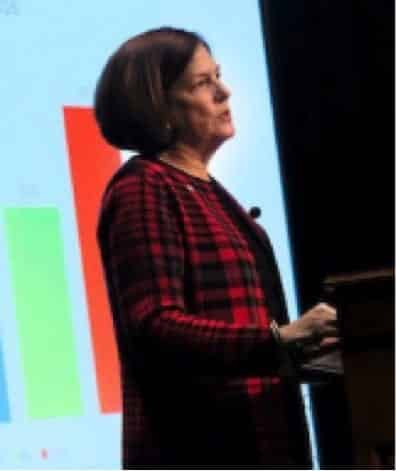 Ann Blakeney Clark brings a quarter-century of experience in Charlotte-Mecklenburg Schools in North Carolina to her role as superintendent. Clark’s extensive education background includes serving as principal at elementary, middle and high schools. She has held a variety of teaching and administrative positions in CMS since joining the district. She most recently served as the chief academic officer.
She graduated from Davidson College with a B.A. in English and earned a master’s degree in special education from the University of Virginia.
Her achievements in education and the community have been widely recognized. She has been named a Broad Superintendent Fellow, Charlotte Women of the Year, the Thomas Jefferson Distinguished Alumnae Award from University of Virginia, National Principal of the Year (1994) and William Friday Fellow and Council for Great City Schools Outstanding Urban Educator Award winner.
Follow Ann Blakeney Clark on Twitter