Share Your Voice on edCircuit

CoffeEd: Sprinting Toward a Bionic Future

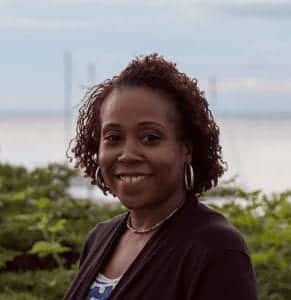
Roboticist Ayanna Howard, a former NASA engineer, discusses robotics, artificial intelligence and her path into teaching and research.
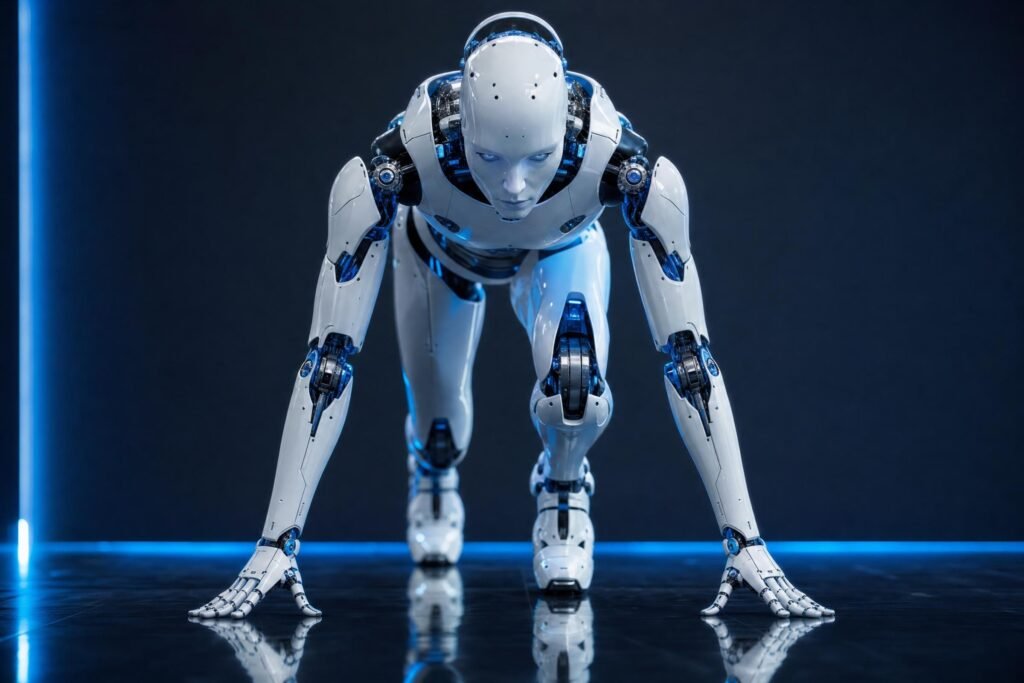
A white and blue humanoid robot crouched in a sprinter starting position on a glossy black floor cool blue rim lighting

Dr. Ayanna Howard, as a teacher and lecturer, is a storyteller. A huge science fiction fan growing up, she was determined at an early age that she was going to build a bionic woman after being inspired by the television show of the same name. At the time she did not know that the technology she would need to make someone better, stronger, and faster through biomechanical improvements was only the figment of a writer’s imagination and had yet to be invented.

a video

A leading mind in robotics and artificial intelligence discusses education

A humanoid robot with blue and white body parts crouches in a sprinters starting position on a reflective black surface poised and ready to launch forward against a dark backgroundDr. Ayanna Howard, as a teacher and lecturer, is a storyteller. A huge science fiction fan growing up, she was determined at an early age that she was going to build a bionic woman after being inspired by the television show of the same name. At the time she did not know that the technology she would need to make someone better, stronger, and faster through biomechanical improvements was only the figment of a writer’s imagination and had yet to be invented. But Ayanna was always good at math; in middle school, at the age of 12 she loved to design, build, and tinker with simple engines and machines. Her academic career started to ascend, so she started mapping her path to build a bionic woman.

She worked for NASA for 12 years and then entered the academic world as a professor and researcher, building her expertise in robotics and engineering the entire way. She has made significant contributions in the technology areas of artificial intelligence, computer vision, and robotics in her professional career. Dr. Howard is currently a Professor and the Linda J. and Mark C. Smith Endowed Chair in Bioengineering at the School of Electrical and Computer Engineering at the Georgia Institute of Technology.

Dr. Howard talks about her early passions for science, technology, and math.

A 3D stick figure sits and looks worried on a large red downward pointing arrow symbolizing a decline or decrease The background is whiteShe says, “We have to teach the student from a very early age how to learn from failure. We have to teach them not to give up so easily. Too many give up too soon before the lesson is learned. We need to teach them that there is an out, a next, a way BEYOND the problem.” Dr. Howard shares the importance of realizing early in life that real learning comes from trying, failing and then trying again. She speaks about being the “smart nerd” in a school that concentrated on sports, and being defined by her mathematical acumen… and the shock of getting to college and discovering that she was defined as being a black woman first and mathematician second, and feeling the pressure and the struggle to justify her enrollment.

She discusses her belief in the necessity to teach students to persevere, to hang on and learn from their failures and hardships. She says, “They need to understand that sustained growth comes from accepting the vulnerability in not knowing the answers, and stretching learning in middle school and high school better prepares students for the increased pressures of higher education.”

More on K-12

  • Educator and researcher

    Dr. Ayanna Howard is an educator, researcher, and innovator. Her academic career is highlighted by her focus on technology development for intelligent agents that must interact with and in a human-centered world, as well as on the education and mentoring of students in the engineering and computing fields. Dr. Howard has made significant contributions in the technology areas of artificial intelligence, computer vision, and robotics. Her published research, currently numbering over 200 peer-reviewed publications, has been widely disseminated in international journals and conference proceedings. She has over 20 years of R&D experience covering a number of projects that have been supported by various agencies including: National Science Foundation, Procter and Gamble, NASA, ExxonMobil, Intel, and the Grammy Foundation. She continues to produce novel research and ideas focused on applications that span from assistive robots in the home to therapy gaming apps to remote robotic exploration of extreme environments. By working at NASA before entering the academic world, she brings a unique perspective to the academic environment. Currently, Dr. Howard is Professor and Linda J. and Mark C. Smith Endowed Chair in Bioengineering in the School of Electrical and Computer Engineering at the Georgia Institute of Technology. She also holds the position of Associate Chair for Faculty Development in ECE and Director of the Human-Automation Systems Lab (HumAnS). In 2015, she founded and now dir

    View all posts
Share
Share Your Voice on edCircuit

More from edCircuit

Subscribe to edCircuit

Get the latest research, ideas, and stories delivered to your inbox.

Cancel
-
00:00
00:00
Update Required Flash plugin
-
00:00
00:00