Too often, students see writing as boring and hard. Use writing to enhance learning is an important life skill and a key aspect of classroom instruction. However, too often, students think writing is boring and hard. Let’s look at three creative ways to use writing with students to enhance learning. Here are 4 Creative Ways to Use Writing to Enhance Learning.
Writing Journals Help Students Process Learning
Kendra Alston used journals with her students. She asked students to continually reflect on their learning in their daybooks, which are simple bound notebooks. Then, she asked them to write a reflection on their learning at the end of the nine weeks. Some wrote about specific content they learned, and others of her students reflected on how they learned.
“Over this quarter, I’ve learned many things. One thing I’ve learned is teachers mean business and don’t take kindly to slacking. I found that out the hard way. Another thing is that if you take the time to listen, teachers have a lot of helpful tips for passing the school year.”
Justin, end of first nine weeks
“Something else that I learn [sic] would be about text organizers such as title, headings, caption/photograph, sidebars, and tags. Text organizers were not that confusing. At first I was getting tags and headings mixed up, but shortly I begin to understand them by the hands-on labs…I found that I understand the lessons better when we are able to do hands-on and get to experience and find what it is about ourselves.”
Melissa, end of first nine weeks
How would your students respond if asked to write about their own learning? Would they agree with Justin that it’s important to listen to teachers? Or would they write about the content they are struggling with? Either way, it’s helpful to process learning in writing.
You can also use journals for students to write specific information about their subject area. For example, in math, students might focus on explanations.
Sample Math Journal Prompts
- Explain a formula.
- Write about a time that you were really confused in math class. What did you do? Who did you get help from? How did you explain what was confusing you?
- Write about a time that you helped explain something to a classmate. What was your classmate having difficulty with? How did you help your classmate?
- Write everything you know about (choose a math topic).
- Write as many examples of a ratio that you can think of in five minutes.
In science classes, students could keep a fieldbook as they work through the scientific process.
Sample Questions for Science Fieldbook
- What did you observ
- What did it sound like, look like, or feel like?
- What do you think might occur or what is your hypothesis?
- What variables (or things) might impact the results?
- What will you do next?
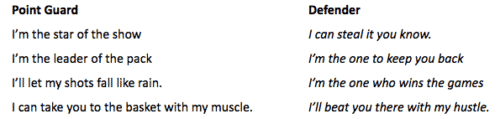
Poetry allows students to creatively demonstrate their learning. In a workshop for prospective teachers, we completed an activity where they compared two perspectives. After drafting the examples, I asked them to write some sample comments that each person or perspective might say. Then, they turned that into a poem of two voices. They wrote the comments as a back-and-forth conversation. Before you decide this is only a language arts activity, look at the examples. Ben Lovelace, a physical education teacher, developed one to demonstrate the different roles of two basketball players.
 .
.
RAFTs Provide Real-Life Writing Options
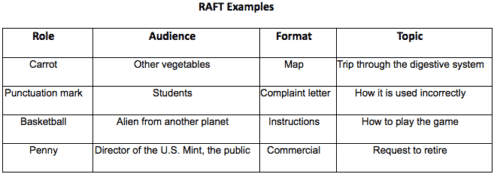
Perhaps you would like your students to write a paragraph about the solar system (the topic you have been teaching in class). This is a standard, lower-level assignment that requires students to restate or summarize the information that you have covered. We can increase the rigor and teach point of view using the RAFT (Role, Audience, Format, and Topic) strategy (Santa, Havens, & Macumber, 1996). Using this strategy, students assume a role, such as an astronaut, and write from that perspective to a more authentic audience, such as people who read his online blog. In this case, students are required to understand the topic at a higher level in order to complete the task. Below you’ll find examples, but it’s easy to do an internet search for “RAFT” and your grade range and subject area (such as “high school science”) to find more samples.
Creativity Can Push Students Beyond Basic Information
Too often, we ask students to write a paragraph or essay about a historical figure, main character from a text, or another famous person. However, students tend to write about basic information. Other options, such as creating profiles of main characters, historical figures, famous people can be structured so students must include extended information about a person. For example, in a Social Studies classroom, students can create blogs of a person from history. In order to do so, they must apply what they have learned about the person to create personal accounts for the blogs. Similarly, students could research a scientist and create a fake Facebook page. They must research all the information needed for a Facebook profile, including friends, events, interests, education, family, photos, and a series of posts over time. Another strategy is to require students to write a job description and job application for the role the person held or holds. They switch information with another student, who uses his or her research to complete the application and write a resume.
Chad Maguire, a former math teacher, asked his students to research and write about a famous mathematician. The finished report included standard information about the person, but students also presented the information creatively, such as role-playing the mathematician or creating a game. As a final incentive, students earned additional points based on the number of things they had in common with the person they researched. The last part of the project required students to move beyond basic information to apply to their own lives.
A Final Note on how to use writing to enhance learning
Writing can enhance student learning if you incorporate it into your classroom. Find simple ways to encourage students to “show you what they know” in written form.
Subscribe to edCircuit to stay up to date on all of our shows, podcasts, news, and thought leadership articles.


 Amongst these sheep there is a single llama. Why this sheep farm feels the need to have a llama I do not know. What I do know is that this llama stands out in stark contrast to the sheep. It does not take me more than a few seconds to locate my furry friend. And why can I find him so quickly? Yes he looks different than everyone else, but more importantly, he acts different than everyone else. While the sheep constantly have their head to the ground, chewing their grass, the llama is picking his head up and moving it in all sorts of interesting ways. He is unique. He stands out from all of the sheep.
  Why is it so important to produce llamas? What will eventually happen to these sheep is they will go to college and continue to be sheep. And who can blame them? This is all they have been trained to do. Then when they go out into the real world, there is nothing that distinguishes them from the rest of the herd of sheep. They all have great GPAs, they all have met the course requirements of their schooling, and they are all eager, although as sheep the only thing they are eager for is more grass. Imagine you were hiring folks for your company, one that requires employees to be creative, think fast on their feet, and be adaptable. As you are interviewing these sheep, there is truly nothing that separates them from the other sheep. Sure, one might be slightly better than another, but in the end, they are all just sheep. These sheep certainly can follow directions, they work hard, they get along with the other sheep, and they are not going to give you any problems. This is not going to move your company.
  How do you make a llama? Simple, you give it space to be a llama. Instead of intently watching your herd of sheep and correcting them with you shepherd’s crook should they make even a single step out of line, you should let them wander wherever they like. This means allowing for more authentic and inquiry learning in the classroom. If you are covering a topic and a student seems genuinely inquisitive about a certain aspect of it, you should have the opportunity to allow this student the space in order to explore this topic further? The excuse often becomes that the teacher has a lot of material to get in and students needs to stay with the pack? Of course, this is how we produce sheep, not llamas.




 Danny Wagner is Senior Editor, Education Reviews at
 I keep reliving this conversation over and over again with different moms. One mom, who now runs an after school center for kids, said when her daughter was young she was behind in math. So, she took her daughter to one of the math centers that make kids do worksheets in a very strict progression. She was excited to see her daughter solve 3+6 one day on the worksheet.
  Recently, I met another concerned mom and dad whose daughter is struggling with math. Her daughter is in 2nd grade and having trouble with math facts at school. She is frustrated. Her daughter is supposed to work on her math facts at home. She says teaching her daughter math is like Groundhog Day. Her daughter memorizes the math facts, and then the next day they start with the same facts all over again when she forgets them (just like Groundhog Day).
 Ana Redmond is the founder and CTO of
 Cameron Guerrero has been the Director of Bands and Orchestras for the
  “It just offers them the opportunity to unplug a little bit for a moment. That’s what I tell them, that they should use their daily practice as a mini-vacation from their daily life.”
 Cameron Guerrero is the Director of Bands and Orchestras at
 S: Select research questions and search tools. Have one or more questions that get to the core of what you want to find out in your search. Also, choose search engines and tools most relevant to what you’re looking for.
 Merve Lapus is responsible for the overall outreach strategy for Common Sense Education and oversees a team that works directly with school leadership to impact school communities using technology for learning. Collaborating with school networks, state-level organizations, and community leaders, Merve is committed to fostering a whole-community approach to digital teaching and establishing supportive learning spaces for children and families to thrive in a world with media and technology.