
 EdCircuit Staff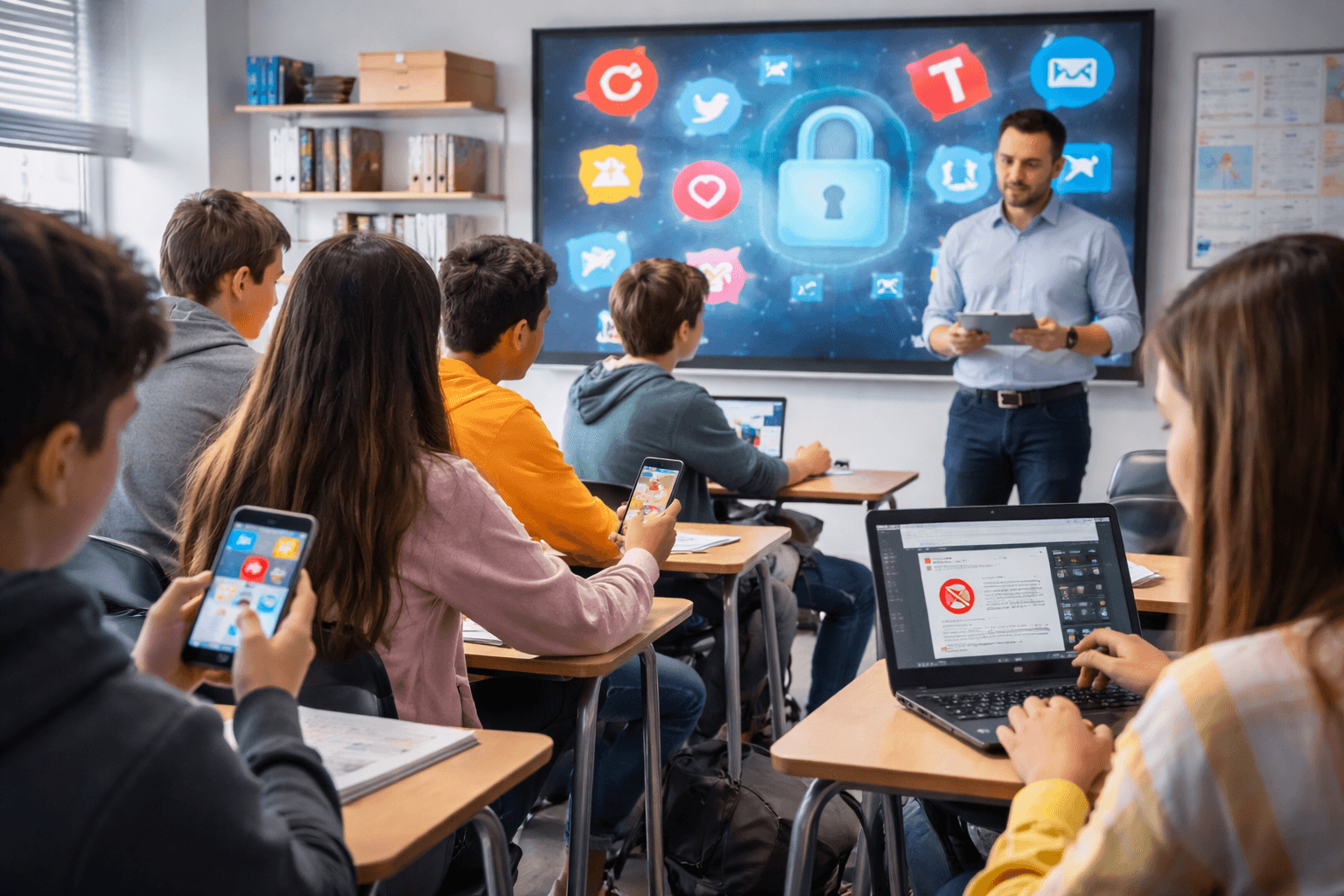
Table of Contents
Social media education in high school has become a critical priority as districts confront cyberbullying, AI-generated deepfakes, and the reality that every post can follow students for life.
In high schools nationwide, social media no longer stays outside the building. Even in districts that restrict or ban phones during the school day, administrators acknowledge that devices resurface instantly when something goes wrong—a hallway argument, a disciplinary encounter, a prank that spirals.
Videos are posted before adults intervene. Screenshots circulate before investigations begin. Online narratives form while facts are still emerging.
That reality is driving a shift in district strategy. Schools are moving away from treating social media solely as a disciplinary concern and toward teaching it as a form of literacy—one connected to ethics, law, reputation, and civic participation.
When Digital Decisions Become Permanent
High school students use social platforms to explore identity, organize social lives, advocate for causes, and showcase accomplishments for college or careers. Yet many still assume posts disappear.
District programs increasingly challenge that assumption through classroom scenarios and advisory discussions: deleted posts that resurface years later, forwarded “private” messages, and altered clips shared without consent.
Educators emphasize four consistent truths:
-
Digital footprints accumulate.
-
Reposting is participation.
-
Context evaporates quickly.
-
Intent does not erase impact.
For many students, these conversations reframe social media from casual expression into something closer to a public record.
Cyberbullying in a 24/7 Environment
Cyberbullying remains one of the most persistent threats to student well-being. Unlike conflicts that fade when the bell rings, online harassment can escalate overnight and spread across platforms.
Instruction now expands students’ understanding of what bullying can look like digitally, from anonymous rumor pages and group-chat exclusion to coordinated comment attacks and humiliating videos.
District leaders report that some of the most effective approaches focus on bystanders. Students practice documenting incidents responsibly, avoiding amplification, and seeking adult help early.
Several systems have also adopted peer-led models, training students to facilitate conversations about digital behavior. Administrators note that these efforts resonate because they reflect real-world pressure rather than abstract warnings.
Deepfakes, AI, and the Erosion of Trust
Artificial intelligence has introduced new ethical dilemmas for adolescents. With little technical skill, students can now fabricate realistic audio, images, or videos of classmates or teachers.
Sometimes these creations begin as jokes. Other times, they become weapons.
High school curricula increasingly include lessons on how manipulated media is created, why consent matters, the emotional harm caused to victims, legal risks tied to harassment, and ways to verify authenticity.
Teachers connect these discussions to civics and media studies, emphasizing credibility and accountability in public spaces. In a world where “seeing is believing” no longer applies, students must learn to pause before sharing.
Phone Restrictions and Instant Publishing
Across the country, districts are tightening phone policies. While restrictions often improve classroom focus, leaders admit policies cannot eliminate impulsive posting during moments of conflict.
Students still record altercations. Partial clips circulate without context. Algorithms reward speed over accuracy.
As a result, districts are teaching privacy and recording rules, how filming that violates policy can distort events, and the difference between reporting for safety and broadcasting for attention.
The emphasis is judgment—helping students slow down when emotions run high and think before tapping “share.”
Embedding Social Media Education Across the Curriculum
Rather than relying on one-time assemblies, districts are weaving instruction into daily learning through advisory programs, health classes, English analysis of digital narratives, civics lessons on misinformation, and technology electives exploring AI.
This approach reinforces that online behavior is not separate from academic life—it is part of community participation.
Preparing Graduates for Life Beyond Campus
Ultimately, social media education in high school is about readiness.
Graduates carry digital histories into workplaces, universities, and civic spaces shaped by virality and algorithms. When schools teach students to verify information, communicate responsibly, and consider impact, they prepare them for adulthood in a connected world.
In a permanent digital environment, preparation is protection.
Subscribe to edCircuit to stay up to date on all of our shows, podcasts, news, and thought leadership articles.