
 EdCircuit Staff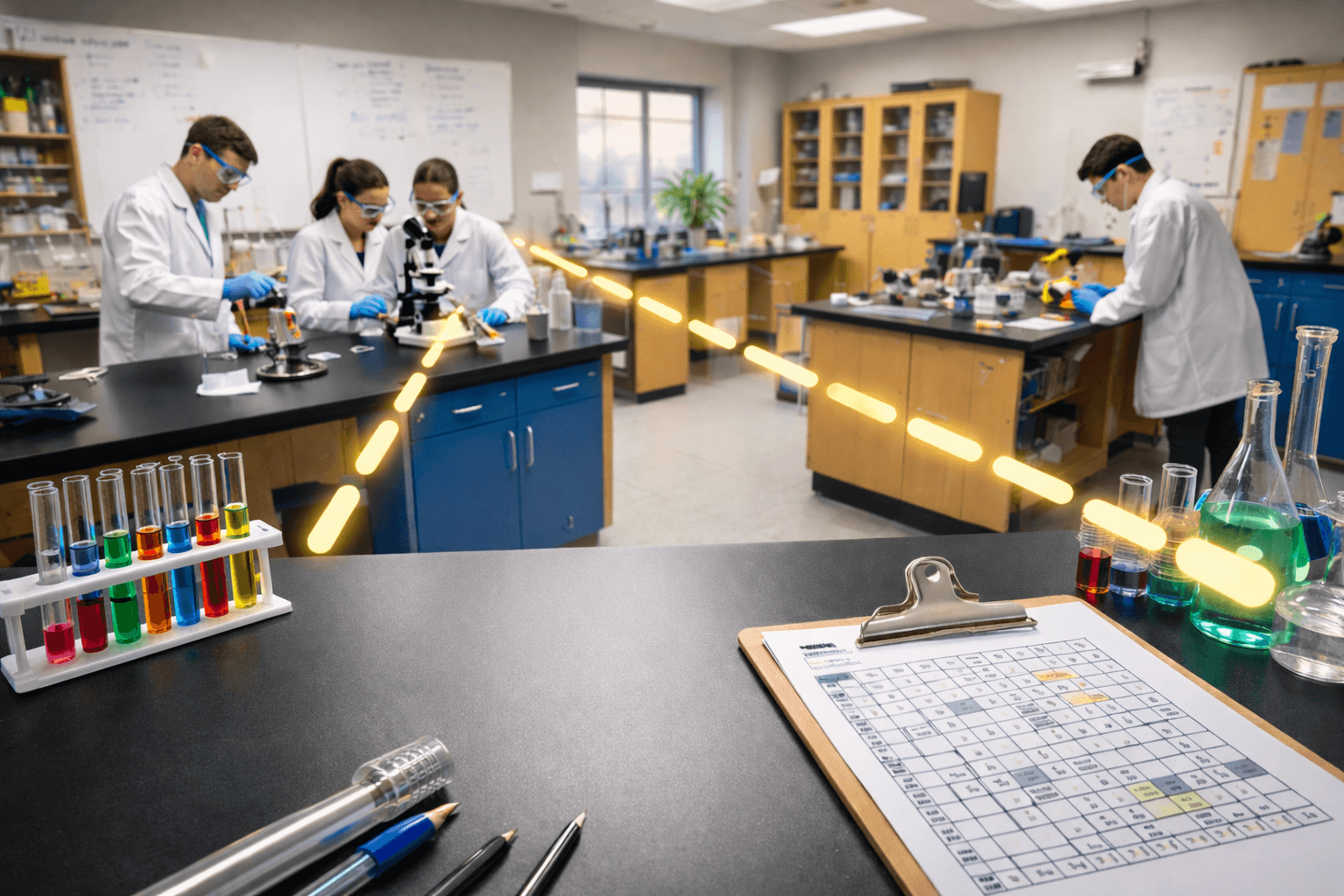
Table of Contents
Supervision by design determines whether teachers can actually see risks as they develop in real time.
A classroom can look perfectly safe before students arrive. Equipment is organized. Workstations are clear. Emergency stations are accessible. But the moment students enter, and movement begins, the room transforms—and the teacher’s ability to see what is happening everywhere can disappear.
Students gather around the equipment. Groups cluster near shared tools. Materials move between stations. Conversations happen in several places at once. Within minutes, visual barriers begin to form.
Nothing dramatic happens. No alarms sound. But in that moment, the safety system depends on one critical factor: whether the adult in the room can see what is happening before a small mistake becomes something larger.
That is the principle behind supervision by design.
This article accompanies the latest episode of the Safer Ed Podcast: Supervision by Design: Why Sightlines Prevent Incidents.
The Visibility Problem Schools Rarely Recognize
When schools evaluate safety, they often focus on policies, procedures, and training. These elements are essential, but they rely on one condition that is frequently overlooked—visibility.
If educators cannot see an unsafe behavior beginning, they cannot intervene early enough to prevent it.
This challenge is especially important in active learning environments such as:
-
STEM laboratories
-
Career and Technical Education spaces
-
Engineering and Robotics classrooms
-
Makerspaces and Project-Based learning environments
These spaces involve tools, materials, and processes that require constant observation. When visibility is interrupted, supervision shifts from proactive prevention to reactive response.
And that shift often determines whether a near miss becomes an incident.
How Blind Spots Develop
Blind spots rarely appear intentional. They usually develop through routine decisions about storage and equipment placement.
Tall cabinets, stacked supplies, equipment carts, and shelving units are often positioned where space allows rather than where visibility is strongest. Over time, these objects create areas of the room that cannot be seen clearly from the teacher’s natural position.
In quiet walkthroughs, these obstacles may not seem significant.
But once students begin moving through the space, those same objects become barriers that interrupt sightlines across the room.
When that happens, the teacher’s awareness of certain areas depends on physically moving to inspect them.
Even brief gaps in visibility can create moments where mistakes go unnoticed.
Supervision Zones and Active Classrooms
In many modern classrooms, several activities occur at the same time.
One group may be conducting an experiment while another gathers supplies. A third group may be documenting results or cleaning equipment. In CTE spaces, students may operate tools in multiple locations simultaneously.
These environments create what safety professionals often call supervision zones—distinct areas of activity that require attention.
If those zones are arranged so the teacher can observe them from a central position, supervision becomes efficient and proactive.
If they are scattered across blind spots, the teacher must constantly move between areas simply to maintain awareness.
That constant movement creates brief moments where other zones fall outside supervision.
Supervision by design organizes these zones so they remain visible within a teacher’s line of sight.
Congestion Creates Hidden Risk
Even well-designed classrooms can lose visibility when congestion occurs.
Students naturally gather around certain areas:
-
supply cabinets
-
sinks and wash stations
-
shared tools
-
charging stations
-
demonstration areas
When these features are clustered together, groups of students form visual barriers that block the teacher’s view of nearby workstations.
Over time, these congestion points become predictable areas where supervision weakens.
Spreading these high-traffic features across the room helps maintain clear sightlines even when multiple students are present.
Why Walkthroughs Often Miss the Problem
Administrators frequently observe classrooms during walkthroughs, but those observations typically occur during calm periods of instruction.
Students are seated. Movement is minimal. The teacher is leading the lesson.
Under those conditions, supervision appears straightforward.
The real test of visibility occurs during the most active parts of learning:
-
lab setup
-
equipment use
-
collaborative work
-
transitions and cleanup
Observing classrooms during these moments reveals whether the environment supports supervision—or quietly undermines it.
Small Adjustments Can Restore Visibility
Improving supervision often requires far less change than people expect.
Simple adjustments can significantly improve sightlines:
-
lowering tall storage units
-
relocating equipment carts
-
repositioning workstations toward central visibility
-
redistributing supply locations
-
reducing clutter along walkways
These small design changes allow educators to monitor several areas of the room simultaneously.
When teachers no longer need to constantly reposition themselves to maintain awareness, supervision becomes more stable and effective.
Visibility Influences Behavior
Students quickly recognize whether adults can see what is happening in a classroom.
When visibility is clear, expectations are easier to enforce because students know their actions are observable.
But when blind spots exist, those areas can unintentionally become spaces where rules feel less enforced.
Visibility, therefore, shapes behavior just as strongly as policies or reminders.
Supervision by design helps align the environment with the expectations educators are trying to maintain.
Designing Classrooms for Awareness
Effective safety systems support the way people actually move and work within a space.
Rules and training matter, but they depend on awareness. Awareness depends on visibility.
When classrooms are designed with clear sightlines and intentional supervision zones, educators can recognize problems early and respond quickly.
That is the core idea behind supervision by design.
A Conversation Worth Sharing
For school leaders, the lesson is simple but powerful.
Supervision is not only a staffing responsibility.
It is a design decision.
When learning spaces allow teachers to see activity clearly, safety systems become stronger, interventions happen earlier, and complex learning environments operate more smoothly.
Because in active classrooms, safety does not begin with rules.
It begins with what adults can see.
Subscribe to edCircuit to stay up to date on all of our shows, podcasts, news, and thought leadership articles.