
 EdCircuit Staff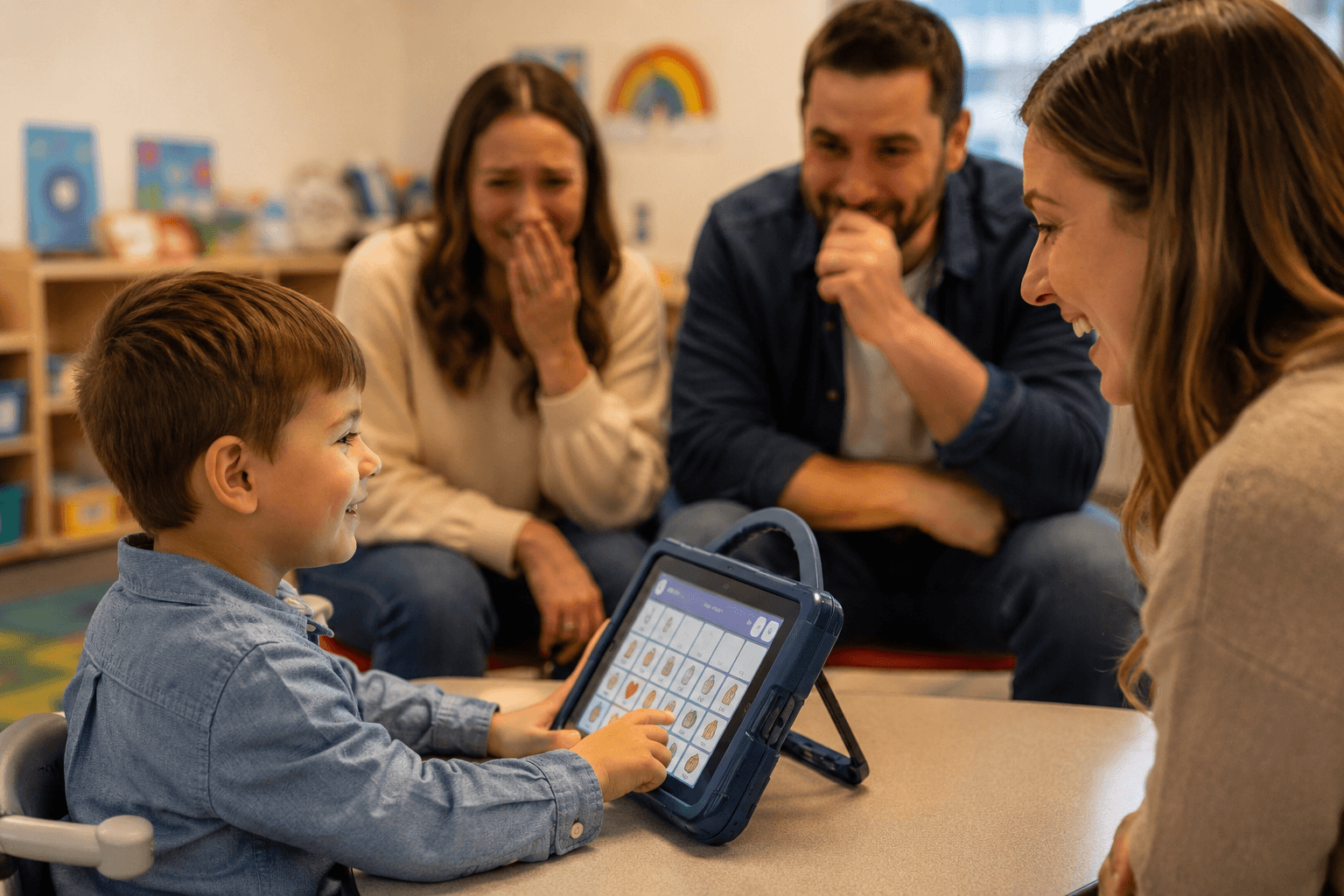
Table of Contents
National Speech-Language-Hearing Month celebrates the speech-language pathologists (SLPs) and audiologists who help students, families, and adults communicate, connect, and thrive.
A young student presses a button on a communication device for the very first time.
“I love you.”
For the parent sitting nearby, the moment can feel overwhelming. For the speech-language pathologist supporting that child, it is a powerful reminder of why the profession matters so deeply.
Moments like these happen every day in classrooms, therapy rooms, hospitals, clinics, and homes across the country. Speech-language pathologists help people communicate, connect, learn, and build confidence in ways that often change the direction of a person’s life.
Some help young children say their first words. Others support students struggling with language development, social communication, or literacy skills. Many work with adults recovering from strokes, traumatic brain injuries, neurological conditions, or hearing loss. No matter the setting, speech-language pathologists help people feel understood.
That impact is why it matters. The month celebrates speech-language pathologists and audiologists whose work helps students, families, patients, and communities communicate more confidently and connect more meaningfully. Supported in part by the American Speech-Language-Hearing Association, the national observance shines a spotlight on professionals whose work often happens quietly but changes lives every single day.
For many outside the profession, the role of an SLP is often misunderstood. Some assume speech-language pathologists only help children pronounce sounds correctly or overcome stuttering. The reality is far more complex.
SLPs work with communication in nearly every form imaginable. They support individuals with language disorders, articulation challenges, cognitive communication difficulties, swallowing disorders, voice conditions, social communication needs, traumatic brain injuries, developmental delays, autism spectrum disorders, and neurological conditions. They work with toddlers learning first words, students building literacy skills, adults recovering from strokes, and elderly patients trying to maintain communication and safe swallowing abilities.
Their work is educational.
It is medical.
It is emotional.
And it is profoundly life-changing.
The Professionals Behind the Scenes
In schools across the country, speech-language pathologists are among the most essential — and often most overlooked — members of the educational team.
While teachers are visible in classrooms each day, SLPs frequently move quietly behind the scenes, balancing enormous caseloads and responsibilities that many families never fully see. A school-based SLP may spend a single day traveling between multiple buildings, coordinating schedules with teachers, documenting progress, attending meetings, conducting evaluations, completing Medicaid billing paperwork, communicating with parents, and delivering individualized therapy sessions — all while ensuring students receive legally required services and meaningful support.
Their schedules are often relentless.
A morning might begin with articulation therapy for elementary students, transition into language interventions connected to literacy instruction, continue with social communication support for middle school students, and end with high school meetings focused on accommodations and transition planning.
And through all of it, SLPs are helping students do something foundational to every aspect of life:
Communicate.
Communication affects nearly everything inside a school environment. It impacts reading, writing, classroom participation, social interaction, emotional regulation, self-advocacy, and confidence. When students struggle to communicate effectively, they often struggle academically, socially, and emotionally as well.
SLPs help bridge those gaps.
They help students participate more confidently in classroom discussions.
They help children express frustration without behavioral outbursts.
They help students build literacy and language connections.
They help individuals advocate for themselves.
They help students feel heard.
That kind of work changes educational outcomes — but it also changes lives.
The Emotional Weight of the Profession
Speech-language pathology is deeply personal work.
Many communication challenges are tied closely to confidence, identity, and emotional well-being. Students who struggle to communicate may experience embarrassment, isolation, anxiety, or frustration that extends far beyond academics. Families often carry emotional stress while trying to navigate evaluations, interventions, and support systems for their children.
SLPs become trusted guides through those experiences.
They celebrate progress that others may overlook.
They reassure families during difficult moments.
They help students regain confidence after setbacks.
They provide encouragement when progress feels slow.
And sometimes, the biggest victories are the smallest moments.
A student raising their hand in class for the first time.
A child successfully ordering food independently.
A teenager confidently participating in a conversation.
A parent hearing a clearer sentence after months of therapy.
These moments are difficult to measure on spreadsheets or reports, but for families, they can mean everything.
Many speech-language pathologists will say their greatest rewards are not found in documentation, evaluations, or meetings.
They are found in hugs from students.
In smiles after successful communication.
In emotional thank-you messages from parents.
In watching someone finally feel understood.
Technology Has Changed the Profession
Technology has dramatically reshaped speech-language pathology over the last two decades.
What once relied heavily on flashcards, worksheets, mirrors, and paper visuals has evolved into a profession deeply connected to digital tools and assistive technologies. Today’s SLPs use tablets, speech-generating devices, communication applications, teletherapy platforms, visual supports, adaptive software, and artificial intelligence tools to help individuals communicate more effectively and independently.
For nonverbal students and individuals with significant communication challenges, augmentative and alternative communication (AAC) technology has been transformative.
Modern AAC systems allow users to communicate wants, needs, emotions, ideas, questions, and opinions with greater independence than ever before. For many families, hearing a child independently communicate through technology can become one of the most emotional moments of their lives.
Technology has also expanded access to services.
Teletherapy and virtual intervention platforms now help SLPs reach students in rural communities, underserved districts, and areas facing significant staffing shortages. During and after the COVID-19 Pandemic, speech-language pathologists adapted rapidly to virtual environments while continuing to support students and families during one of the most disruptive periods in modern education.
Digital tools now assist with:
- Progress monitoring
- Therapy engagement
- Data collection
- Collaboration with teachers
- Parent communication
- Personalized interventions
- Accessibility supports
But despite all the innovation, one thing has not changed:
The heart of the profession is still human connection.
No device replaces patience.
No software replaces compassion.
No technology replaces encouragement.
SLPs combine innovation with empathy in ways that make communication more accessible and more meaningful.
Collaboration Across Entire Support Systems
Speech-language pathologists rarely work alone.
Inside schools, they collaborate constantly with classroom teachers, intervention specialists, occupational therapists, psychologists, administrators, paraprofessionals, counselors, and families. Their role intersects with nearly every support system connected to student success.
An SLP may help a teacher modify communication strategies inside the classroom.
They may work alongside occupational therapists to support students using assistive devices.
They may collaborate with school psychologists during evaluations.
They may guide parents on communication strategies to continue at home.
Their expertise becomes part of a much larger team focused on helping students succeed academically, socially, and emotionally.
That collaboration often goes unnoticed, but it is critical to creating inclusive learning environments where students feel supported and understood.
The Growing Challenges Facing SLPs
As awareness surrounding communication needs has grown, so have the demands placed on speech-language professionals.
Many districts across the country face shortages of qualified SLPs while student needs continue to increase. Large caseloads, staffing shortages, compliance requirements, and expanding responsibilities have placed significant pressure on professionals already balancing emotionally demanding work.
In some districts, SLPs travel between multiple schools each week while managing dozens of students across multiple age groups and service plans. Others balance school responsibilities with home visits, outpatient services, or additional clinical work.
And despite the intensity of those demands, they continue showing up each day ready to support students and families with compassion and professionalism.
That commitment deserves recognition.
Supporting Communication Across a Lifetime
While schools play a major role during Speech-Language-Hearing Month, speech-language pathology extends far beyond K–12 education.
SLPs work extensively with adults in hospitals, rehabilitation centers, nursing homes, universities, and home healthcare settings. They support stroke recovery, traumatic brain injuries, Parkinson’s disease, voice disorders, swallowing challenges, neurological conditions, and cognitive communication impairments.
For adults recovering from medical trauma, communication can become central to reclaiming independence and quality of life.
The ability to safely swallow food again.
The ability to speak clearly with loved ones.
The ability to communicate needs and emotions.
The ability to reconnect socially and emotionally.
These are not small victories.
They are life-changing milestones.
Why National Speech-Language-Hearing Month Matters
Professions centered around communication often work quietly in the background. SLPs rarely seek attention for the work they do, yet their impact reaches classrooms, homes, clinics, hospitals, and communities every single day.
Communication is connection.
Communication is confidence.
Communication is learning.
Communication is belonging.
Communication is independence.
Speech-language pathologists help make all of those things possible.
As schools continue focusing on inclusion, accessibility, student wellness, literacy, and personalized learning, the role of speech-language pathologists will only become more important. Their ability to support communication across educational, emotional, social, and medical settings makes them essential members of both healthcare and educational communities.
This month is an opportunity to celebrate professionals whose work often happens quietly but whose impact lasts a lifetime.
Behind every breakthrough in communication is usually someone who refused to give up on helping another person feel heard, understood, and connected to the world around them.
And sometimes, all it takes to remind an SLP why they chose this profession is a smile, a hug, or two simple words spoken for the very first time:
“I love you.”
Subscribe to edCircuit to stay up to date on all of our shows, podcasts, news, and thought leadership articles.