



edcircuit
Banner for the CoSN 2026 Ed Tech Conference, reading “Building What’s Next, Together,” April 13–15 at Sheraton Grand Chicago Riverwalk. Includes a city skyline graphic and the website www.CoSN.org/CoSN2026.
Promotional graphic for the CoSN 2026 EdTech Conference featuring event details, a city skyline logo, and five professionally dressed people smiling against a blue gradient background.
Home EducatorsK-12 Teachers Building the Bridge Between Early Childhood and Elementary School
5 minutes read

Building the Bridge Between Early Childhood and Elementary School

A high-quality early childhood program sets the stage for a successful elementary experience and beyond.

Chicago’s Christopher House: quality education, infancy through elementary Logo for Christopher House with the words LEARN DREAM ACHIEVE below. The H in HOUSE is stylized as a blue ladder with three yellow stars above it.
by Kristin Novy

In recent years, the research on the importance of early childhood has been clear: early education matters. A high-quality early childhood program sets the stage for a successful elementary experience and beyond. Early Head Start and Head Start programs have played a critical role in providing these services to families. The missing piece, however, is often the bridge to elementary. The mandates in early childhood (EC) and elementary school settings vary greatly, making it difficult for providers to find a way to bridge the two in a way that makes sense for families and keeps students on a solid track.

Christopher House Elementary School in Chicago has done a significant amount of intentional workaround that bridge. With an early childhood program that starts at birth, it offers a continuum of quality education from infancy through elementary. Here are the major components from their concerted efforts to bridge early childhood and elementary for both student and school success:

  1. Consistent Assessment. Early childhood students (Pre-K) are assessed on the same literacy tool as kindergartners, which allows for better data talks among schools and more cohesive sharing of strategies that align to the data. This makes the transition to kindergarten much smoother for teachers and parents, as they are already familiar with both the assessment tool and the way the components are addressed.  In addition, teachers from EC and the elementary school share and analyze this data so that they are most prepared for the incoming students.

  2. A group of children and an adult stand in a circle, looking down at the camera with curious expressions, framed by a bright blue sky above them.Early Childhood MTSS Program. The elementary school team has built out a multi-tiered system of support (MTSS) program, which addresses all three tiers of the intervention system.  Teachers differentiate instruction to meet the needs of individual students in order to address their specific academic and behavioral deficits. This year, the elementary school collaborated with the early childhood program and implemented a multi-tiered system of support in the pre-kindergarten classrooms, which enabled EC teachers to address their students’ behavioral and academic deficits at an individualized level through the use of observation, data collection, and differentiated instruction. The elementary school MTSS coordinator provided coaching and professional development on how to develop an MTSS program and implement differentiated instruction based on student need.
  3. Social-Emotional Synergy. Social-emotional philosophy and strategies align between EC and elementary, and the school leverages similar tools so that students can build their emotional competence systematically. Christopher House uses elements of Responsive Classroom, a curriculum to explicitly teach SEL skills, and a common data tracking system that allows the school to develop targeted supports for students in need of additional help.
  4. Kindergarten Readiness Matrix. The kindergarten teachers at Christopher House developed a matrix of skills and knowledge that children coming into kindergarten should have in order to be most successful. The matrix includes self-help skills such as putting on and taking off their coat, as well as early literacy and math knowledge such as letter and number identification.
  5. Cross-Departmental Collaboration. Meetings are scheduled for the end of the school year where current Pre-K teachers, future kindergarten teachers, social workers, and diverse learners staff review each student’s school and relevant family history in-depth to address their strengths and areas of growth. Teachers across schools group students, review data and share strategies that have worked well to inform future practices.
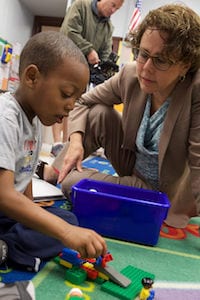
A young boy plays with colorful building blocks on the floor while an adult woman in glasses and a suit watches and interacts with him in a classroom setting.Finally, it’s important to mention that one of the other unique aspects of the Christopher House approach is their immersive family support and continuity of care, which has proven beneficial in bridging EC and elementary school as well. For example, family advocates work one-on-one to enroll interested families in the school. They help them understand what to expect with school as well as how to implement learning activities at home starting from early childhood and continuing through elementary. In addition, Christopher House also has social workers on staff that serve each school and develop long-term relationships with families. If a child in the elementary school has a sibling in the early childhood program, the social worker will continue to support both students and the entire family to ensure continuity of care.

This approach coupled with the intentional – and innovative – efforts to bridge early childhood and elementary school is helping students and their families start strong and stay on track for success. Christopher House believes collaboration is key and always welcomes the opportunity to connect with other educators. For more information, visit www.christopherhouse.org.

Author

A woman with straight blonde hair and light skin smiles at the camera. She is wearing a light-colored top and a necklace. The background is softly blurred and neutral.Kristin Novy is principal of Christopher House Elementary School in Chicago, Illinois. Kristin has served schools in multiple Chicago neighborhoods over the past thirteen years as a teacher, literacy coach and Resident Principal and now Principal. As an instructional leader serving culturally and linguistically diverse student populations, she became a leader in creating curriculum and assessments aligned to the Common Core State Standards at the district level.

As a literacy coach, she served a pivotal role in increasing student achievement by coaching teachers, implementing balanced literacy, and working with families to create a culture of high expectations and a love of reading and learning. She has created strong leadership teams at two schools that used data to develop and monitor student progress, resulting in outstanding student growth and more invested staff.

She also developed literacy outreach programs at multiple schools to support and invest families in their children’s education. Kristin holds a B.A. in Journalism from Indiana University, an M.A. in Teaching fromDominican University, an M.Ed. in Curriculum and Instruction from National Louis University, and earned her school leadership licensure from DePaul University. She achieved National Board Certification in 2009.

Now in her fourth year as principal of Christopher House Elementary, Kristin is proud to be leading the development of an outstanding whole-child focused school that prepares children for success and happiness in life. She can be reached at knovy@christopherhouse.org, and you can follow Kristin on Twitter.

  1. Teach.com – Early Childhood Education
  2. NEA – Unifying the Early Childhood Profession
  3. NBER – Children and the Economics of Education 

Promotional graphic with the text “Register Today for the EdTech Conference of the Year! www.CoSN.org/CoSN2026.” Below is a skyline and Ferris wheel graphic with “CoSN 2026.” Blue gradient background.

Join Thousands of Other Subscribers

This field is for validation purposes and should be left unchanged.

Participate in the COmmunity

Square graphic with a purple background featuring CoSN Leading Education Innovation THE PODCAST above a microphone icon. Text below reads Produced in partnership with edCircuit. Thin green border outlines the image.
Share Your Voice on edCircuit

Use EdCircuit as a Resource

Would you like to use an EdCircuit article as a resource. We encourage you to link back directly to the url of the article and give EdCircuit or the Author credit.

MORE FROM EDCIRCUIT

edCircuit emPowers the voices of education, with hundreds of  trusted contributors, change-makers and industry-leading innovators.

YOUTUBE CHANNEL

@edcircuit

Copyright © 2014-2025, edCircuit Media – emPowering the Voices of Education.  

This website uses cookies to improve your experience. We'll assume you're ok with this, but you can opt-out if you wish. Accept

-
00:00
00:00
Update Required Flash plugin
-
00:00
00:00
