



Drone clubs in schools are helping students develop Safer STEM, aviation, engineering, and technology skills while preparing them for careers in some of the fastest-growing industries in the modern economy.
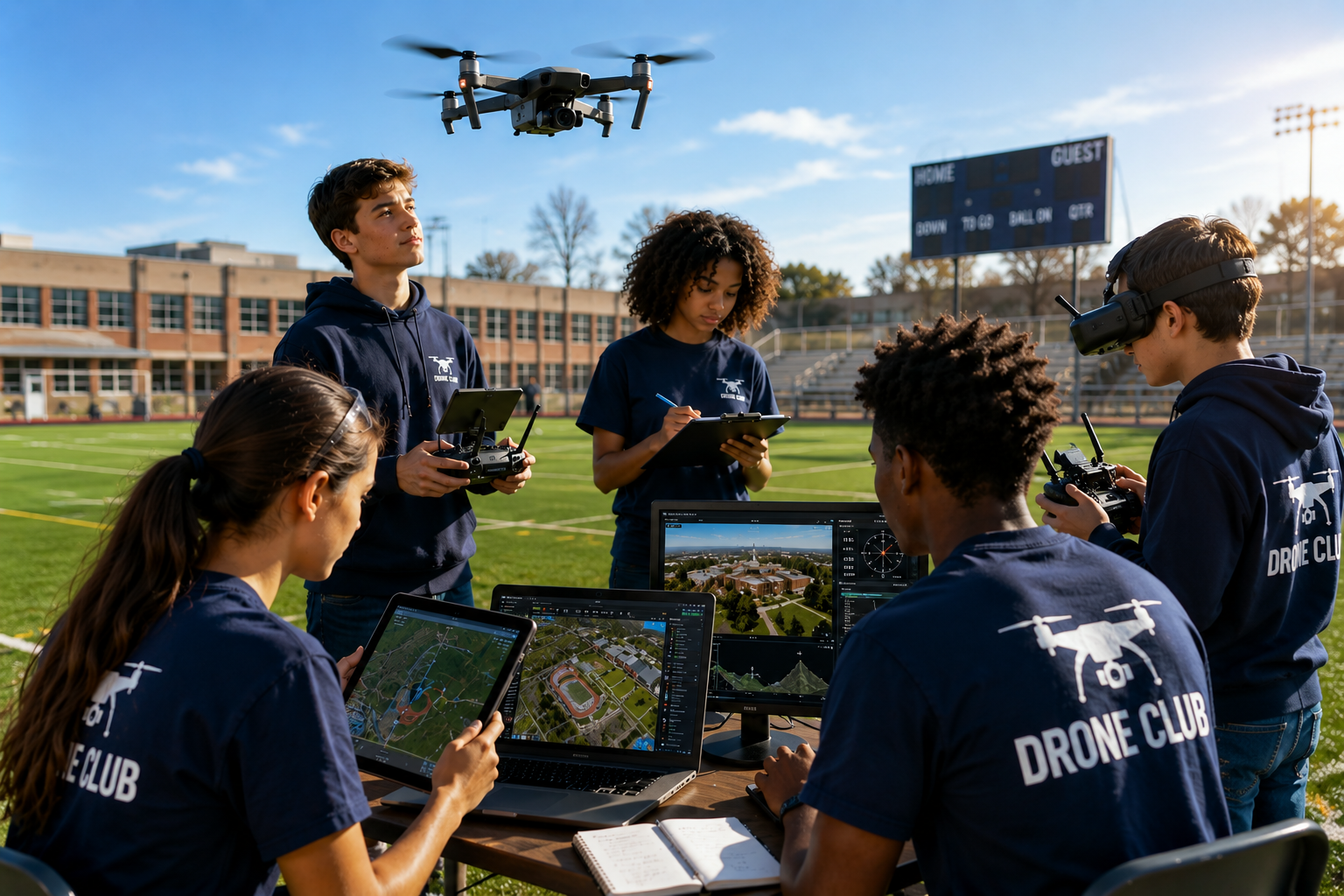
A drone lifts off from a school athletic field and climbs steadily into the morning sky.
Students watch a live video feed as the aircraft surveys the campus below. One student monitors flight telemetry. Another tracks battery performance and weather conditions. A third reviews aerial imagery being collected in real time and begins analyzing the data.
To an outside observer, it may appear that students are simply flying a drone.
In reality, they are learning many of the same skills used by engineers, surveyors, emergency responders, construction managers, agricultural specialists, aviation professionals, environmental scientists, and technology experts every day.
Across the country, drone clubs are emerging as one of the most exciting and versatile opportunities in K-12 education. What makes these programs particularly powerful is their ability to blend science, technology, engineering, mathematics, aviation, artificial intelligence, problem-solving, leadership, and career exploration into a single experience.
For educators, administrators, and parents searching for opportunities that genuinely connect classroom learning to the real world, drone clubs may represent one of the most promising pathways available today.
More Than Flying: A Gateway to Real-World Learning
One of the biggest misconceptions about drone clubs is that they are primarily about operating small aircraft.
The reality is far more impressive.
A successful drone program introduces students to a wide range of disciplines that extend far beyond flight operations. Students learn about aerodynamics, aviation safety, weather patterns, data collection, engineering design, photography, videography, mapping technologies, geographic information systems (GIS), mission planning, risk management, and emerging technologies such as automation and artificial intelligence.
Flying the drone is often just the beginning.
Students must determine the purpose of the flight, evaluate environmental conditions, plan routes, collect information, analyze results, and communicate findings. These are the same types of challenges professionals face in industries that increasingly rely on drone technology.
The result is a learning experience that feels authentic because it is authentic.
Students are not simply completing assignments.
They are solving problems.
One of the Fastest-Growing Technologies in the Workforce
Few technologies have expanded into as many industries as drones.
Construction companies use drones to monitor project progress and generate highly detailed site maps. Farmers use them to assess crop health and improve productivity. Utility companies inspect power lines, pipelines, and infrastructure. Public safety agencies deploy drones during search-and-rescue operations, natural disasters, and emergency response situations.
Environmental organizations use drones to monitor wildlife habitats and conservation projects. Transportation agencies rely on aerial imagery to support planning and infrastructure development. Media companies use drones to capture footage that would have been impossible or prohibitively expensive only a few years ago.
The list continues to grow.
As organizations discover new uses for drone technology, the demand for skilled professionals continues to rise.
Students participating in drone clubs gain exposure to industries that are actively searching for future talent.
That makes these programs much more than extracurricular activities.
They become workforce development opportunities.
Building STEM Skills Through Hands-On Exploration
Educators often struggle with a common challenge: helping students understand why classroom concepts matter.
Drone programs naturally solve that problem.
Mathematics becomes more meaningful when students calculate distances, altitudes, and flight paths.
Physics concepts become easier to understand when students see lift, drag, thrust, and motion in action.
Geography comes alive when students create maps and analyze aerial imagery.
Engineering becomes tangible when students troubleshoot equipment, improve performance, and solve technical challenges.
Computer science gains relevance when students use software platforms to process flight data and generate visualizations.
Instead of learning concepts in isolation, students experience how multiple disciplines work together to accomplish a mission.
That connection between theory and application often leads to higher engagement and deeper learning.
Preparing Students for FAA and Aviation Pathways
One of the most overlooked benefits of drone education is its connection to aviation careers.
Many students who join a drone club because they enjoy technology discover a much broader interest in aviation, aerospace, and flight operations.
Drone clubs provide an early introduction to concepts associated with the Federal Aviation Administration’s Part 107 Remote Pilot certification, which is required for many commercial drone operations in the United States.
While students may not immediately pursue certification, they begin learning about airspace, flight planning, weather considerations, safety procedures, regulations, and operational responsibilities.
These experiences can spark interest in careers as pilots, aviation managers, aerospace engineers, flight systems specialists, air traffic professionals, and drone operators.
For students fascinated by aviation, drone clubs often become the first step toward a much larger journey.
National Competitions Create Excitement and Opportunity
One reason drone clubs are expanding rapidly is the growing number of competitions and organized programs available to schools.
Students can participate in programs supported by the AUVSI Foundation, which promotes STEM learning through drone and autonomous systems education.
The Academy of Model Aeronautics provides educational resources, safety guidance, and opportunities for students interested in aviation and drone operations.
The REC Foundation has helped fuel the growth of student drone competitions through its Aerial Drone Competition programs, which challenge students to combine flight skills, teamwork, engineering, and problem-solving.
Drone Soccer is also gaining momentum across the country, creating exciting opportunities for schools to engage students through competition while introducing concepts related to aviation, engineering, and technology.
Organizations such as SkillsUSA continue expanding opportunities for students interested in aviation, technology, and emerging workforce skills.
These competitions provide more than trophies.
They build teamwork, leadership, communication skills, and confidence while exposing students to peers who share similar interests.

Drones as Problem Solvers for Schools
One of the most exciting opportunities for drone clubs is their ability to contribute directly to the school community.
Students can create aerial campus maps for facilities planning.
They can support environmental science projects by documenting restoration efforts or analyzing local ecosystems.
They can assist media programs by producing aerial footage for school promotional videos.
Athletic departments can use drone footage to highlight facilities and events.
STEM classes can use aerial imagery for interdisciplinary projects that connect science, mathematics, geography, and technology.
In many cases, drone clubs become valuable contributors to the broader educational mission of the school.
Students see firsthand how technology can be used to solve real problems and create meaningful outcomes.
That experience is incredibly powerful.
Artificial Intelligence and Autonomous Systems
The future of drones is increasingly connected to artificial intelligence.
Modern drone platforms already use AI-assisted technologies for navigation, obstacle avoidance, object recognition, mapping, and data analysis.
As autonomous systems continue advancing, drones will play an even larger role in industries ranging from transportation and agriculture to infrastructure management and public safety.
Students participating in drone clubs gain exposure to these emerging technologies at an early age.
They begin understanding how automation works, how data is analyzed, and how intelligent systems make decisions.
These experiences prepare students not only for drone-related careers but also for a future where artificial intelligence and autonomous technologies become increasingly common across nearly every profession.
Creating Powerful Community Partnerships
Drone clubs offer some of the strongest partnership opportunities of any student organization.
Local engineering firms, construction companies, agricultural businesses, public safety agencies, utilities, airports, transportation departments, environmental organizations, and universities often have a direct interest in drone technology.
Many are eager to support schools because they recognize the growing need for skilled professionals.
These organizations can provide guest speakers, demonstrations, mentorship opportunities, site visits, internships, and career exploration experiences.
Students gain valuable insight into how drone technology is being used in the real world.
Schools gain access to expertise and resources.
Communities benefit from stronger connections between education and workforce development.
Everyone wins.
Helping Students Discover What’s Possible
Perhaps the greatest strength of a drone club is its ability to expand students’ understanding of what is possible.
Many students join because flying a drone sounds exciting.
What they often discover is a world of opportunities they never knew existed.
They discover careers.
They discover technology.
They discover engineering.
They discover aviation.
They discover leadership.
They discover confidence.
Most importantly, they begin to see themselves as future innovators.
That shift in perspective can change the trajectory of a student’s life.
Looking Beyond the Horizon
At first glance, a drone club may appear to be about aircraft.
Look closer, however, and something much more meaningful is happening.
Students are learning how technology solves problems.
They are developing technical and leadership skills.
They are connecting classroom concepts to real-world applications.
They are exploring industries that continue to transform the global economy.
Somewhere on a school athletic field today, a student is preparing a drone for flight. They are checking weather conditions, reviewing safety procedures, planning a mission, and collecting data that will help solve a real-world challenge.
A decade from now, that same student may be designing autonomous aircraft, supporting emergency response operations, managing infrastructure projects, protecting natural resources, developing aerospace technologies, or helping shape the future of aviation.
Drone clubs are not simply teaching students how to fly.
They are helping students discover how high their futures can soar.

Subscribe to edCircuit to stay up to date on all of our shows, podcasts, news, and thought leadership articles.
Related reading
More on STEM and STEAM Education