 Science Safety
  Jacqueline Monteith
Table of Contents
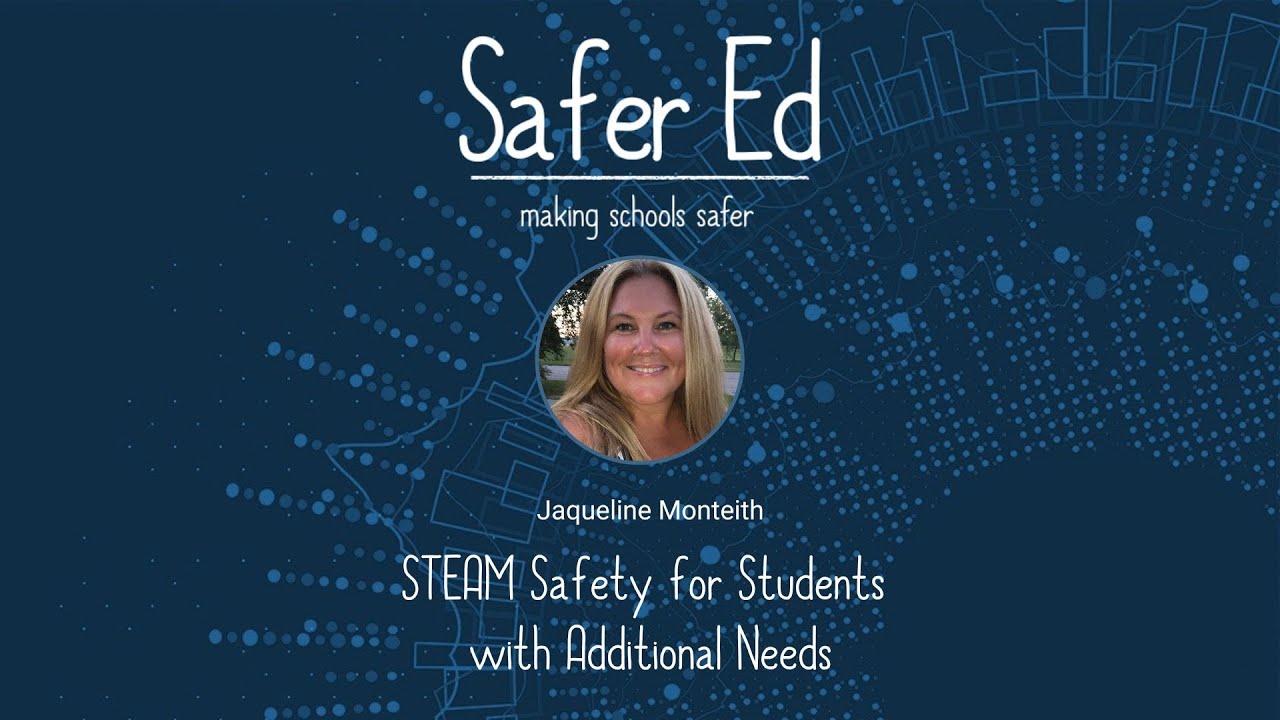
For this episode of Safer Ed, special guest Jacqueline Monteith shares how developing an informed perspective on keeping students with special education needs safer in schools. As an instructional coach and mother of a child with additional needs, Jacqueline is uniquely qualified to provide a framework for supporting students with special needs.
Challenges of Learners With Additional Needs
The conversation begins by discussing challenges that students with disabilities and additional needs come across and educators’ ability to support those different needs. As Jaqueline points out, each student with specialized needs has a wide range of challenges depending on their individualized needs ranging from physical, social, emotional, and cognitive difficulties. It is important to remember that these challenges are not monolithic, and even two students with the exact needs can have different accommodations.
To make students safer and more successful in learning environments, educators need to recognize the unique needs of these students and work to accommodate and modify learning with them in mind. Part of that accommodation/modification structure is Individualized Education Plans (IEPs), a significant focus of the first part of this discussion.
Accommodation vs. Modification for Students with Additional Needs
An important distinction to understand when working with students with IEPs is accommodation and modification. As Jacqueline discusses, accommodations are adjustments made by the educator to ensure that a student can actively participate in classroom goals and learning objectives. With accommodations, there are no changes to curricular outcomes. Standard accommodations include dedicated physical spaces and additional instructional or emotional support from support professionals.
In contrast, a modification is a curricular change in which educators and administrators change a particular learning objective to support a student’s individualized learning journey best.
Opportunities for Growth in Supporting Students with Additional Needs
In the second part of the episode, our guest discusses how educators and stakeholders that can make schools more inclusive and supportive of students with additional needs. These growth opportunities include universal design, improving the identification of conditions, and creating structures for student support. Each of these opportunities for growth addresses all kinds of learning environments, from specialized schools to home schools to traditional public school environments.
Jacqueline astutely points out that even though students with additional needs require different support structures, every learner is unique and reacts differently to learning environments. With this in mind, Jacqueline discusses a framework for more equitable learning – the universal design framework.
Universal Design Framework
The universal design framework is a movement towards building curricular content around learners rather than building a curriculum and adjusting for the needs of your students. This framework is groundbreaking as it truly challenges educators to identify the needs of their students and build a curriculum to what they’ve identified. It is a very learner-centric framework that could help provide more equitable learning.
Overall this conversation sets an excellent groundwork for supporting students with disabilities and how schools, educators, and administrators can best support students with additional needs. You can learn more about Jacqueline’s platform and thought leadership below.
Subscribe to edCircuit to stay up to date on all of our shows, podcasts, news, and thought leadership articles.