
 EdCircuit Staff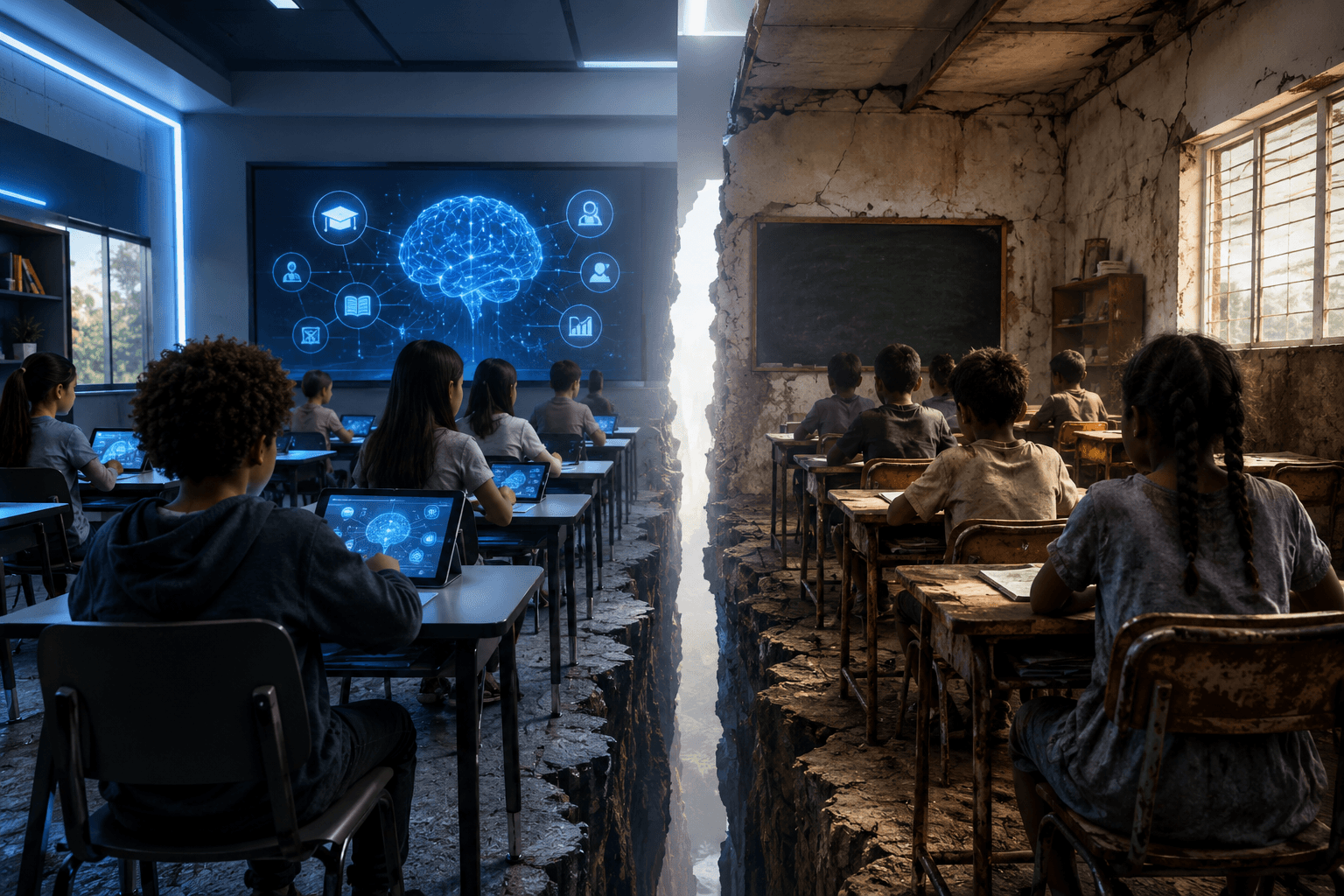
AI access in K–12 schools is rapidly creating a new digital divide that could determine which students are prepared for the future, and which students are left behind.
In one district, students are learning prompt engineering, exploring AI ethics, using intelligent tutoring systems, and interacting with classroom tools designed to personalize learning. Teachers are being trained on responsible AI integration, district leaders are building governance frameworks, and technology departments are preparing for a future where artificial intelligence becomes embedded into nearly every aspect of school operations.
In another district, educators are still being told to avoid AI tools altogether.
There are no AI literacy initiatives. No professional development sessions. No district guidance. No strategic planning discussions. Technology teams are already overwhelmed managing aging devices, cybersecurity threats, and shrinking budgets. Artificial intelligence feels less like an opportunity and more like another challenge schools simply do not have the capacity to address.
That gap may become one of the defining educational equity issues of this decade.
For years, conversations surrounding the digital divide focused on internet access, student devices, and broadband connectivity. The pandemic exposed major inequities in those areas and forced districts across the country to rapidly modernize their technology infrastructure.
But a new divide is now emerging—one that goes beyond connectivity.
The next digital divide may be defined by access to artificial intelligence.
AI Readiness Is Becoming a New Form of Educational Equity
The districts moving aggressively into AI adoption are not simply purchasing software licenses. They are building ecosystems designed to prepare students and educators for a future where AI is integrated into communication, research, business operations, healthcare, engineering, media production, cybersecurity, and countless other industries.
Some school systems are already introducing:
- AI literacy curriculum
- Student prompt-writing instruction
- AI-powered tutoring platforms
- Translation and accessibility tools
- AI-assisted lesson planning
- Automated administrative workflows
- Personalized learning environments
- Career pathway programs tied to emerging technologies
Meanwhile, other districts remain stuck in a holding pattern.
Some are waiting for state guidance. Others are concerned about cybersecurity and student data privacy. Many simply lack the staffing, infrastructure, funding, or leadership bandwidth needed to evaluate AI tools responsibly.
The disparity is becoming increasingly visible.
According to the 2026 State of EdTech District Leadership report released by Consortium for School Networking (CoSN), district leaders continue identifying artificial intelligence, cybersecurity, and staffing capacity among the most significant challenges shaping K–12 technology leadership. At the same time, many districts report concerns about preparedness, policy development, and professional development surrounding AI implementation.
The result is a rapidly widening gap between districts building AI-ready learning environments and districts struggling just to maintain existing technology systems.
Wealthier Districts Often Move Faster
The uncomfortable reality is that districts already positioned with strong technology infrastructure are often the same districts able to adopt AI the fastest.
Large suburban districts may have:
- Dedicated instructional technology coaches
- Data privacy officers
- Cybersecurity teams
- Technology integration specialists
- Strategic planning departments
- AI pilot programs
- Stronger local funding support
These resources allow districts to experiment, evaluate, and scale AI initiatives more confidently.
Meanwhile, smaller and underfunded districts may rely on a single technology administrator responsible for:
- Device management
- Network operations
- Cybersecurity
- Student information systems
- Classroom support
- Help desk tickets
- Testing platforms
- Software deployment
For these schools, AI exploration can quickly become operationally overwhelming.
This creates a compounding effect in K–12 education:
The districts most capable of preparing students for an AI-driven future are often the districts that already possess significant technological advantages.
Rural Schools Face Some of the Biggest Challenges
Rural districts may face some of the most difficult barriers in the emerging AI landscape.
Limited staffing, aging infrastructure, bandwidth limitations, and recruitment challenges can all slow AI readiness. Many rural districts continue fighting to attract technology professionals, maintain aging systems, and provide equitable digital access to students spread across large geographic regions.
Yet rural students will eventually enter the same workforce as students graduating from wealthier suburban districts.
That reality is creating growing concern among education leaders.
If AI literacy becomes an expected workforce skill—as many experts believe it will—students without structured exposure to AI systems may graduate at a significant disadvantage.
The concern extends far beyond computer science classrooms.
Future careers in healthcare, agriculture, manufacturing, business, engineering, media, and skilled trades may all require workers capable of interacting with AI-powered systems. Students unfamiliar with automation, intelligent systems, and AI-assisted workflows could find themselves struggling to compete in higher education and employment environments where those technologies are already standard.
In many ways, the issue mirrors earlier concerns surrounding internet access during the rise of the digital economy.
The difference is that AI may evolve even faster.
Teachers Are Entering Two Different Professional Worlds
The AI divide is not affecting only students.
It is increasingly shaping the professional experiences of educators themselves.
In some districts, teachers are actively learning:
- AI-enhanced lesson planning
- Responsible prompt engineering
- AI-assisted differentiation
- Automated rubric creation
- Data analysis tools
- Accessibility supports
- Ethical classroom integration strategies
Professional development sessions focused on AI are becoming common in forward-thinking districts. Technology departments and curriculum leaders are collaborating to help educators understand both the opportunities and limitations of artificial intelligence.
For many teachers, these tools are beginning to reduce administrative workload while creating more opportunities for personalization and instructional creativity.
In other schools, educators are receiving little guidance at all.
Some districts continue blocking AI tools entirely. Others have yet to establish clear policies, leaving teachers uncertain about what is permitted or discouraged. Many educators are experimenting privately without formal training, governance, or support structures.
This inconsistency creates another layer of inequity.
Teachers with access to strong AI training may become significantly more efficient and technologically fluent over time. Educators without support may feel increasingly isolated as AI integration accelerates across the profession.
The divide is no longer simply technological.
It is becoming instructional, operational, and professional.
Cybersecurity and Privacy Concerns Are Real
Not every district moving cautiously on AI lacks innovation.
Many school leaders have legitimate concerns.
Artificial intelligence introduces difficult questions surrounding:
- Student data privacy
- Cybersecurity vulnerabilities
- Deepfakes and misinformation
- Bias in AI-generated outputs
- Academic integrity
- Age-appropriate safeguards
- Data ownership
- Legal liability
District leaders are being asked to evaluate rapidly evolving technologies while balancing student safety, compliance obligations, and public trust.
For schools already facing ransomware threats and growing cybersecurity pressures, the stakes are high.
Questions districts continue asking include:
- Where is student information stored?
- Is student data used to train AI models?
- How accurate are AI-generated outputs?
- What safeguards protect minors?
- How should AI-generated work be cited?
- What happens when AI produces harmful or inaccurate information?
These concerns are valid and increasingly urgent.
However, many experts warn that avoiding AI entirely may ultimately create additional risks. Students are already using AI tools outside school environments, often without guidance or oversight.
The challenge for K–12 education may not be whether students will use AI.
It may be whether schools choose to teach students how to use it responsibly.
Workforce Readiness Is Now Part of the Conversation
Artificial intelligence is rapidly reshaping industries nationwide. Employers increasingly expect workers to understand automation, digital collaboration, data analysis, and AI-assisted workflows.
Students graduating from AI-forward districts may leave school with:
- Stronger digital communication skills
- Greater familiarity with emerging technologies
- Experience evaluating AI-generated information
- Understanding of AI ethics and limitations
- Confidence using automation tools
- More advanced problem-solving strategies
Meanwhile, students without meaningful exposure to AI systems may enter higher education or the workforce already behind peers who have spent years developing those skills.
This is why many education leaders now believe AI literacy may eventually become as foundational as digital literacy itself.
The schools that ignore this shift risk preparing students for a world that no longer exists.
Equity Must Remain at the Center
The solution is not reckless AI adoption.
Nor is it fear-driven avoidance.
The challenge facing K–12 education is building responsible, equitable, and sustainable AI implementation models that ensure all students—regardless of ZIP code—have opportunities to develop future-ready skills.
That may require:
- State-level AI guidance
- Regional collaboration models
- Expanded professional development
- Public-private partnerships
- Shared technology services
- Federal support programs
- AI governance frameworks
- Cross-district resource sharing
Organizations, including the International Society for Technology in Education and the Consortium for School Networking (CoSN), are increasingly helping districts navigate AI governance, policy creation, and implementation planning.
Still, the pace of change continues accelerating.
Districts waiting too long to begin these conversations may eventually find themselves struggling to close a gap that becomes increasingly difficult to overcome.
The Next Digital Divide Has Already Begun
The original digital divide focused on internet access.
The next divide may focus on access to intelligence itself—specifically, who has the opportunity to learn alongside AI systems and who does not.
This moment represents far more than a technology trend.
It is a conversation about equity, leadership, workforce readiness, educational opportunity, and the future direction of K–12 learning itself.
The districts investing thoughtfully in AI literacy, governance, infrastructure, and professional development today may ultimately shape which students are prepared to lead in an AI-driven economy.
Those unable to move forward risk leaving students to play catch-up in a future that is arriving faster every day.
The AI divide will not simply be measured by devices or bandwidth.
It may ultimately be measured by which students were prepared to shape the future—and which students were left trying to catch up to it.

CGTN Europe – Is AI in education becoming the next great digital divide?
Subscribe to edCircuit to stay up to date on all of our shows, podcasts, news, and thought leadership articles.