



 EdCircuit Staff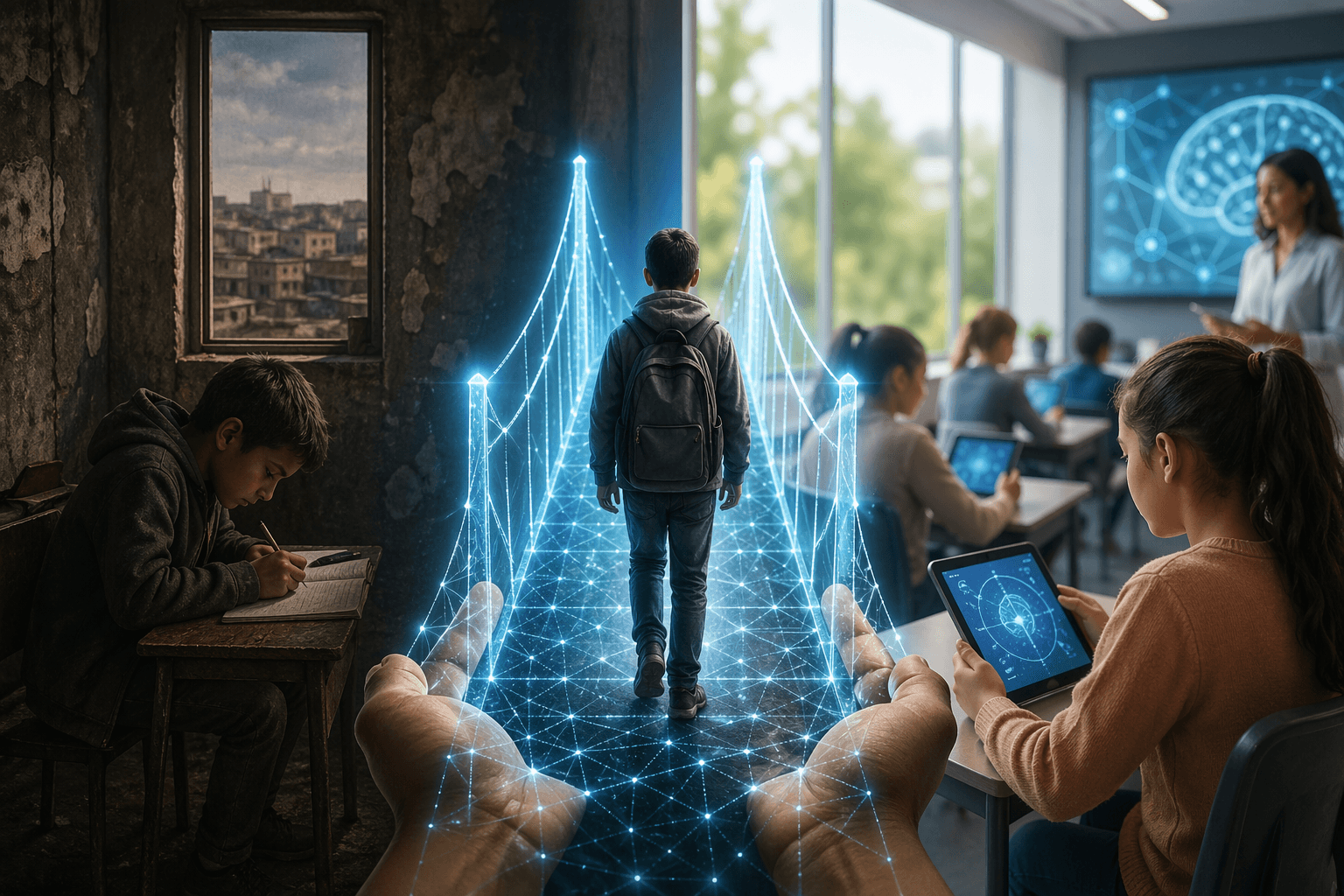
AI equity in education is no longer a future conversation—it is a present reality shaping classrooms, policies, and student outcomes across K–12 systems.
In one district, students are being taught how to use AI to think, write, and solve problems.
In another, students are being told not to use it at all.
Both believe they are preparing students for the future.
Only one is.
This is the defining tension of artificial intelligence in education:
AI has the potential to close equity gaps—and at the same time, widen them faster than any technology before it.
The Promise: AI as an Equity Accelerator
At its best, AI represents one of the most powerful tools educators have ever had to personalize learning.
For decades, equity in education has been limited by scale. Teachers, no matter how skilled, can only differentiate instruction to a certain extent within the constraints of time, class size, and resources. AI changes that equation.
Students can now:
- Receive real-time feedback on writing and problem-solving
- Access tutoring support beyond the school day
- Translate content instantly into their home language
- Engage with content adapted to their pace and level
For multilingual learners, AI-powered translation tools remove barriers that once isolated them from instruction. For students with learning differences, AI can scaffold content in ways that feel personalized rather than standardized. For those who lack access to traditional tutoring, AI offers a form of academic support that is immediate and consistent.
In theory, AI creates a classroom where every student has a support system, not just those who can afford one.
The Risk: A New Digital Divide
But equity in education has never been about tools alone—it has always been about who gets to use them effectively.
The introduction of AI is exposing a new layer of inequity:
Access Gaps
Not all students have reliable devices or internet access at home. Even within well-resourced districts, disparities exist between schools, neighborhoods, and families.
AI Literacy Gaps
Knowing how to use AI effectively is quickly becoming as important as having access to it. Students who understand how to prompt, refine, and evaluate AI-generated content gain a significant advantage over those who do not.
Policy Gaps
Some districts encourage responsible AI use. Others restrict or ban it. The result is inconsistency—not just between states or districts, but sometimes between classrooms in the same building.
Bias in AI Systems
AI tools are only as unbiased as the data they are trained on. Without careful oversight, these systems can reinforce existing inequities rather than eliminate them.
The outcome is a new kind of divide:
Not just who has access to information—but who knows how to leverage intelligence.
And in many districts, this divide is already forming.
In some classrooms, students are being taught how to use AI to deepen thinking. In others, they are navigating it alone—or not at all.
In some schools, teachers are supported with training and clear expectations. In others, they are left to figure it out on their own.
This is not a future problem.
It is already happening.
The Leadership Challenge: Where Equity Is Won or Lost
This is where the conversation shifts from technology to leadership.
Equity in the age of AI will not be determined by the tools themselves—it will be determined by the decisions made by:
- Superintendents
- CIOs and CTOs
- Principals
- School boards
- Classroom teachers
District leaders are now facing questions that didn’t exist just a few years ago:
- Should AI tools be open, restricted, or monitored?
- How do we ensure consistent access across all schools?
- What professional development do teachers need to guide students effectively?
- How do we protect student data while still allowing innovation?
In many districts, AI use is already happening—but without policy, without training, and without consistency.
That is where inequity takes hold.
The greatest risk is not adopting AI too quickly.
It is allowing inequity to grow quietly while decisions are delayed.
When one school integrates AI meaningfully and another does not, inequity expands—not because of intent, but because of inaction.
What AI Equity in Education Actually Looks Like
If equity is the goal, then access alone is not enough. True AI equity in education requires a coordinated, intentional approach.
1. Universal Access to AI Tools
Districts must ensure that all students—not just some—have access to approved AI platforms, both in school and, when possible, at home.
2. AI Literacy as a Core Skill
Students need to be taught how to:
- Ask effective questions
- Evaluate AI-generated responses
- Recognize bias and misinformation
- Use AI ethically and responsibly
AI literacy is quickly becoming as fundamental as digital literacy.
3. Professional Development for Educators
Teachers cannot guide what they do not fully understand. Ongoing training is essential—not just on how AI works, but how it fits into instruction, assessment, and classroom management.
4. Clear, Inclusive Policy Development
AI policies should not be written in isolation. Including student voice, teacher input, and community perspectives ensures that policies reflect real-world use, not just theoretical concerns.
5. Consistency Across Classrooms and Schools
Equity requires alignment. Students should not have vastly different experiences with AI based solely on the classroom they are assigned to.
The Classroom Reality: Already in Motion
The most important thing to understand is this:
Students are already using AI.
Some are using it to enhance their learning. Others are navigating it without guidance. And some are not using it at all—either because they lack access or because they have been told not to.
This uneven landscape is where inequity grows.
Educators are not starting from scratch—they are catching up to a reality that is already unfolding in real time.
The Path Forward: Intentional, Not Accidental
AI will not wait for education systems to fully catch up. The pace of innovation is too fast, and student adoption is already widespread.
The question is not whether AI will be part of education.
The question is whether it will be implemented intentionally or unevenly.
Districts that approach AI with a clear focus on equity—through access, literacy, policy, and leadership—have an opportunity to redefine what equitable education looks like in the modern era.
Those that do not risk repeating a familiar pattern:
New technology arrives, early adopters benefit, and gaps widen before systems catch up.
Final Thought
AI won’t decide who succeeds.
But it will expose—faster than ever—which systems were built for equity… and which were not.
Subscribe to edCircuit to stay up to date on all of our shows, podcasts, news, and thought leadership articles.