


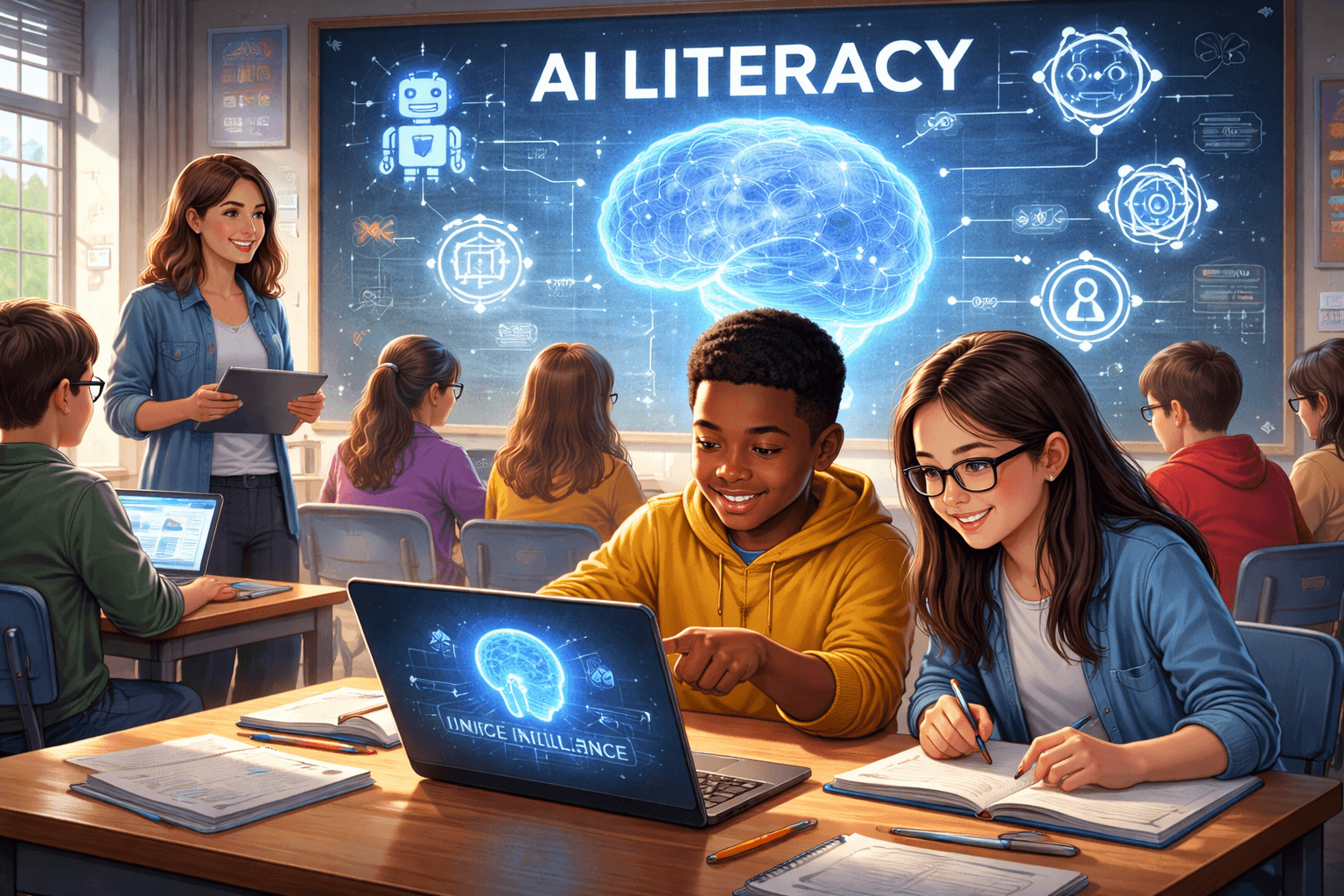
AI literacy in schools is rapidly becoming a priority for educators as artificial intelligence tools reshape how students access information, complete assignments, and interact with technology. While early conversations about AI in education focused largely on preventing misuse, many districts are now recognizing that the more sustainable approach is to teach students how these tools work and how to use them responsibly.
From elementary classrooms to high school career programs, artificial intelligence is increasingly part of the learning environment. Students encounter AI through search engines, writing tools, recommendation algorithms, and digital assistants long before educators formally introduce the concept in the classroom.
For teachers, administrators, and policymakers, the challenge is clear: students must learn not only how to use AI tools but also how to understand their capabilities, limitations, and ethical implications.
Why AI Literacy Is Becoming Essential
Just as digital literacy became essential during the rise of the internet, AI literacy is emerging as the next critical competency for students. Artificial intelligence already influences the information students encounter daily, from social media feeds and streaming recommendations to academic research tools.
Without a basic understanding of how AI works, students may struggle to recognize when algorithms are shaping the information they see or when automated tools are generating content.
Educators increasingly believe that AI literacy should include an understanding of several key concepts:
How AI systems generate responses and predictions
The limitations and potential inaccuracies of AI-generated content
The importance of verifying information produced by AI tools
Ethical considerations surrounding automation and data use
Responsible ways to incorporate AI into research and learning
Teaching these concepts helps students become informed users rather than passive consumers of artificial intelligence systems.
Students Are Already Using AI
One reason AI literacy is becoming urgent is that students are already interacting with AI tools—often without fully understanding them.
Generative AI writing platforms, coding assistants, and automated research tools have become widely accessible. Many students experiment with these technologies when studying, completing homework, or exploring ideas.
In some cases, educators initially responded by attempting to limit or detect AI use. However, many schools now recognize that banning or ignoring AI may not be practical.
Instead, the focus is shifting toward helping students understand when and how AI can be used productively. Just as calculators eventually became accepted tools in mathematics education, artificial intelligence may become a common support tool across many subject areas.
The difference is that AI tools generate information, which requires students to evaluate accuracy and reliability more carefully.
What AI Literacy Actually Means
AI literacy is not simply about learning how to use AI tools. Instead, it involves developing a deeper understanding of how artificial intelligence systems function and how they affect decision-making in society.
In practical terms, AI literacy can include:
Understanding How AI Works
Students learn the basics of machine learning, algorithms, and data training in accessible ways appropriate to their grade level.
Evaluating AI-Generated Content
Students practice identifying when AI output may contain errors, bias, or incomplete information.
Responsible AI Use
Students explore when AI can support learning and when independent thinking is necessary.
Ethical Awareness
Students discuss issues such as privacy, bias in algorithms, and the societal impact of automation.
These skills help students move beyond simply using technology and toward understanding its broader implications.
How Schools Are Beginning to Integrate AI Literacy
Across the country, school systems are experimenting with different ways to introduce AI literacy into existing curricula.
Some districts are incorporating AI topics into digital citizenship or computer science courses. Others are embedding discussions of AI tools directly into writing, research, and project-based learning assignments.
Examples of emerging approaches include:
Elementary classrooms: introducing basic concepts about how computers “learn” from data
Middle school lessons: exploring how recommendation algorithms influence online content
High school courses: examining AI ethics, bias in algorithms, and real-world applications
Professional development is also becoming an important part of the process. Many teachers did not encounter artificial intelligence in their own training, so districts are investing in workshops and resources that help educators feel comfortable teaching AI concepts.
Teaching Responsible AI Use
One of the most important aspects of AI literacy is helping students develop responsible habits when using artificial intelligence tools.
Educators emphasize that AI should support learning rather than replace it. For example, AI tools might help students brainstorm ideas, summarize information, or explore alternative perspectives—but students must still engage critically with the material.
Teachers often encourage students to:
verify AI-generated information with trusted sources
use AI as a starting point rather than a final answer
acknowledge when AI tools contributed to their work
maintain original thinking and analysis
By emphasizing these principles, schools aim to preserve academic integrity while acknowledging that AI tools are becoming part of the modern learning landscape.
Preparing Students for an AI-Driven Future
Beyond classroom assignments, AI literacy also prepares students for a workforce increasingly influenced by automation and intelligent systems.
Artificial intelligence is already transforming industries ranging from healthcare and finance to engineering, agriculture, and media. Students entering these fields will likely encounter AI tools as part of their daily work.
Developing AI literacy, therefore, helps students build the critical thinking and adaptability needed to navigate an evolving technological environment.
Employers are increasingly seeking workers who can collaborate with technology, interpret data, and evaluate automated systems rather than rely on them.
Schools that introduce AI literacy today may therefore be helping students build foundational skills for future careers.
A New Chapter in Digital Education
The conversation about artificial intelligence in education is still evolving. Early debates often focused on whether AI should be restricted or detected in student work. Increasingly, however, educators are recognizing that the long-term challenge is not preventing AI from entering classrooms but ensuring that students understand it.
AI literacy in schools represents an important step in that direction.
By helping students explore how artificial intelligence works, how it influences information, and how it should be used responsibly, schools can prepare learners to navigate a world where AI systems are increasingly present.
Just as previous generations learned to use the internet responsibly, today’s students must learn to engage thoughtfully with artificial intelligence.
For educators and school leaders, the goal is not simply to keep pace with technological change but to ensure that students develop the knowledge and judgment needed to use these powerful tools wisely.
Related: AI Literacy in Education Defines the New Divide
Subscribe to edCircuit to stay up to date on all of our shows, podcasts, news, and thought leadership articles.
Related reading
More on Artificial Intelligence