 EdCircuit Staff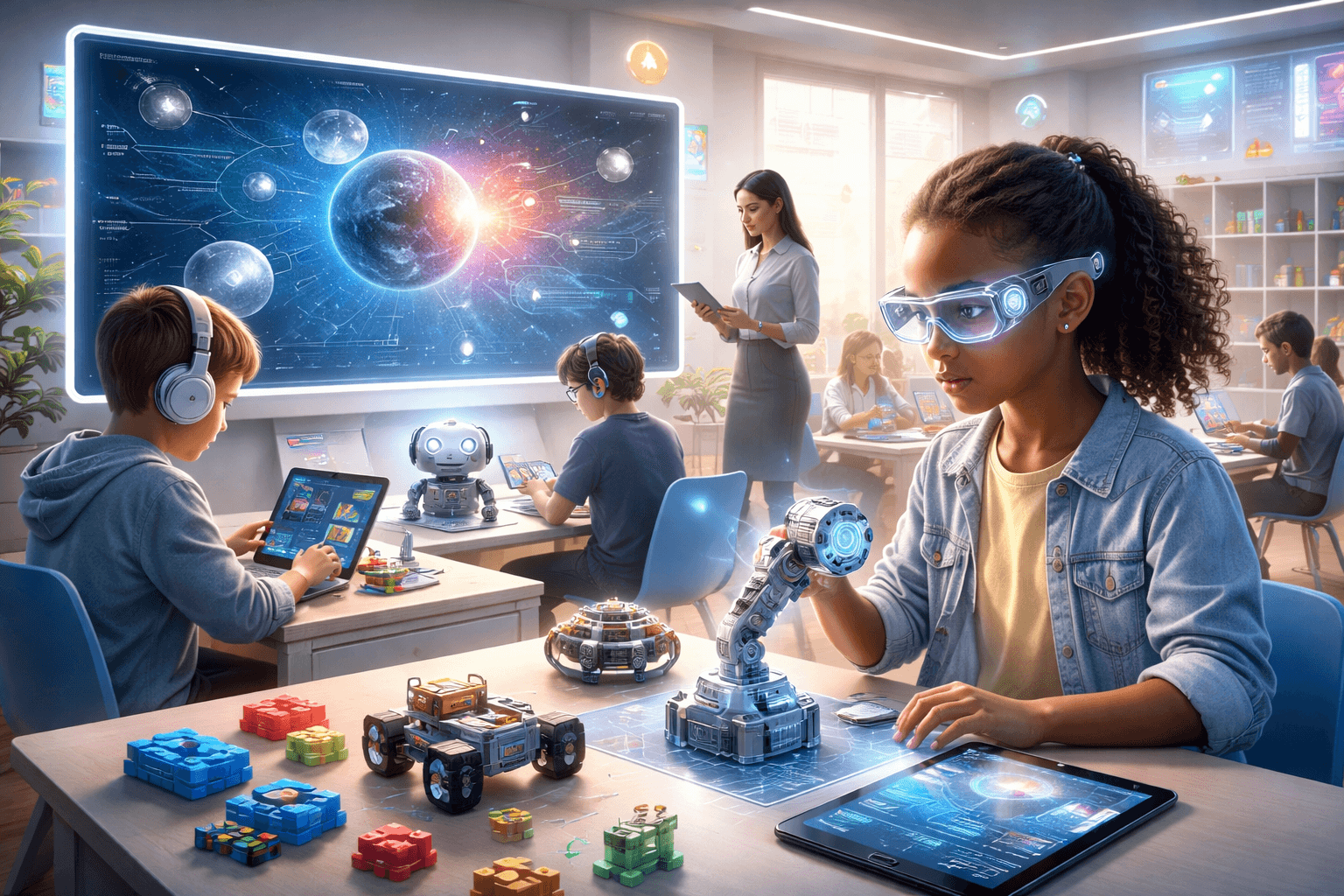
Table of Contents
CES 2026, held each January in Las Vegas, offers a glimpse into where technology is headed. While education technology was not positioned front and center, the signals for educators and education leaders were unmistakable.
Rather than unveiling traditional classroom tools, CES 2026 highlighted platforms, devices, and experiences that are likely to influence how students learn as they are adapted for educational use. The most important education signals were embedded inside broader consumer innovations: artificial intelligence, smart play, wearables, robotics, and immersive interaction.
The takeaway for education is clear: the next wave of edtech will not arrive neatly labeled “for schools.”
AI Learning Tools Move From Supplemental to Foundational
Artificial intelligence dominated CES 2026, but what stood out for education was not novelty — it was integration.
Education-adjacent platforms demonstrated how AI is becoming contextual, conversational, and embedded into everyday workflows. Rather than focusing on drill-and-practice or test preparation, these systems emphasized:
-
Personalized explanations and pacing
-
Audio-first learning formats
-
Real-time summaries and reinforcement
-
Learner support that adapts to individual needsCES 2026
Companies such as Think Academy showcased AI-driven learning tools that blend academic support with broader learner engagement, reinforcing a shift toward more holistic educational experiences.
At the platform level, Google highlighted Gemini-powered content capabilities that point toward AI-generated lesson summaries, audio learning modules, and embedded instructional support — tools designed to assist teachers rather than replace them.
For classrooms, this signals a future where educators guide instruction and context, while AI supports personalization, feedback, and access.
Smart Play and Hands-On STEM Take a Leap Forward
One of the most compelling education-adjacent trends at CES 2026 came from the evolution of smart physical play.
Interactive building systems demonstrated how physical materials can now respond dynamically through sensors, lights, sound, and software integration. The LEGO Group, for example, showcased advancements in smart play platforms that blend tactile construction with digital feedback.
For schools investing in STEAM, maker spaces, and project-based learning, these tools reinforce an important lesson: the future of learning is not screen-only. Physical-digital hybrids support collaboration, design thinking, and kinesthetic learning in ways traditional software cannot.
Wearables and Personal AI as Learning Companions
CES 2026 also featured a surge in AI-powered wearables and personal companion devices. While primarily consumer-focused, their implications for learning are increasingly visible.
Devices such as Plaud NotePin, an AI-enabled wearable designed to capture and summarize conversations, demonstrate how personal AI tools may eventually support learning if adapted within appropriate educational frameworks, including:
-
Note-taking and lecture capture
-
Study organization and review
-
Memory reinforcement
-
Executive function support
In education, these technologies raise important questions around privacy, equity, and appropriate use — but they also hint at future supports for learners who struggle with traditional academic structures.
Robotics, Interaction, and the Next Generation of STEM
Robotics remained a strong presence at CES 2026, with a noticeable shift away from novelty and toward purposeful interaction.
Many platforms emphasized human–machine collaboration, adaptability, and real-world application. While most demonstrations targeted consumer or enterprise markets, the underlying technologies align naturally with education — particularly in advanced STEM and career-technical pathways.
As robotics, automation, and AI continue to converge, schools will increasingly be tasked with preparing students not just to use technology, but to understand, design, and ethically engage with it. Robotics is increasingly aligned with workforce preparation goals, especially in engineering, manufacturing, and applied sciences.
What CES 2026 Tells Educators About the Road Ahead
While CES 2026 included notable EdTech Innovation Awards honorees, the show’s strongest education signals came from broader AI, wearables, and smart-play platforms that will likely flow into classrooms over time.
Three signals stand out:
-
AI is becoming invisible, embedded into tools rather than marketed as a standalone feature.
-
Learning is expanding beyond screens, blending physical, digital, and experiential environments.
-
Personalized technology is accelerating, increasing both opportunity and responsibility for schools.
For district leaders, educators, and edtech developers, CES 2026 reinforces a familiar truth: innovation will continue — but intentional adoption, strong pedagogy, and ethical frameworks will determine its impact.
Why This Matters for Schools Now
The technologies showcased in Las Vegas may not appear in classrooms tomorrow. But they will influence the platforms, devices, and expectations schools encounter over the next three to five years.
CES 2026 reminds us that the future of education will be shaped not only by edtech companies, but by broader technology ecosystems — and schools that understand those signals early will be better positioned to lead rather than react.

Subscribe to edCircuit to stay up to date on all of our shows, podcasts, news, and thought leadership articles.