
 EdCircuit Staff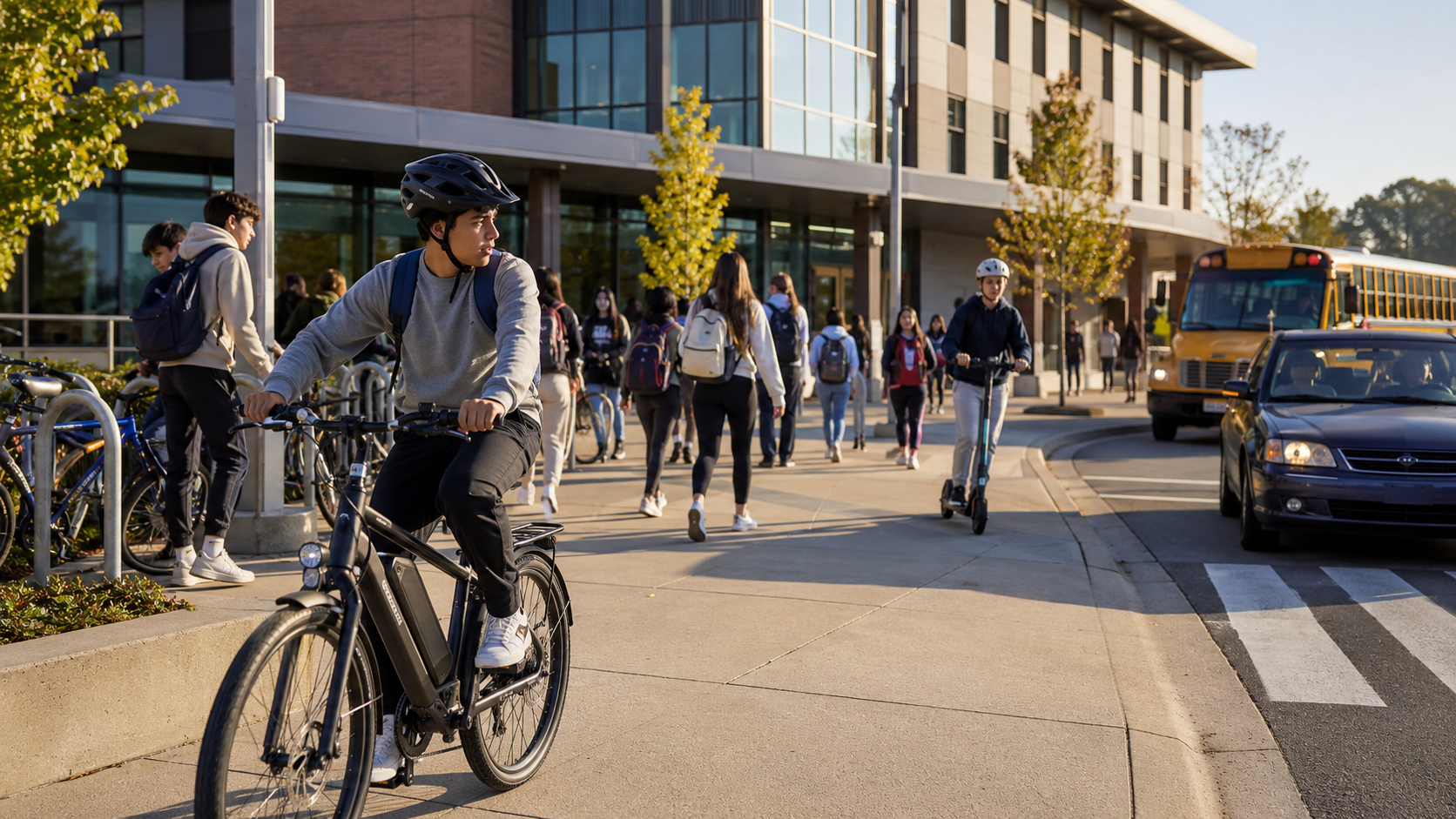
E-bike safety is becoming a new back-to-school responsibility for districts as more students ride electric bikes and scooters to class.
Consider the morning arrival line. Buses are turning into the lot. Parents are pulling away from the curb. Students are crossing between cars, and staff members are trying to keep traffic moving.
Then a student on a nearly silent electric bike enters the same space at 20 miles per hour.
It may look like a bicycle, but it does not always move like one. Its speed, weight and acceleration give drivers and pedestrians less time to react. That is why e-bikes and e-scooters are beginning to force a conversation that many school districts have not yet had.
Which devices are allowed? How old should a student be before riding one to school? Can the bike be operated on campus, or must it be walked? Where should it be stored? What happens when a student arrives on a modified device capable of traveling far faster than a traditional bicycle?
These questions belong in district transportation and safety planning now—not after a serious accident.
The Appeal Is Easy to Understand
For students, an e-bike can mean independence. It can make a longer commute manageable, provide transportation to after-school activities, and give families another option when bus service or a parent ride is unavailable.
Schools may benefit, too. Every student who safely rides instead of arriving in a car potentially removes one vehicle from an already crowded drop-off lane.
The concern is not simply that these devices have motors. It is that a young rider can reach the speed of an experienced adult cyclist without having the same balance, judgment or understanding of traffic.
Some students ride without helmets, carry passengers or move unpredictably between sidewalks and streets. Others use phones or wear headphones while riding. A growing number are operating electric motorcycles or modified devices that are marketed and described as e-bikes even though they may not meet the legal definition.
That distinction matters. A legal low-speed e-bike and a 35-mile-per-hour electric motorcycle should not be treated as the same vehicle simply because both have pedals and are parked near a bicycle rack.
Doctors Are Seeing More Serious Injuries
Trauma doctors in Central California told ABC30 that they are treating young riders for traumatic brain injuries, facial injuries, broken bones and internal bleeding. The report followed the death of a 15-year-old student who crashed an e-scooter while leaving football practice.
The latest national report from the U.S. Consumer Product Safety Commission, covering 2017 through 2023, estimated 448,600 emergency-department visits involving e-bikes, e-scooters and hoverboards.
Annual micromobility-related emergency visits increased from approximately 34,000 in 2017 to 87,800 in 2023. The CPSC found that e-bike injuries increased nearly tenfold during that period. Motor-vehicle collisions and loss-of-control incidents were among the leading hazards associated with e-bike and e-scooter deaths.
Those numbers extend well beyond school-age riders, but the trend is difficult for districts to ignore when the devices are becoming part of the daily student commute.
Most States Have Laws—But the Rules Differ
It would not be accurate to say that many states have no laws governing e-bikes. Most states regulate them through specific e-bike legislation or existing laws covering bicycles, motorized bicycles, mopeds and similar vehicles.
By the end of 2024, PeopleForBikes reported that 43 states recognized some version of the common three-class system:
- Class 1: Pedal assistance that stops at 20 miles per hour
- Class 2: Throttle-powered operation that stops providing assistance at 20 miles per hour
- Class 3: Pedal assistance that stops at 28 miles per hour
The problem is consistency.
Federal law addresses the manufacturing and consumer-product definition of a low-speed electric bicycle. States and local communities determine where it may be ridden, how old an operator must be, whether helmets are required, and whether the device belongs on a street, sidewalk, bike path, or trail.
E-scooters may fall under a different section of state law. Local governments may also establish restrictions that go beyond statewide requirements. Devices exceeding the power or assisted-speed limits for e-bikes may legally be considered mopeds, motorcycles, or another type of motor vehicle.
A student and parent may believe a device is legal because it was purchased as an “e-bike.” That label alone does not settle the question.
School districts must understand their state and local rules, but they also need policies for their own property. Something that may be operated legally on a neighborhood street is not automatically appropriate for a crowded school sidewalk or bus loop.
Districts Are Beginning to Respond
Orange County Public Schools in Florida is implementing one of the clearest K–12 responses. Beginning after Labor Day, students must have a learner’s permit or driver’s license before riding an approved e-bike or e-scooter to school. They must also obtain a permit from their school.
That effectively prevents elementary and middle school students from bringing the devices to campus. The district is emphasizing family communication before moving into progressive discipline, according to ClickOrlando.
A News 6 report shows how the new rules are affecting Central Florida families while local police help parents distinguish legal e-bikes from faster electric motorcycles.
Individual high schools are translating the district policy into specific arrival instructions. Windermere High School, for example, requires approved devices to be walked once they reach campus and stored in designated locations. Modified e-bikes, Class 3 devices, and electric motorcycles are prohibited. Students may not charge batteries or bring detached batteries into school.
Fairfield Public Schools in Connecticut adopted a similarly firm policy. Its district notice prohibits students under 16 without a valid driver’s license from bringing motorized devices onto school grounds. Approved riders are limited to roadways and designated parking areas. Sidewalks, athletic fields, playgrounds and grassy areas are off-limits.
These districts are not waiting for families to interpret a patchwork of traffic laws. They are telling students exactly what is permitted once they reach school property.
A Policy Should Match the Campus
Not every district will conclude that a ban is necessary. A high school with protected bike lanes, secure storage and a separate entrance for riders faces a different situation from an elementary campus where every bicycle must cross the bus loop.
The review should begin with what is actually happening. Administrators need to know how many students are arriving on electric devices, where they enter the property, and whether they are mixing with buses, cars or large groups of students on foot.
From there, a district should answer several practical questions:
- Which types and classes of devices are permitted?
- Is there a minimum rider age or license requirement?
- Must students register the device and display a decal?
- Where must riders dismount and walk?
- Are helmets and single-rider operation required?
- Where will devices and batteries be stored?
- Are charging and detached batteries prohibited?
- How will modified or higher-powered devices be identified?
- What accommodations are available for students with disabilities?
- What happens when a student violates the policy?
The district should also decide how the rules apply after the final bell. Students may arrive for practices, games, rehearsals, and evening events when the normal traffic plan is no longer in place.
Local police, fire officials, legal counsel, and the district’s insurance carrier should be part of the review. A police department can explain traffic laws and enforcement limitations. Fire officials can help evaluate battery storage and charging risks. School leaders can identify where pedestrian conflicts are already occurring.
The Ride to School Still Matters
A campus policy only controls school property. It does not protect a student during the ride from home.
Families need to know the device’s classification, assisted-speed limit and manufacturer age recommendation before handing over the keys or charger. Students should be able to brake quickly, signal, ride with traffic and recognize that drivers may not see a small, quiet device approaching an intersection.
A helmet should be part of every ride. Passengers should not be carried on a device designed for one person. Phones, headphones and unpredictable movement between sidewalks and streets add risk to a trip that already requires a young rider’s full attention.
Schools can reinforce those habits through permit programs, safety sessions and partnerships with police departments, hospitals and local bicycle organizations. Fresno Unified, for example, worked with the Fresno State Transportation Institute and the Fresno County Bicycle Coalition to offer students a summer bike academy focused on safe riding and injury prevention.
Electric bikes are not going away, nor should every one of them be treated as a threat. For many students, they are affordable, efficient and dependable transportation.
But schools cannot continue treating a 28-mile-per-hour electric device as if it were simply another bicycle at the rack.
The school commute has changed. District safety plans need to change with it.
Subscribe to edCircuit to stay up to date on all of our shows, podcasts, news, and thought leadership articles.