 EdCircuit Staff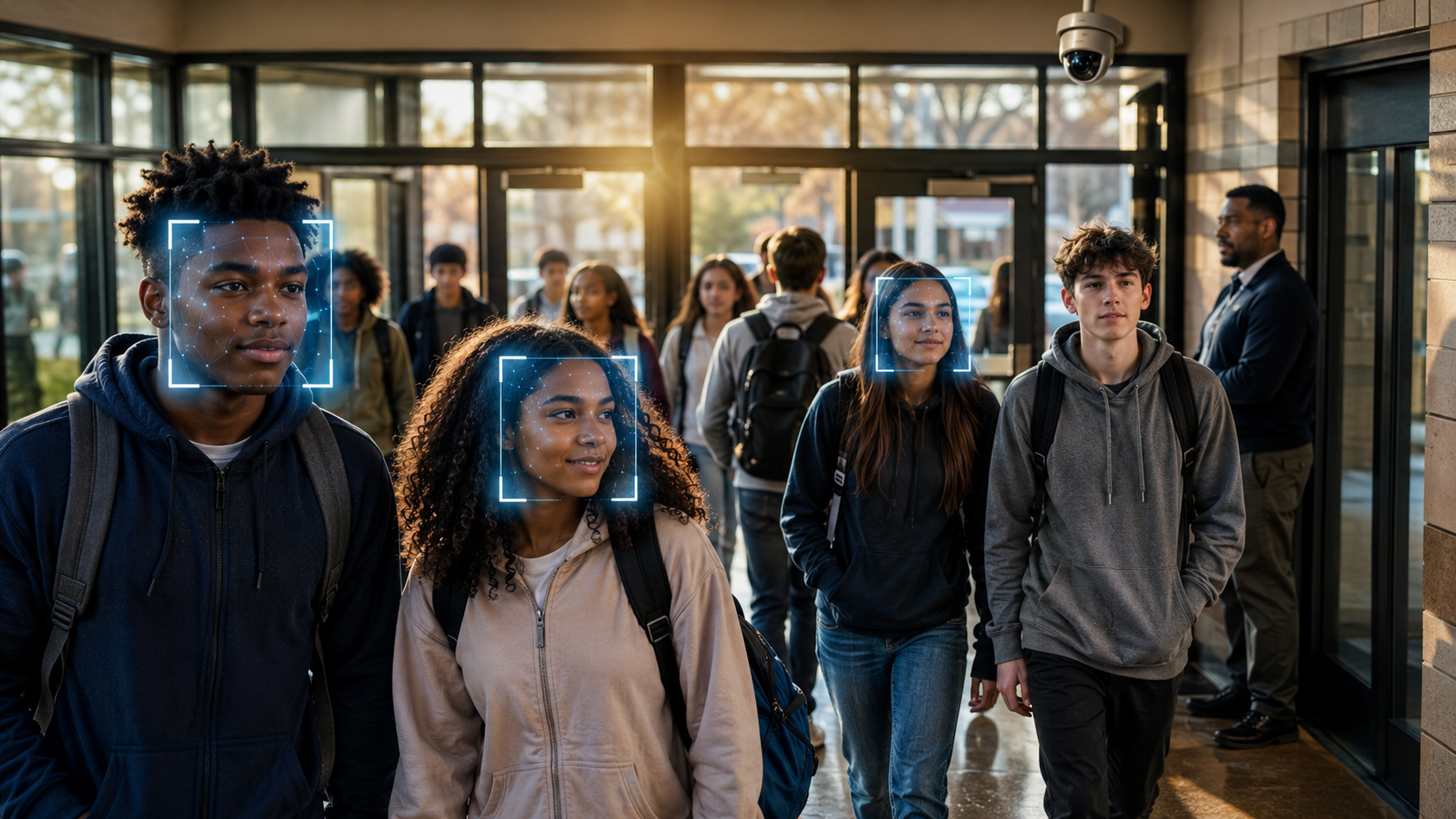
Imagine a student walking into school without swiping an ID card or stopping at the attendance office. A camera recognizes the student and records the arrival. Later, another camera notices that the student never entered third-period English and alerts the office.
Now imagine that same system spotting a person prohibited from entering school property and warning security before the individual reaches a classroom.
One system. Two very different uses. And one difficult question: Does facial recognition belong in schools?
The technology is already moving from possibility to practice. Schools have used it to screen visitors, automate attendance, control building access, verify online test takers, and monitor student movement. Supporters see a faster, more accurate way to manage campuses. Critics see children growing up under a level of surveillance once reserved for airports, casinos, and law enforcement.
Both sides are responding to legitimate concerns. Schools need better attendance data. They need to know who enters their buildings. They also have an obligation to protect student privacy and create an environment where children feel supported—not watched.
The debate should not begin with what the technology can do. It should begin with what schools actually need it to do.
Recording Absenteeism Is Not Reducing It
Facial recognition could make attendance more efficient. Cameras at school entrances might automatically record arrivals, identify late students, and reduce errors caused by manual attendance-taking. Classroom systems could also make it harder for a student to skip class without being noticed.
Those capabilities will appeal to districts struggling with chronic absenteeism. But they address only one part of the problem: documentation.
A camera may produce a more accurate list of absent students. It will not explain why those students are missing.
Chronic absenteeism can be connected to transportation, illness, housing instability, family responsibilities, anxiety, bullying, academic frustration, or a belief that school no longer matters. Even perfect attendance data will not remove those barriers.
The real value would come after the alert. Does someone contact the family? Does a counselor meet with the student? Can the school identify a pattern before missed days become missed weeks?
Facial recognition might tell a school who is absent sooner. Whether that information helps depends entirely on what the adults do next.
When Attendance Becomes Location Tracking
Using facial recognition to record entry into a building is one thing. Using it to follow students between classrooms is another.
A hallway system could identify students who are skipping class, entering restricted areas, or leaving campus without permission. For administrators responsible for hundreds or thousands of students, that may sound like a practical solution.
It would also create a record of where students go throughout the day.
A visit to the counselor, nurse, special education office, or trusted teacher could become part of that record. An inaccurate match could result in a disciplinary referral. A correct match could still turn an ordinary lapse in judgment into a permanent data point.
The concern is not that schools should ignore students who skip class. The concern is what happens when every movement becomes searchable, storable, and potentially punishable.
Researchers Mark Andrejevic and Neil Selwyn warn in “Facial Recognition Technology in Schools: Critical Questions and Concerns” that the technology could shift schools in increasingly authoritarian and oppressive directions. Their argument goes beyond technical accuracy. Surveillance changes how people behave, even when they have done nothing wrong.
A school can maintain order without making students feel as though they are continually under investigation.
The Strongest Case Is at the Front Door
School security presents a more compelling use.
Detroit Public Schools Community District recently installed a facial recognition visitor-management system across its campuses. Visitors provide identification and have their faces scanned before entering. The system verifies whether the visitor matches the photograph on the ID and can flag people who may not be permitted inside.
District officials told Government Technology that the system is more secure than a handwritten sign-in sheet. They also emphasized that visitors are verified against their own identification rather than indiscriminately searched against a large facial database.
That is an important limitation. One-to-one verification asks, “Is this person the individual named on this ID?” One-to-many identification asks, “Who is this person among everyone in our database?” The second use introduces considerably greater risks of misidentification and misuse.
Even then, facial recognition is not a complete school safety strategy.
A watchlist works only when officials already know whom to watch. The technology cannot identify a person who has never been flagged, recognize a developing crisis, or determine someone’s intentions.
A New York State review of biometric technology found little real-world evidence that facial recognition had prevented violent incidents in schools. The report noted that many school attackers have been current students who were authorized to enter the building. In many averted attacks, intervention began because someone heard a threat, saw a concerning post, or told a trusted adult.
Technology may strengthen an entrance. Relationships are more likely to reveal what is happening behind it.
A Face Is Not a Password
Facial recognition data is not an ordinary school record.
Under federal student privacy rules, biometric records—including facial characteristics used for automated identification—are considered personally identifiable information. The U.S. Department of Education specifically includes facial characteristics in its definition.
If a password is compromised, it can be changed. A student cannot replace a face.
That makes vendor practices critical. Districts must know where biometric templates are stored, how they are encrypted, whether subcontractors can access them, how long records are retained, and what happens when a contract ends. They also need firm restrictions preventing the data from being sold, reused to train other systems, or shared with law enforcement without appropriate legal authority.
Accuracy cannot be reduced to a number in a sales presentation. Lighting, camera angle, image quality, age, skin tone, disability, and changes in appearance can affect performance. Children’s faces also change as they grow.
Most important, districts must consider the consequence of an error. A delayed visitor check is inconvenient. A false accusation, police encounter, or disciplinary action can alter a student’s life.
Communities Are Drawing Different Lines
There is no national consensus on where facial recognition belongs in education.
New York concluded that the risks outweighed the potential benefits. In 2023, the state prohibited schools from purchasing or using facial recognition technology.
Elsewhere, adoption is moving faster than regulation. Brazil is considering a legal framework after facial recognition expanded across its schools. More than 1,700 schools in Paraná reportedly use the technology, according to Biometric Update.
These sharply different approaches reveal the real debate. It is not simply whether facial recognition works. It is how much biometric monitoring communities are willing to place around children—and whether families have a meaningful voice before it happens.
Set the Rules Before Installing the Cameras
A narrowly limited visitor-verification system may be defensible when it follows state law, compares one person with one ID, stores minimal information, and requires a staff member to confirm every alert.
Continuous student monitoring deserves a much higher standard.
Before approving it, district leaders should be able to show that the technology addresses a clearly defined problem, performs better than a less intrusive alternative, and produces benefits that can be measured. Families should know what is collected, who can access it, and when it will be deleted. Independent accuracy testing, human review, public reporting, and a contract expiration date should be requirements—not promises left in a vendor presentation.
The wrong question is whether a camera can recognize a student’s face. It can.
The better questions are what decision will be made because it did, who could be harmed if it is wrong, and whether the school can accomplish the same goal without creating a permanent biometric record.
Facial recognition may tell educators who walked through a doorway. It will not explain why a student stopped coming to school, why another is hiding in the hallway, or why someone who appears present every morning feels completely unseen.
Safe schools need secure entrances and reliable information. More than anything, they need adults who know their students well enough to recognize when something is wrong—without needing an algorithm to tell them.
Subscribe to edCircuit to stay up to date on all of our shows, podcasts, news, and thought leadership articles.
More on School Safety