



 EdCircuit Staff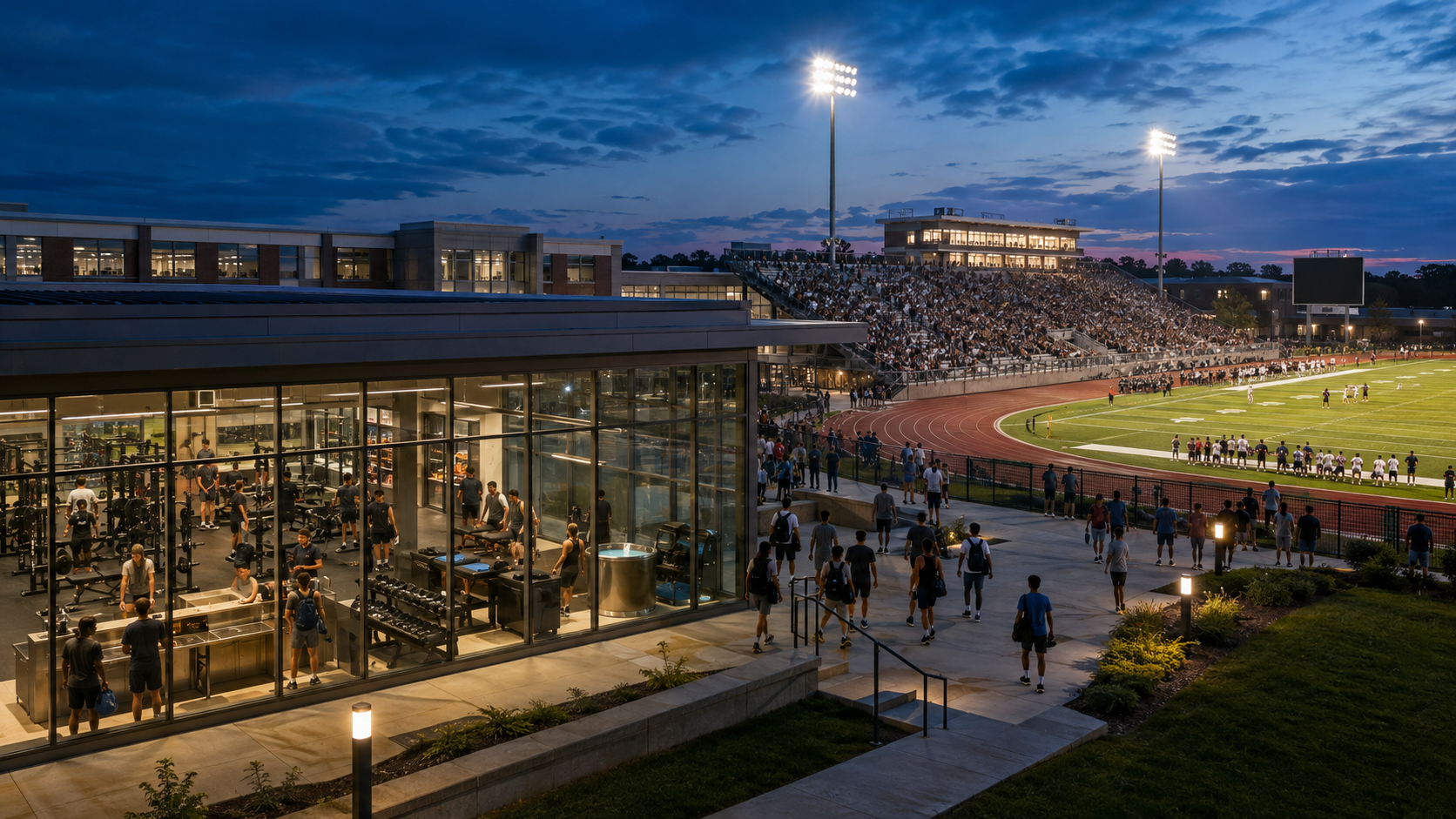
The high school athletics arms race is easy to see on a Friday night. The video board flashes. Music rolls through a stadium packed with thousands of fans. Players leave a college-style locker room, run beneath the lights and take a field surrounded by media booths, premium seating and enough production equipment to make the game feel like a televised event.
The bigger change, however, may be happening before the gates open.
Inside some high schools, athletes now train in expansive weight rooms, recover in hydrotherapy pools, receive treatment in sports-medicine suites and refuel at nutrition stations. Indoor turf fields eliminate weather cancellations. Film rooms and branded hallways sell the identity of the program before an athlete reaches the field. Some of these facilities rival—and occasionally surpass—those found at Division III and smaller Division I colleges.
The teenagers are still playing high school sports. The surroundings say: This is serious. This is where athletes come to compete.
That message has pushed facilities beyond their traditional role. They are now part training center, part community gathering place, and part recruiting and enrollment showcase. The result is a difficult question for school communities: Are these projects responsible investments in health, safety and participation, or signs of a competition that only the wealthiest districts and donor networks can win?
Bigger Than Some College Stadiums
The college comparison is not an exaggeration. Allen ISD’s Eagle Stadium in Texas seats 18,000 spectators. Brown Field at Division I Valparaiso University seats 5,000, while Bailey Memorial Stadium at Division I Presbyterian College seats 6,500. Many Division III venues are smaller still.
Seating capacity alone does not determine the value or extravagance of a project. A district stadium used by several high schools is different from a single-campus facility, and published costs may include parking, roads, utilities, or community event space. Still, the numbers show how far the top end of high school athletics has moved.
| Public project | Reported cost | How it was financed and used |
|---|---|---|
| Allen ISD Eagle Stadium | $59.6 million | Included in a voter-approved 2009 bond package; 18,000 seats and primarily associated with the district’s single large high school at the time. |
| Katy ISD Legacy Stadium | About $72 million | Built through the district’s 2014 bond program; shared by eight high schools when it opened, along with soccer, band and other events. |
| McKinney ISD Stadium and Community Event Center | About $70 million | Funded through bond money approved in 2000 and 2016; built for three district high schools and includes a rentable event center. |
| Prosper ISD proposed second stadium | $94 million | Part of a separate 2023 athletics proposition; voters rejected it while approving the other three propositions in the district’s bond package. |
These are original project figures, not inflation-adjusted totals, and they are not clean side-by-side comparisons. Katy’s venue opened as a shared stadium for eight high schools, while McKinney’s project included a community event center. Scope matters as much as the headline price.
So does age. In 2025, Spring Branch ISD voters approved three athletic-facility propositions totaling $558.6 million across high schools and central venues; the district said the targeted facilities averaged 58 years old. In May 2026, Lufkin ISD voters approved $42 million for a replacement stadium intended to replace a field more than 50 years old.
Old facilities develop real problems, from inaccessible seating and outdated electrical systems to fields that no longer support the number of students using them. The hard decisions begin when necessary replacement grows into a list of premium features.
The Competition Is About More Than Football
Facilities send a message, and school leaders know families are paying attention.
A polished athletic complex appears in social media videos, campus tours, and enrollment materials. It can help retain a successful coach and convince families that student-athletes will receive serious training and care. At private schools and in communities with open-enrollment options, that impression can influence where a family chooses to go.
This is not limited to football. A field house can serve lacrosse, soccer, baseball, softball, track, cheer, marching band, and physical education. A quality strength program can support nearly every sport. An athletic-training room can improve injury care for hundreds of students.
Competitive pressure can turn useful improvements into a cycle. One school opens an indoor facility. A rival announces a larger weight room. Another adds a recovery center or video board. What began as an upgrade becomes the new expectation.
Schools unable to keep pace feel that pressure too. Their athletes may be just as talented and their coaches just as committed, yet worn equipment and limited training space can make the program appear less serious. Facilities can shape participation, coaching stability and public perception—even when they say little about the education students receive.
Public-School Projects: The Taxpayer Has a Vote
Public districts commonly finance major construction through voter-approved bonds. In Texas, where many of the best-known stadium projects are located, the school property-tax system separates daily maintenance-and-operations funding from the interest-and-sinking tax used to repay facility debt. The Texas Education Agency explains that the two revenue streams serve different purposes.
That distinction matters. Bond proceeds generally cannot be moved into the annual account that pays teacher salaries, so the familiar claim that a stadium’s construction dollars could simply have been handed to teachers is usually misleading.
The debt is not free, however. Taxpayers authorize repayment of principal and interest over time. A district may issue bonds without increasing the current tax rate as older debt retires or property values rise, but the obligation remains. Leaders must also consider public confidence when the district later needs money for roofs, buses, classrooms, or security.
Recent votes show that communities do make distinctions. Texas requires certain specialized facilities, including large stadium projects, to appear separately on the ballot. In 2023, Prosper ISD voters approved funding for schools, technology and a performing arts center while rejecting the proposition that included a proposed $94 million stadium.
Public schools also supplement tax dollars with booster-club gifts, education foundations, corporate sponsorships and naming-rights agreements. PlainsCapital Bank agreed to pay Lubbock ISD $3 million over 10 years for stadium naming rights. Academy Sports + Outdoors agreed to pay Katy ISD $2.5 million over 10 years for naming rights to its student-activities complex.
Those agreements produce revenue, but they also place commercial branding inside a public-school experience. Communities should know what a sponsor receives and whether the money pays for construction, maintenance or broader student programs.
Private Schools: Donors Can Change the Timeline
Private schools use a different playbook. They do not ask local voters to approve a school bond. Athletic projects are more likely to move through capital campaigns, major gifts, naming opportunities, reserves or borrowing supported by tuition and fundraising.
That model can move quickly when the right donor steps forward.
Bishop Gorman High School in Las Vegas opened a 41,000-square-foot athletic training center with an 11,500-square-foot weight room, indoor sprint track, hydrotherapy, treatment areas and film space. School officials said donations paid for the facility, although they did not publicly disclose the cost.
In 2025, The Bolles School in Jacksonville announced a $6 million gift toward a $12 million athletic performance center. Its plans include a weight room, hydrotherapy, indoor and covered turf, recovery space and a “Nutrition Zone.”
In Ohio, Padua Franciscan High School launched a $16 million capital campaign covering athletics, performing arts and other priorities. The school reports raising $11.2 million, with $8 million designated for a new athletic center and another $3 million pavilion identified as an additional opportunity.
Private funding removes the direct burden from taxpayers, but not questions about priorities or access. It also creates a transparency difference: public bond costs and repayment structures are usually visible; private donor terms and total project costs may not be.
The private model depends on the giving power of alumni and supporters. One major gift can transform a campus. A school a few miles away may have no comparable path, regardless of need.
A Training Room Is Not a Luxury Suite
It is easy to see a large price and dismiss the entire project as excess. That misses the legitimate student benefits inside many modern facilities.
Athletic trainers need adequate space to evaluate injuries and protect student health. Strength rooms need safe equipment and qualified supervision. Indoor practice areas reduce exposure to lightning, extreme heat and dangerous field conditions. Nutrition stations can help students who leave class and practice for hours without a proper meal.
The amenities can outrun the operating plan. Hydrotherapy equipment needs trained oversight. Nutrition stations must be stocked. Bigger buildings bring utility, insurance and staffing costs long after the ribbon-cutting photos disappear.
Access matters just as much. If a new performance center is marketed as a schoolwide facility, girls’ teams, lower-profile sports, physical-education classes and students with disabilities should be able to use it—not simply fit around the schedule of one prominent program.
When Booster Wealth Becomes an Equity Issue
The arms race can create gaps within the same school system. One booster club may finance equipment, uniforms and facility improvements while another struggles to cover transportation or basic gear.
Public schools cannot hand responsibility for equity to their donors. The U.S. Government Accountability Office notes that booster-club support counts when schools evaluate equal treatment under Title IX. A gift designated for one team does not erase the district’s obligation to provide equitable athletic opportunities and treatment.
Leaders should also look beyond the boys’ and girls’ comparison. Who receives prime practice times? Which students can reach the facility after school? Can band, physical education, youth programs and community groups use it? A shared complex busy throughout the week offers a stronger public return than a showcase built around a handful of home football games.
The Questions Behind the Rendering
Communities do not have to choose between athletics and academics. School sports build belonging, discipline and community identity. Safe fields, sound strength training and appropriate medical care are part of a responsible program.
But an impressive rendering is not a financial plan. Before approving a stadium, field house or performance center, a school should be able to explain:
- What the published price includes—and what it leaves out.
- How many schools, teams, classes and community groups will use the facility.
- What the debt, staffing, utilities, food and maintenance will cost over time.
- How access and equity will be protected when private gifts favor one program.
- What safety or participation problem the project solves, and whether renovation or shared use could solve it for less.
High school athletics has changed, and many aging facilities need to change with it. The issue is not whether athletes deserve good places to train and compete. They do.
The issue is what happens when “good” is measured by the stadium down the road, the private school across town or the latest college-style complex circulating on social media.
The strongest athletic facility is not the one that looks most like a college campus. It is the one a school can afford to operate, every student can benefit from, and the community can still defend years after the Friday-night lights come on.
Subscribe to edCircuit to stay up to date on all of our shows, podcasts, news, and thought leadership articles.
More on K-12


