 EdCircuit Staff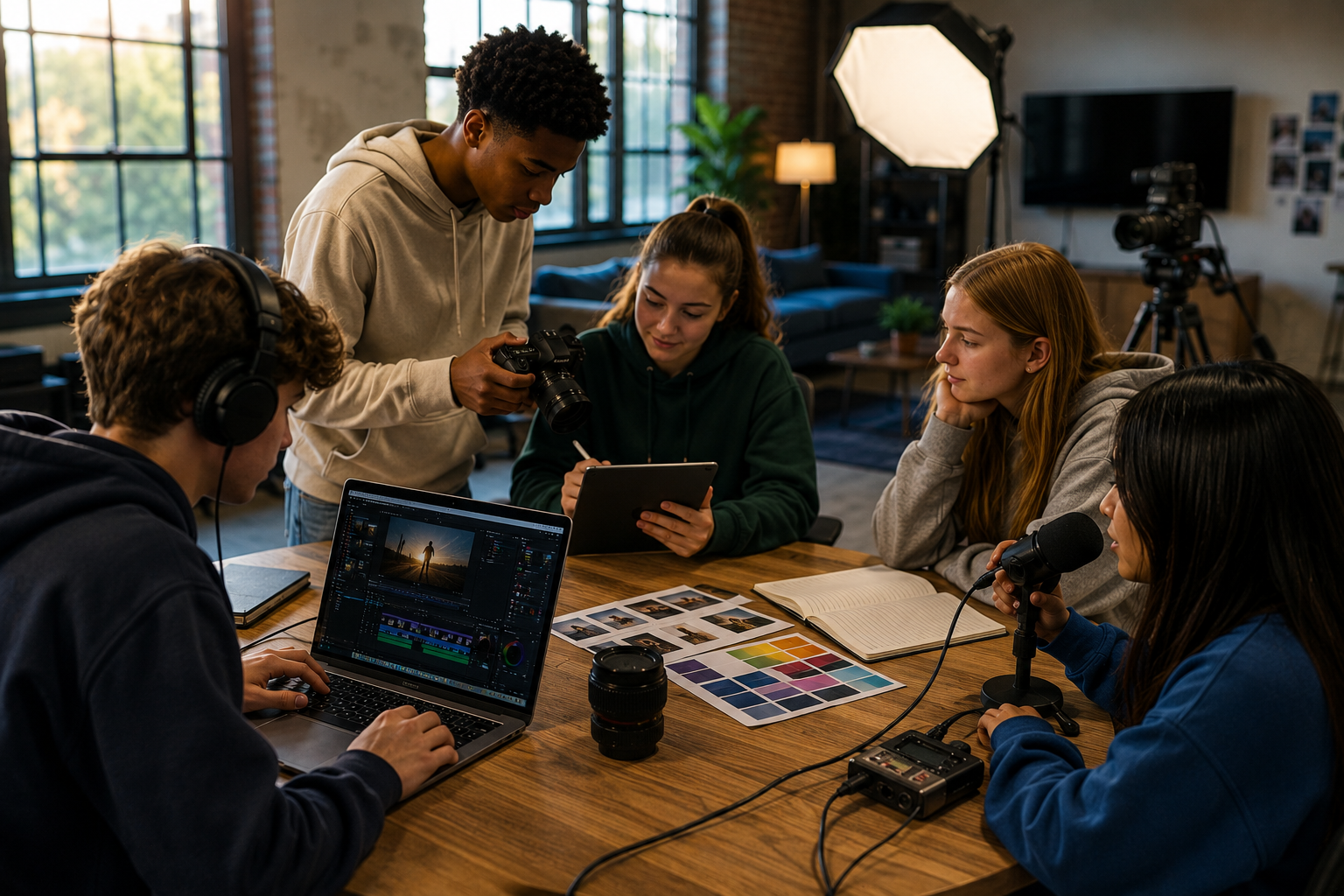
How AI is transforming student media programs is one of the most important shifts happening in education today, as students learn to create content faster while also learning when and how to use these tools responsibly.
Walk into a high school media classroom today, and you will still see cameras, microphones, editing stations, and students working in teams. But look a little closer, and something new is happening.
Artificial intelligence is quietly becoming part of the workflow.
In one classroom, a student records an interview, uploads the audio, and within seconds has a full transcript ready for editing. Another student generates captions for a video before it is even exported. At the same time, a third uses AI tools to clean audio and prepare the final cut—all before the end of the class period.
For many students, AI is not just another tool. It is the first time they realize how quickly they can turn an idea into something real.
AI as a Creative Assistant
In many classrooms, AI is not replacing student work; it is supporting it.
Students use AI tools to transcribe interviews in seconds, turning recorded conversations into editable text. What once took hours can now be done almost instantly. That allows students to spend more time shaping the story rather than simply organizing it.
They also use AI to generate captions for videos, making content more accessible to a wider audience. For schools that serve diverse communities, translation tools are helping students reach viewers who speak different languages.
Audio tools powered by AI can clean up background noise, enhance voice clarity, and improve overall sound quality. Video tools can assist with identifying clips, organizing timelines, and speeding up editing workflows. AI can also support script development, helping students brainstorm ideas, refine structure, and experiment with tone.
These tools are not doing the creative thinking for students.
They are giving students more time to focus on it.
Speed vs. Responsibility
With AI, content can be created faster than ever before.
But speed introduces new challenges.
Students must learn that just because something can be published quickly does not mean it should be. Accuracy, context, and fairness still matter. In some ways, they matter even more.
A caption generated by AI still needs to be reviewed. A transcription still needs to be checked. A script still needs human judgment. Students must ask important questions:
Is this accurate?
Is this fair?
Does this represent the story correctly?
Should this be shared at all?
These are not technical questions.
They are ethical ones.
Media classrooms are becoming spaces where students learn to slow down, think critically, and take responsibility for what they create.
AI and the Evolution of Storytelling
AI is also influencing how stories are told.
Students can now experiment with new formats and approaches. They can quickly test different versions of a video, explore alternative headlines, or adjust pacing and tone with greater flexibility. AI can assist with brainstorming ideas or organizing content, helping students move from concept to execution more efficiently.
But storytelling itself remains deeply human.
The best stories still come from curiosity, empathy, and the ability to ask meaningful questions. AI can help structure a story, but it cannot replace the experience of sitting down with someone, listening carefully, and understanding what matters.
That balance is what media programs are teaching.
Use the tools.
But do not lose the story.
Preparing Students for an AI-Driven World
For today’s students, AI is not a future concept.
It is part of their present.
By learning how to use these tools in a structured environment, students gain an advantage. They are not just consumers of AI—they are learning how to use it thoughtfully and effectively.
This preparation extends beyond media careers.
Students who understand AI will carry that knowledge into business, healthcare, education, engineering, and countless other fields. They will be better equipped to evaluate information, question outputs, and make informed decisions.
In a world where AI-generated content is becoming more common, that ability is critical.
The Role of the Teacher Has Evolved
As AI enters the classroom, the role of the media teacher is evolving as well.
Teachers are no longer just instructors of technical skills. They are guides who help students navigate a rapidly changing landscape. They help students understand when to use AI, when not to use it, and how to maintain authenticity in their work.
They also create space for conversations about ethics.
What happens when AI generates incorrect information?
How do we verify sources?
What does originality mean in an AI-assisted world?
How do we give credit when tools are involved?
These are complex questions, and students need support in exploring them.
A New Layer of Media Literacy
The rise of AI has added a new dimension to media literacy.
Students are not only learning how to create content—they are learning how to evaluate it.
They must consider whether something was created by a human or generated by AI. They must think about bias, accuracy, and intent. They must understand how algorithms influence what people see and how quickly information spreads.
This awareness is essential.
Students are not just the next generation of content creators.
They are the first line of defense in a world filled with information.
Opportunity, Not Replacement
There is often concern that AI will replace human creativity.
Inside high school media classrooms, the opposite is happening.
AI is expanding what students can do.
It allows them to experiment more, produce more, and refine their work more efficiently. It gives them tools that were once only available in professional environments. It opens doors to new forms of storytelling and communication.
But the most important skills remain unchanged.
Creativity.
Curiosity.
Judgment.
Ethics.
Voice.
Those cannot be automated.
The Future Is Already Here
Artificial intelligence will continue to evolve, and so will the way students use it.
New tools will emerge. Workflows will change. Expectations will shift.
But the goal of media education will remain the same: helping students communicate clearly, think critically, and tell stories that matter.
They are not waiting to see how AI will shape the future.
They are already learning how to use it—and how to lead with it.
Subscribe to edCircuit to stay up to date on all of our shows, podcasts, news, and thought leadership articles.