 EdCircuit Staff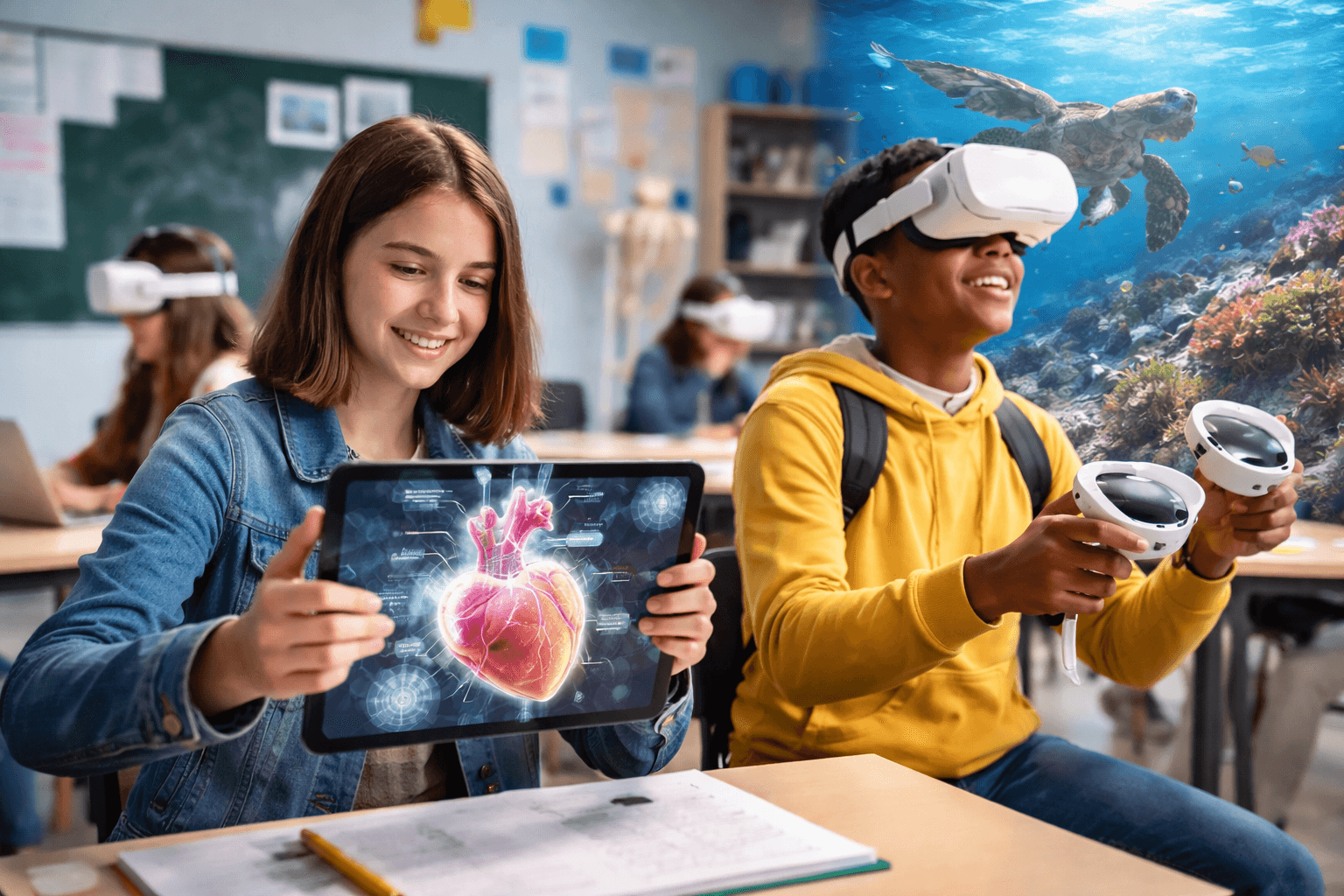
Table of Contents
Immersive Learning is no longer a novelty reserved for occasional demonstrations or special events. In middle and high schools, augmented reality (AR) and virtual reality (VR) are increasingly being used to turn abstract concepts into lived experiences—allowing students to manipulate a 3D heart during anatomy, explore historical environments, or rehearse high-stakes safety procedures before ever touching real equipment.
This shift matters because grades 6–12 sit at a pivotal intersection in a student’s educational journey. Students are developmentally ready for complexity, yet many are still discovering their strengths, interests, and possible career paths. Immersive learning helps bridge that gap by shortening the distance between “learning about” and “learning through,” making instruction more experiential, relevant, and durable.
Understanding AR and VR in K–12 learning
Although often discussed together, AR and VR serve different instructional purposes in middle and high school classrooms.
Augmented Reality (AR) overlays digital content onto the physical world. Students might scan a lab setup and see safety prompts appear, view animated chemical reactions layered onto equipment, or examine labeled anatomical structures over a printed diagram.
Virtual Reality (VR) places students inside a fully simulated environment. They may explore ecosystems, navigate historical settings, practice technical skills, or investigate scientific systems from the inside out.
The value of immersive learning is not the technology itself—it is the instructional leverage it provides. AR and VR help students visualize complex systems, practice procedures safely, and engage with content that would otherwise be inaccessible due to cost, time, safety, or geography.
How immersive learning is changing education inside the classroom
Science becomes experiential, not abstract
Middle and high school science courses often struggle with the same challenges: abstract concepts, limited lab time, safety constraints, and uneven access to equipment. Immersive learning addresses each of these issues in practical ways.
Virtual labs allow students to repeat experiments, test variables, and see outcomes without risk. Instead of watching a demonstration or following rigid lab steps, students can explore cause-and-effect relationships and learn from mistakes. AR tools, meanwhile, help students visualize invisible systems—molecular interactions, anatomical structures, or environmental processes—by placing them directly into the learning space.
For subjects like biology, chemistry, physics, and environmental science, immersive tools deepen conceptual understanding while reinforcing scientific thinking and inquiry skills.
Social studies shifts from recall to understanding
In many middle and high school classrooms, social studies becomes overly text-heavy, emphasizing memorization over meaning. Immersive learning introduces spatial and emotional context that supports deeper understanding.
Through VR, students can explore historical environments, analyze geography in real time, and better grasp how physical spaces, resources, and cultural factors shaped historical decisions. These experiences do not replace primary sources or discussion; instead, they provide a shared context that helps students interpret texts more thoughtfully and ask better questions.
When students feel present in the learning, historical events stop feeling distant and begin to feel connected.
Career and Technical Education (CTE) becomes safer and more accessible
CTE programs stand to gain significantly from immersive learning, particularly at the high school level. Many technical and career-focused skills involve expensive equipment, safety risks, or limited access to real-world environments.
VR allows students to practice procedures, identify hazards, and understand workflows before stepping into a real lab, workshop, or clinical setting. Students can rehearse skills, build confidence, and demonstrate readiness—making immersive learning a powerful complement to hands-on instruction rather than a replacement for it.
For districts expanding CTE pathways, immersive learning provides an equitable on-ramp to career exploration and skill development.
Extending learning beyond the classroom
Immersive learning also expands what is possible outside the traditional classroom environment. Not every student has access to field trips, internships, specialized labs, or travel-based learning experiences. AR and VR help narrow that experience gap by providing exposure to environments and careers students may otherwise never encounter.
For rural districts, under-resourced schools, or students with mobility or scheduling constraints, immersive learning opens doors to exploration and engagement that extend well beyond school walls.
What immersive learning looks like in strong instruction
Effective immersive learning is not defined by devices—it is defined by lesson design. The most impactful middle and high school lessons using AR or VR tend to follow a clear instructional arc:
-
An anchor question or problem grounded in real-world relevance
-
An immersive experience that allows exploration, simulation, or practice
-
Evidence capture, such as observations, screenshots, measurements, or decision logs
-
Sense-making, through discussion, writing, modeling, or argumentation
-
Transfer, where students apply learning to a new scenario or assessment
When immersive experiences are connected to reflection and application, they move from engaging moments to lasting learning.
What district leaders and administrators should plan for
For many schools, the first hurdle isn’t interest—it’s logistics. Scheduling immersive lessons, ensuring adequate bandwidth, managing devices, and carving out professional development time for teachers who are already stretched thin often determine whether AR and VR move beyond pilot programs. Districts that succeed tend to plan for these constraints early, treating immersive learning as an instructional shift rather than an add-on.
Key considerations include:
-
Starting with learning outcomes, not devices
-
Piloting in a small number of courses before scaling
-
Providing teacher training and instructional support, not just hardware
-
Planning for accessibility and student comfort, including alternatives for students who cannot use VR
-
Using immersive tools to support performance-based assessment, not avoid accountability
When implementation is intentional, immersive learning strengthens—not complicates—existing instructional goals.
A shift in how students experience learning
Immersive learning does not replace teachers, textbooks, labs, or field trips. Instead, it amplifies what effective educators already do best: spark curiosity, build understanding, and give students meaningful opportunities to apply knowledge.
For middle and high school students, AR and VR can make learning feel connected to the real world—preparing them not just to pass assessments, but to think critically, solve problems, and imagine themselves in future roles. That is not a gimmick. It is a shift in how students experience learning—and how schools prepare them for what comes next.
Subscribe to edCircuit to stay up to date on all of our shows, podcasts, news, and thought leadership articles.