EdCircuit Staff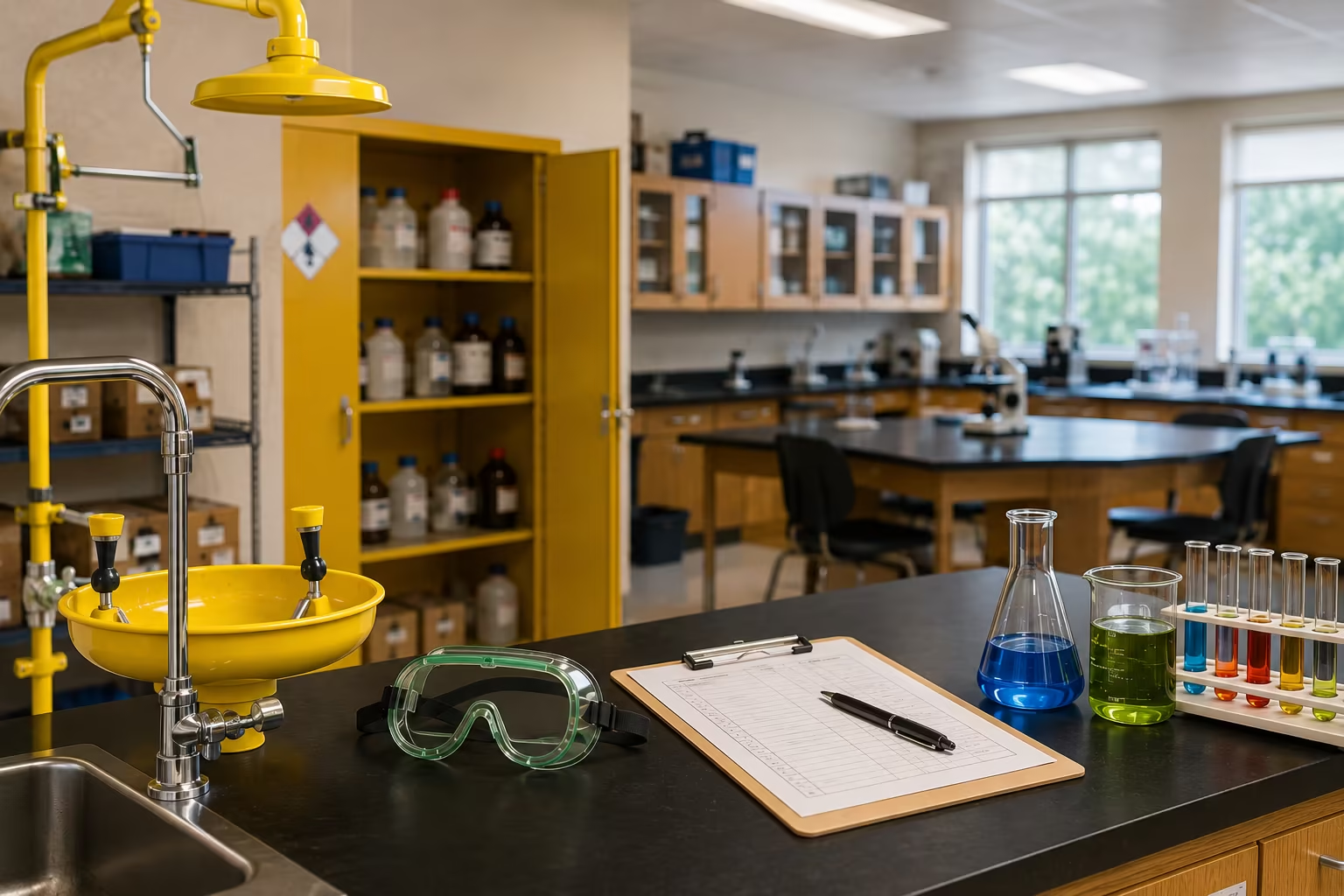
Physical safety inspections are one of the most valuable tools available to schools seeking to create safer science learning environments. While many educators hear the term and immediately think about compliance requirements, checklists, or annual reviews, an effective inspection is much more than an audit. It is an opportunity to see a science laboratory through a different lens—a lens focused entirely on prevention.
Every year, students across the country walk into science classrooms expecting a safe place to learn, experiment, and explore. Teachers conduct demonstrations, students handle laboratory equipment, chemicals are used and stored, and hands-on investigations help bring scientific concepts to life.
Most days pass without incident.
That is exactly the goal.
The challenge is that the conditions that lead to accidents rarely appear overnight. Risks develop gradually. Equipment ages. Storage areas become crowded. Documentation becomes outdated. Emergency equipment becomes overlooked. Small concerns accumulate until one day they become significant problems.
A physical safety inspection helps schools identify those concerns before they contribute to an injury, emergency, or compliance issue.
The most effective inspections are not about finding fault.
They are about protecting people.
Walking Into the Laboratory
Imagine an experienced laboratory safety professional entering a science classroom for an annual inspection.
At first glance, everything looks good.
The room is clean.
Student work is displayed on the walls.
Laboratory tables are organized.
Safety goggles are visible.
Chemical cabinets appear orderly.
Many administrators would walk into the room and conclude that the laboratory is in excellent condition.
But an inspection is designed to look beyond appearances.
The inspector moves toward the eyewash station.
The unit appears functional, but there is no evidence it has been tested recently.
Nearby, boxes of classroom supplies partially obstruct access.
A few steps away, the safety shower is operational, but reaching it quickly during an emergency could prove difficult.
The fire extinguisher is mounted properly, but equipment stored nearby may slow access.
Inside a chemical cabinet, acids and bases have gradually migrated next to one another over the course of several years.
Nothing looks dangerous.
Yet every finding represents a potential weakness in the laboratory safety system.
This is the true value of a physical inspection.
It reveals the difference between looking safe and being safe.
Why Familiarity Can Be Dangerous
One of the most common challenges in laboratory safety is familiarity.
Teachers spend years in the same classrooms.
Laboratory managers see the same storage areas every day.
Facilities teams walk the same hallways repeatedly.
Over time, conditions become normal.
A partially blocked exit no longer attracts attention.
An aging chemical container becomes part of the background.
A damaged label seems insignificant.
A missing inspection tag is easily overlooked.
Human beings naturally adapt to their environments. What once appeared unusual eventually becomes accepted as routine.
This phenomenon is one of the primary reasons annual inspections are so important.
An outside perspective often identifies concerns that have become invisible to those working in the space every day.
The safest schools recognize that fresh eyes can uncover risks before those risks have an opportunity to create harm.
What Inspectors Often Discover
Many educators are surprised to learn that the most common inspection findings are not dramatic.
Inspectors rarely discover catastrophic hazards.
Instead, they find dozens of small issues that collectively increase risk.
Eyewash stations that have not been inspected.
Safety showers blocked by storage materials.
Fire extinguishers hidden behind equipment.
Compressed gas cylinders that are not properly secured.
Chemical containers with deteriorating labels.
Expired chemicals that should have been removed years ago.
Damaged goggles still being used by students.
Emergency contact information that no longer reflects current personnel.
Safety Data Sheet collections that have not been updated.
Chemical inventories that no longer match actual laboratory contents.
Individually, each issue may appear minor.
Collectively, they tell a different story.
They reveal opportunities for improvement.
More importantly, they reveal opportunities for prevention.
Emergency Equipment: The Equipment You Hope You Never Need
Perhaps no area receives more attention during an inspection than emergency equipment.
The reason is simple.
Emergency equipment is designed for the moments nobody wants to experience.
An eyewash station may sit unused for years.
A safety shower may never be activated.
A fire extinguisher may remain untouched throughout its service life.
Yet if an emergency occurs, these systems instantly become critical.
Inspections help verify that emergency equipment is accessible, operational, and ready.
Can a student reach the eyewash station within seconds?
Is the safety shower unobstructed?
Can staff immediately access emergency shutoff controls?
Are spill response materials available?
Would emergency responders be able to navigate the laboratory efficiently?
These questions are not theoretical.
They determine whether safety systems function as intended when every second matters.
Chemical Storage: Behind Closed Doors
If emergency equipment represents the visible side of laboratory safety, chemical storage represents the hidden side.
Some of the most significant inspection findings occur inside storage cabinets and preparation rooms.
Inspectors often discover chemicals that have remained untouched for decades.
Some materials have exceeded their useful life.
Others no longer support the current curriculum.
In some cases, schools inherit chemicals from previous instructors and simply continue storing them without evaluation.
Over time, chemical inventories grow more complex.
Without routine review, even organized storage areas can develop concerns.
Physical inspections help schools answer important questions.
What chemicals do we have?
Why do we have them?
Are they stored appropriately?
Do we still need them?
The answers frequently reveal opportunities to reduce risk while simplifying laboratory management.
Why Chemical Hygiene Officers Matter
The most successful inspection programs rarely rely on a single annual visit.
They are supported by individuals who champion safety throughout the year.
In many schools, this responsibility belongs to a Chemical Hygiene Officer (CHO), science supervisor, laboratory manager, or designated safety coordinator.
These individuals serve as the bridge between inspections and daily operations.
They monitor corrective actions.
Review inventories.
Coordinate training.
Track documentation.
Support compliance efforts.
And ensure that inspection findings lead to meaningful improvements.
Without someone guiding the process, even the best inspections can become forgotten reports sitting on a shelf.
Safety improves when ownership exists.
The strongest laboratory programs understand that inspections are not events.
They are part of an ongoing safety journey.
Safety Is a Leadership Issue
Laboratory safety is often viewed as a responsibility that belongs solely to science teachers.
In reality, effective safety programs require leadership support.
Principals.
Facilities personnel.
Risk managers.
District administrators.
School boards.
Each plays a role in creating safe laboratory environments.
Leadership determines priorities.
Leadership allocates resources.
Leadership establishes expectations.
When school leaders ask questions about inspections, corrective actions, training, and laboratory conditions, safety becomes part of the organizational culture.
When those conversations never occur, important issues can remain unresolved for years.
One of the simplest questions a school leader can ask is also one of the most powerful:
“When was our last laboratory safety inspection?”
The answer often reveals far more than expected.
The Goal Is Not the Inspection
Many schools mistakenly view inspections as the finish line.
They are not.
An inspection is the starting point.
The real value comes from what happens afterward.
Findings must be addressed.
Equipment must be repaired.
Training must be conducted.
Documentation must be updated.
Storage systems must be improved.
Every corrective action strengthens the laboratory environment.
Every improvement reduces risk.
The inspection identifies the path forward.
Progress occurs when schools follow that path.
Building a Culture of Continuous Improvement
The strongest science programs do not wait for problems to force change.
They continuously evaluate their practices.
They ask questions.
They seek feedback.
They embrace inspections as opportunities to learn rather than obligations to endure.
This mindset transforms safety from a compliance activity into a cultural value.
Teachers become more engaged.
Administrators become more informed.
Students benefit from safer learning environments.
The laboratory evolves into a place where innovation and safety support one another rather than compete for attention.
Reading the Story Before the Next Chapter Is Written
Every science laboratory tells a story.
The condition of its equipment, storage systems, emergency resources, documentation, and facilities reveals how effectively safety is being managed.
The question is whether schools are willing to read that story before an incident writes the next chapter.
Physical safety inspections provide that opportunity.
They allow educators to identify risks before injuries occur, correct deficiencies before emergencies arise, and create environments where students can safely explore the wonder of science.
That is the true purpose of an inspection—not to find problems, but to protect people.
Because every student deserves a laboratory where curiosity is encouraged, discovery is celebrated, and safety is never left to chance.
Subscribe to edCircuit to stay up to date on all of our shows, podcasts, news, and thought leadership articles.