 Ian Egan
Table of Contents
Part 1: Why are kids different today?
By Ryan L. Schaaf
 Series Synopsis: Due to continuous digital bombardment and the emergence of the new digital landscape, today’s youth process information, interact, and communicate in fundamentally different ways than any previous generation before them. Meanwhile, many of us, having grown up in a relatively low-tech, stable, and predictable world, are constantly struggling with the speed of change, technological innovation, and the freedom to access the overwhelming sea of information online – all defining characteristics of the digital world of both today and the swiftly-approaching future.
Based on the award-winning book, Reinventing Learning for the Always-On Generation: Strategies and Apps That Work, this 12-part article series will provide a comprehensive profile of nine core learning attributes of digital learners, and the core teaching, learning, and assessment strategies that can be used to appeal to their digital lifestyle and learning preferences. Readers will gain a clear understanding of various research-based strategies to optimize learning for the digital generation in the new digital landscape.
Part 1: Why are Kids Different Today?
“For the digital generations, the past is a foreign country” – Ian Jukes
 Many educators express great concern about their students’ lack of ability to learn the way students did in the past. I especially hear this from teachers who have been in the classroom for a long period of time. Many complain their traditional teaching methods are just not as effective with students in classrooms today as they once were. All of this is creating a groundswell of controversy about current teaching methods and the ability of the digital generations to learn.
Concerns have been expressed about the increasing amounts of time the digital generations engage with their tools. There are those who even suggest that these tools are dumbing down our children and diminishing their ability to think for themselves. While we acknowledge that there are concerns, adults must realize that the children of the digital age use these tools in a manner that goes well beyond the ways we used traditional tools like paper, pencils, or a chalkboard. The challenge we face is understanding how these tools can be leveraged in a manner that interests and engage digital learners.
Kids Today Are Wired Differently
 Two books make a case for just how different today’s always-on generations really are. There is iBrain: Surviving the Technological Alteration of the Modern Mind by neuroscientist Gary Small and there’s Brain Rules: 12 Principles for Surviving and Thriving at Work, Home, and School by molecular biologist John Medina. Small and Medina both conclude that today’s kids are different; really different. Their brain is altered by chronic digital bombardment. Now, we stress the need for balance. The digital generations must learn to engage effectively with both online and offline worlds.
But at the same time, balance goes both ways. In the same way that we – the older generations have every right to expect the digital generations to respect, understand and engage with our world and our values, we must also take the time and effort to respect, understand and engage with their world and their values. What is needed is a balance that acknowledges the realities of the digital online world—that acknowledges that kids are way ahead of us in an understanding of the new digital landscape— and that acknowledges that we have a lot to learn before we can apply our life experiences to safely and effectively guide our students through this new digital world.
A Digital Mindset
 And what type of digital world is it? Every minute of the day, YouTube users watch 4.1 million videos, email users send 156 million messages, Google receives over 3.5 million search queries, 900,00 Facebook users log in, Tinder users swipe almost 1 million times, Twitter users tweet 452,000 times, Instagram users post over 46,000 new photos, Spotify users listen to 40,000 hours of music, Apple and Google users download 342,000 apps, and Pinterest users pin 3,472 images.
According to NASBE, in the United States on average, kids today spend more than 80 hours a week using one, two or more screens simultaneously – as opposed to about 25 hours a week they spend attending school. The digital generations play more than 230 hours of video games a month, or 10,000 hours of gaming by the time they’re 21 years old. If we switch to video, in 2014 YouTube had over 2 trillion playbacks of its videos and every minute more than 100 hours of new video content is added for viewing. Consider that 100 hours a minute is almost 6,500 years of content uploaded every year. A Cisco survey reported that one in three teens indicated that the internet was as important as air, shelter, food and water sources.
The always-on generation goes online to chat with their friends, kill boredom, experience the wider world, and follow the latest trends. They use their devices to meet, play, date and learn. It’s an integral part of their social life. It’s how they acknowledge each other and form their personal identities. Exposure to this new digital landscape may be the first experience in their lives with empowerment. Digital technologies enable them to be heard, recognized and taken seriously.
A New, Digital Culture
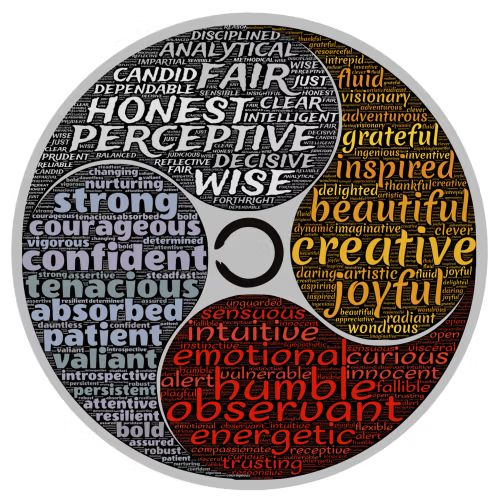 Digital culture is the new normal – not just locally, regionally or nationally, but worldwide. And this new world of digital immersion has affected virtually every aspect of our lives, from our thought processes and work habits to our capacity for linear thinking, to how we feel about ourselves, our friends and even distant strangers.
Digital bombardment is literally wiring and rewiring kids brains on an ongoing basis – and in particular, it’s enhancing their visual memory, visual processing, and visual learning skills. This phenomenon is happening regardless of race, regardless of culture, regardless of socio-economics, and regardless of geography.
In the next installment of the series, we will explore the new learning attributes of the digital generations and outline the rest of the series for readers.
Author
As a professor, author, blogger, consultant, and keynote speaker, Ryan L. Schaaf wants to help educators reach the learners of the digital generations. His book, Reinventing Learning for the Always-On Generation: Strategies and Apps that Work co-authored with Ian Jukes and Nicky Mohan, recently received an IPPY Award for its contributions as a resource book for educators. You can find Ryan at https://myedexpert.com/vendor/rschaaf/.
Follow Ryan Schaaf on Twitter
Further Reading
- EdSurge – How Social Media Can Help Teach Good Writing
- Ideas.TED.com – Forget “digital natives.” Here’s how kids are really using the Internet
- Huffington Post – Adults Must Teach Kids To Use, Not Be Used By, Social Media