



Retiring educators are leaving behind far more than lesson plans, classroom keys, or staff badges. They are closing the chapter on careers that helped shape generations of students while navigating one of the most transformative eras in educational history.
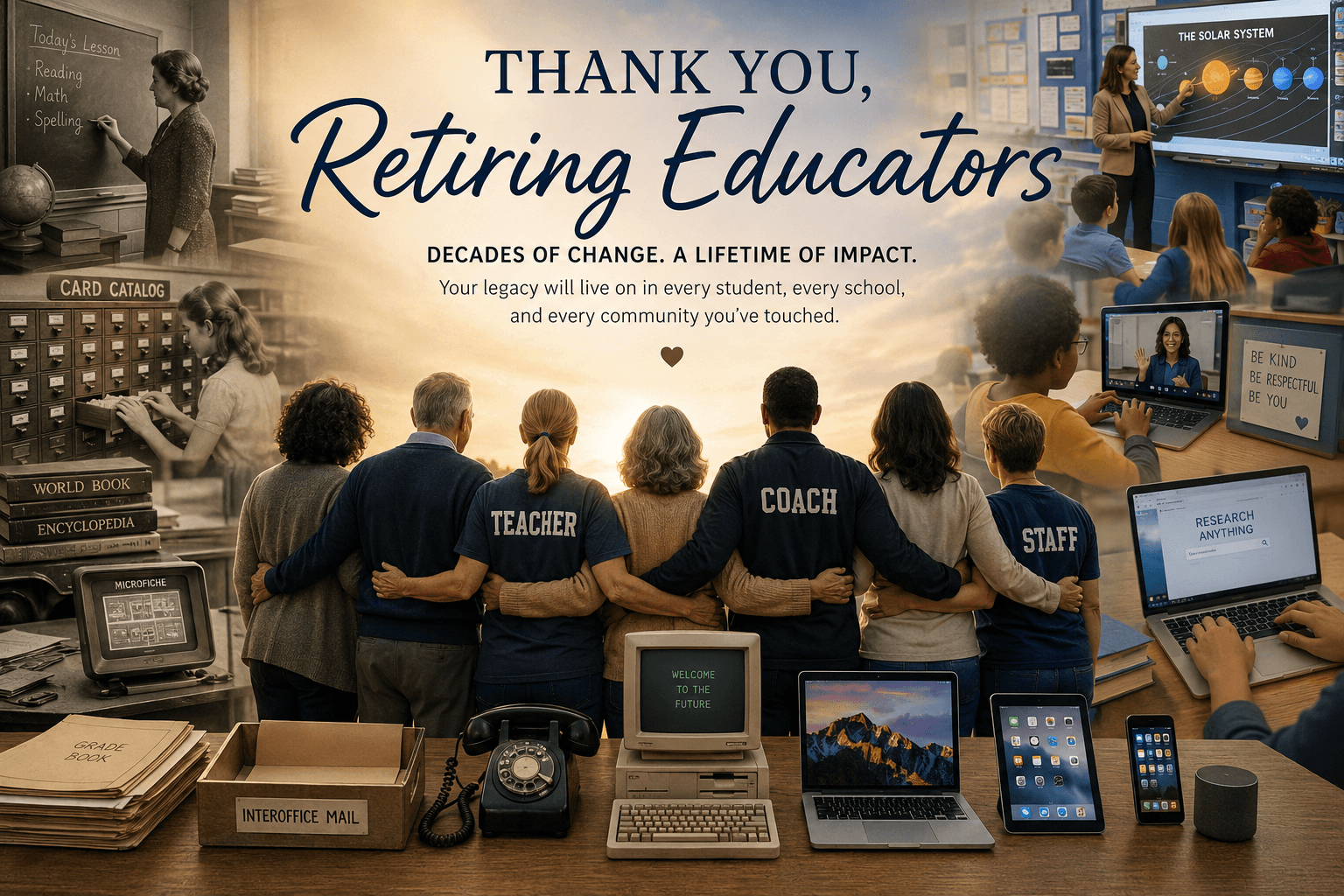
For many educators and school employees retiring this year, their careers began in a completely different world. Attendance was taken by hand. Grades were recorded in paper gradebooks. Overhead projectors represented cutting-edge classroom technology. Interoffice mail trays carried memos across school buildings, and school libraries relied on card catalogs, encyclopedias, microfiche machines, and the Dewey Decimal System to help students conduct research.
Today’s schools look almost unrecognizable by comparison.
Those same educators witnessed the arrival of desktop computers, internet access, email communication, smartboards, laptops, online testing platforms, one-to-one student devices, video conferencing, digital citizenship programs, cybersecurity training, learning management systems, artificial intelligence, and mobile learning.
And through every stage of that transformation, they continued doing the most important work in education: helping students feel safe, supported, challenged, and capable of success.
From Chalkboards to Smartboards
Education is one of the few professions where individuals dedicate decades of their lives not only to mastering their craft but also to constantly reinventing it. Retiring educators did not simply work through change—they adapted to it, learned from it, and often helped lead it.
Many began their careers writing lessons on chalkboards and pulling down classroom maps by hand. Chalk later became dry-erase markers. Film strips became VHS tapes. VHS tapes turned into DVDs. DVDs disappeared into streaming platforms, YouTube clips, and digital learning libraries.
Research papers once required long afternoons inside libraries flipping through encyclopedias and carefully scrolling through microfiche archives. Students today can search the internet in seconds or ask digital assistants like Siri and Alexa for answers instantly.
School librarians experienced one of the greatest transformations of all. Many spent years teaching students how to use card catalogs, alphabetical filing systems, and physical research indexes before transitioning into online databases, digital literacy instruction, internet safety education, and modern search platforms. The role never stopped being important—it simply evolved alongside technology.
Coaches experienced dramatic changes as well. Game film once involved wheeling televisions into classrooms and rewinding VHS tapes repeatedly to scout opponents. Today, coaches analyze digital film instantly, exchange breakdowns online, and use advanced software platforms to evaluate tendencies, statistics, and player development. But the mission remained the same: mentoring young people through teamwork, accountability, resilience, and leadership.
They did not just witness educational transformation.
They helped lead it.
The People Behind the School Day
School secretaries and administrative assistants experienced their own technological revolution inside school offices. Many began their careers handwriting attendance records, maintaining paper student files, scheduling appointments in large desk calendars, sorting stacks of paperwork, and answering constantly ringing landline phones.
Over time, those systems evolved into digital attendance tracking, online scheduling platforms, student information systems, mass notification software, email communication, and real-time parent messaging applications. Yet despite the changing technology, school office staff continued serving as the welcoming face and steady heartbeat of the school building.
School nurses transitioned from paper medication logs and filing cabinets to digital health systems, online medical records, and real-time communication with families and healthcare providers. Cafeteria teams evolved from handwritten lunch counts and cash trays to digital student meal accounts and automated systems.
Bus drivers safely transported generations of students through rain, snow, traffic, and early mornings while learning new routing systems, communication tools, and safety procedures. Custodians adapted to evolving safety expectations, facility technology, and sanitation protocols long before most people realized how important those responsibilities truly were.
Technology departments transformed from maintaining a few desktop computers into managing entire digital ecosystems that support modern learning environments.
Together, these individuals created the foundation that allowed schools to function every single day.
Adapting Through Every Era of Change
Parent communication changed dramatically throughout the careers of retiring educators. Newsletters once folded neatly into backpacks became emails, text alerts, district apps, social media updates, and instant notifications delivered directly to phones within seconds.
Snow day announcements that families once waited to hear on television or radio stations are now posted instantly online. Permission slips became digital forms. Report cards became parent portals. Staff meetings evolved into virtual video conferences.
Technology changed rapidly, but expectations changed even faster.
Retiring educators also experienced enormous societal shifts outside the classroom walls. Expectations surrounding school safety, mental health support, digital citizenship, cybersecurity awareness, student wellness, and social-emotional learning evolved dramatically throughout their careers.
Many educators entering retirement today taught through national tragedies, economic downturns, changing state standards, staffing shortages, evolving testing requirements, and the unprecedented disruption of the COVID-19 pandemic.
That pandemic alone reshaped education forever.
Teachers learned virtual instruction almost overnight. Principals became crisis managers. Technology departments became educational lifelines. School staff distributed meals, solved connectivity issues, supported families remotely, and worked tirelessly to keep students connected to learning during one of the most uncertain periods in modern history.
And through every challenge, educators continued showing up for students.
Technology changed.
Students changed.
Society changed.
But their commitment never did.
More Than a Job
There is something emotional about retirement in education.
The final dismissal bell.
The empty classroom.
The bulletin boards coming down.
The final concert, graduation, science fair, football game, musical performance, or staff meeting.
The final bus duty assignment.
For many educators, schools became a second home. Colleagues became extended family. Students became lifelong memories. Retirement brings excitement and opportunity, but it also carries reflection and emotion because education is never simply “a job.”
It becomes part of a person’s identity.
Ask almost any retired teacher and they can still remember former students decades later. They remember classroom breakthroughs, funny stories, difficult moments, and students who simply needed someone to believe in them.
That lasting impact is what makes education special.
Very few professions allow individuals to directly shape the lives of thousands of young people over the course of a career. Retiring educators helped students learn to read, solve equations, perform music, understand science, write essays, compete in athletics, discover creativity, and build confidence in themselves.
Some inspired future teachers.
Some inspired doctors, engineers, artists, military personnel, entrepreneurs, scientists, and community leaders.
Some simply gave students consistency and kindness during difficult moments in life.
That impact cannot fully be measured through data, test scores, or graduation rates.
It lives inside the lives students eventually build for themselves.
The Generation That Helped Schools Evolve
Future classrooms may include AI-supported learning, augmented reality instruction, advanced robotics, and technologies that do not yet exist. But students will still need trusted adults who encourage them, challenge them, guide them, and believe in their potential.
That human connection is the true legacy retiring educators leave behind.
Their generation helped schools transition from analog to digital.
From chalkboards to smartboards.
From encyclopedias to search engines.
From microfiche to cloud storage.
From handwritten attendance sheets to real-time student information systems.
From landline phones to mobile communication.
From projector transparencies to interactive learning displays.
Yet through every innovation and every challenge, educators continued showing up every morning for students.
That consistency matters.
In a world that constantly changes, schools often remain one of the few stable places in a child’s life. Retiring educators helped preserve that stability for decades.
A Legacy That Will Continue
Their fingerprints are everywhere.
Inside school traditions.
Inside classroom culture.
Inside athletic programs.
Inside music departments.
Inside science labs.
Inside libraries.
Inside school offices.
Inside students who grew into confident adults because someone in a school believed in them.
Retirement may mark the end of a career, but it does not erase the legacy those educators leave behind.
In many ways, their work continues every single day through the students, schools, and communities they helped shape.
To every retiring teacher, principal, counselor, librarian, paraprofessional, bus driver, custodian, secretary, technology specialist, cafeteria worker, coach, and school employee: thank you.
Thank you for adapting.
Thank you for persevering.
Thank you for staying ahead of the curve.
Thank you for helping schools evolve while never losing sight of what mattered most.
And most importantly, thank you for dedicating your life to students.
Subscribe to edCircuit to stay up to date on all of our shows, podcasts, news, and thought leadership articles.
Related reading
More on K-12