
 EdCircuit Staff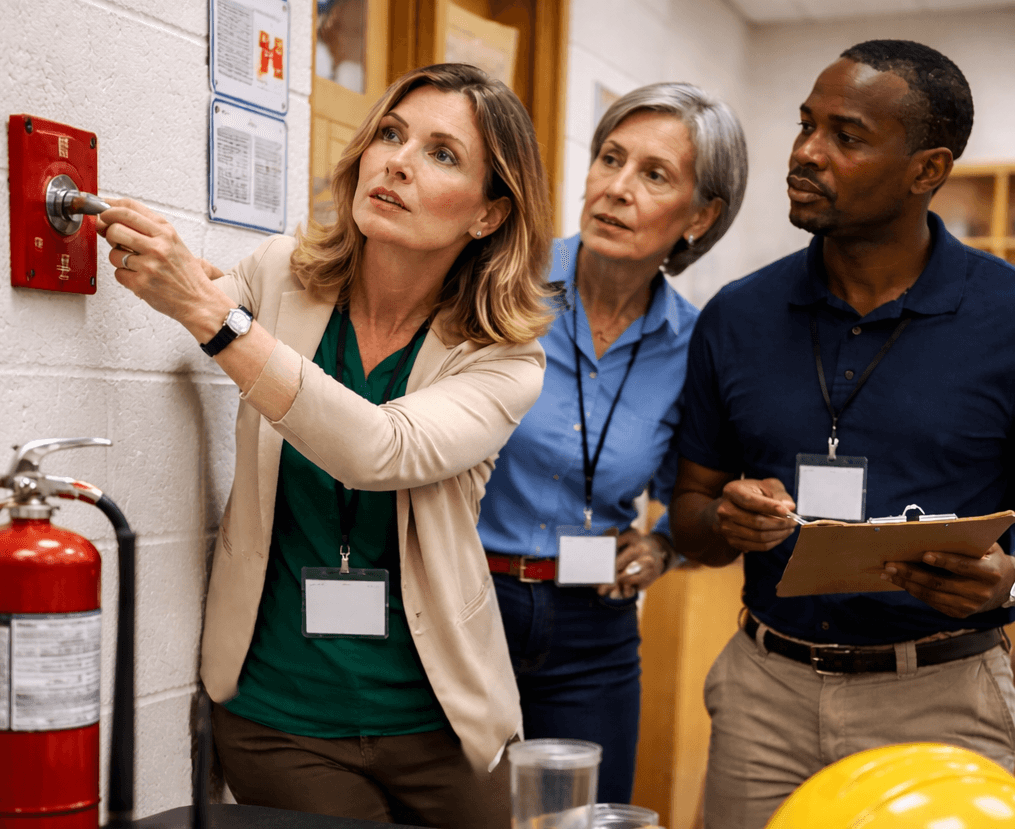
Table of Contents
Safety training determines what happens in the first ten seconds
Safety training is often measured by attendance, completion certificates, and documented compliance. Yet when a real moment unfolds in a lab, makerspace, or CTE classroom, those records do not determine the outcome. What determines the outcome is whether the adults in the room have physically practiced the response in the same environment, under the same conditions, with the same constraints they face every day.
The difference between knowing and doing is where safety lives.
This is the central focus of the latest episode of the Safer Ed Podcast, Training That Sticks: Why Drills and Professional Development Determine Safety Outcomes. The conversation challenges a long-standing assumption in K–12 education: that providing information is the same as building readiness.
It isn’t.
Completion is not competence
Schools have never provided more safety training. Online modules, annual refreshers, policy reviews, and sign-in sheets create the appearance of a complete system. But near-miss data tells a different story. In real classrooms, educators still hesitate, improvise, or rely on the most experienced person in the room to take the first action.
That pattern does not reflect a lack of professionalism—it reflects a mismatch between how training is delivered and how people actually perform under pressure.
In calm environments, adults can describe procedures perfectly. They can identify emergency equipment on a slide. They can pass an assessment. But in a live instructional setting, they are managing behavior, materials, supervision, and time simultaneously. When something unexpected happens, there is no extra space for analysis.
The response must be automatic.
Why spatial fluency matters
Training that changes outcomes always includes a physical component.
Educators must stand where they will stand. Walk the actual exit route. Reach the real shutoff. Navigate the same pathways students use. These are not small details—they are the sensory experiences the brain retrieves during a high-stress moment.
A safety plan reviewed in an auditorium does not prepare a teacher to act in a crowded lab.
A five-minute walkthrough in the actual room does.
That physical familiarity builds confidence, reduces hesitation, and creates coordinated movement. It also reveals obstacles—blocked access points, congested transitions, equipment staged in the wrong location—that written plans cannot capture.
Drills must reflect real conditions
Many drills occur under ideal circumstances: announced in advance, conducted in quiet spaces, and executed without the complexity of active instruction. But incidents do not occur under ideal conditions.
They happen:
-
during cleanup
-
during transitions
-
when multiple activities overlap
-
when supervision is divided
Training that takes place in calm environments prepares people for calm environments. Training in real conditions prepares people for real-world situations.
This shift does not require more time. High-functioning schools embed micro-practice into existing routines: the first two minutes of a lab become a shutdown rehearsal; a staff meeting includes a five-minute scenario tied to a real near miss. Over time, those repetitions create an automatic response.
Role clarity and distributed leadership
One of the most consistent friction points in emergency response is hesitation about who initiates the first action.
Safety plans often assume that everyone will move simultaneously and correctly. In practice, adults look to one another for confirmation. That brief pause changes outcomes.
Training that sticks rehearses leadership as a behavior, not a position. Different staff members initiate responses during drills. Support staff are included. Substitutes receive rapid physical orientation to the room.
This creates distributed competence—a system in which the first critical step can occur immediately, regardless of who is present.
Measuring performance, not participation
Most schools measure training by completion. Effective systems measure execution.
-
How long does it take to begin the first action?
-
Where does movement slow down?
-
Is communication clear and consistent?
-
Can safety equipment be accessed without obstruction?
These are performance indicators. And they are best observed during drills.
When someone watches the process solely to identify friction points, training becomes a diagnostic tool for the entire safety system. A blocked shutoff is not a training failure—it is a layout issue revealed through training. Congestion at an exit is not a behavioral problem—it is a scheduling and space issue.
This is how professional development connects directly to facilities, purchasing, and instructional planning.
The power of the post-drill debrief
The most important learning often happens after the drill ends.
What slowed us down?
What was confusing?
What assumptions didn’t match reality?
When those reflections are documented and revisited, they become institutional memory. As staff, schedules, and spaces change, the organization continues to improve instead of starting over.
Just as importantly, this process builds psychological safety. When educators see that raising concerns leads to system improvements, reporting increases. Silence disappears.
Training builds trust—and trust changes outcomes
In schools where drills are practiced in context and debriefed openly, something shifts. Adults trust each other’s actions because they have seen them before. They trust the system because they have tested it. Students respond more quickly because expectations are consistent across rooms.
Trust reduces hesitation.
Reduced hesitation keeps small incidents from becoming larger ones.
A practical tool for evaluating readiness
One of the most common variables in safety performance is overcrowding. Class size, furniture layout, and equipment storage all affect movement, supervision, and access to emergency systems.
To help schools evaluate that intersection, Science Safety provides a free Occupancy Load Calculator that allows educators and leaders to assess how many people a space can safely accommodate under real-world conditions.
Used alongside drills and walkthrough observations, it turns intuition into evidence and supports informed decisions about scheduling, layout, and program expansion.
You can access the tool here:
https://sciencesafety.com/free-occupancy-load-calculator-tool/
From compliance to capability
Safety outcomes are not determined by the existence of a plan. They are determined by what people can do without hesitation.
Repeated, contextual, and physically practiced training turns written procedures into coordinated action. It transforms near misses into rehearsed responses. And it allows innovation in STEM and CTE spaces to grow without quietly accumulating risk.
In the end, the goal is not more training.
The goal is training that works.
Subscribe to edCircuit to stay up to date on all of our shows, podcasts, news, and thought leadership articles.