 EdCircuit Staff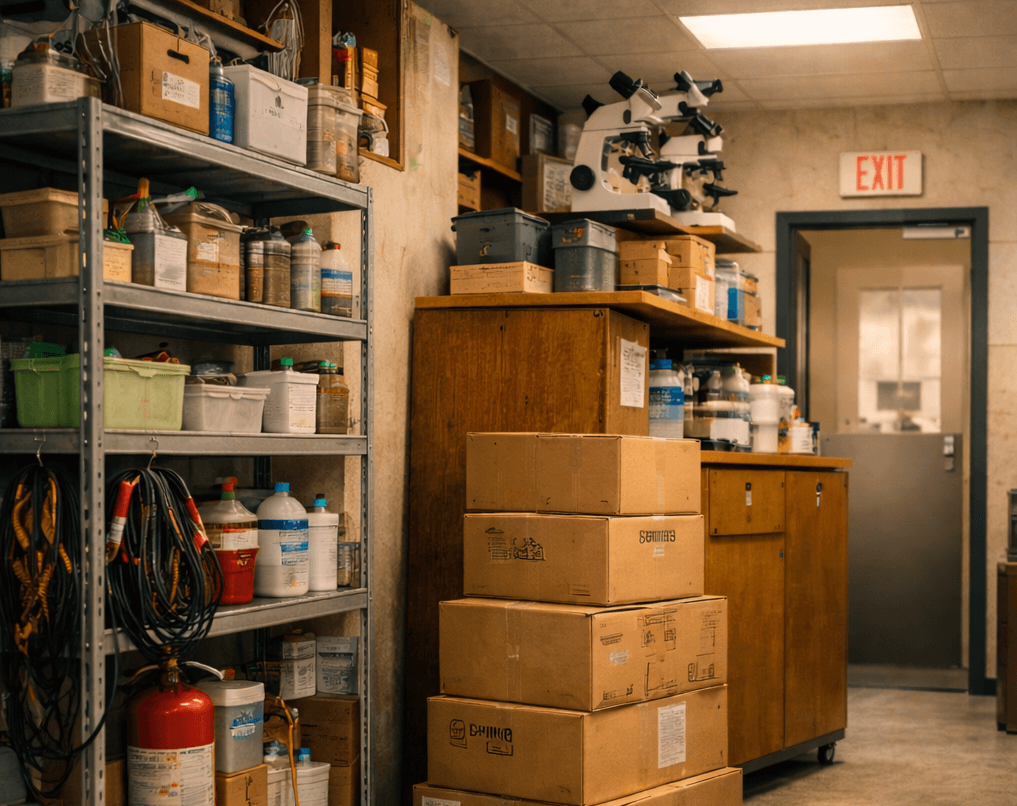
Table of Contents
School equipment safety decisions are made long before a device is unboxed, a lab is stocked, or a CTE pathway launches.
They are made in budget meetings. In vendor selections. In conversations about what a room should be able to handle rather than what it was designed to support.
And by the time new equipment arrives in a classroom, the safety outcome is already built into the system.
That’s the central message of the newest episode of the Safer Ed Podcast, Equipment Decisions Are Safety Decisions: How Purchasing and Storage Shape Risk—and it is a message district leaders, principals, facilities teams, and instructional directors cannot afford to overlook.
Because what looks like a purchasing decision on paper becomes, in practice, a supervision model, a movement pattern, a response-time variable, and an equity issue.
The Hidden Safety System Inside Every Purchase
In most schools, equipment is evaluated through three lenses:
-
Cost
-
Instructional alignment
-
Durability
Safety is assumed to be built in.
But safety is not a product feature—it is a system outcome shaped by:
-
Where the equipment lives
-
How often it moves
-
How quickly it can be accessed
-
Whether it blocks sightlines
-
How it changes student flow
A cart placed in the wrong location can block an emergency shutoff.
A storage cabinet mounted too high changes lifting behavior.
A shared tool station can create congestion, altering supervision.
None of these are discipline issues.
None of these is a teacher failure.
They are design outcomes.
Underused Equipment Is a Safety Signal
One of the most common leadership questions in modern STEM and CTE programs is:
“Why aren’t we using the new equipment more often?”
The answer is rarely instructional.
Equipment goes unused when:
-
setup is not operationally safe
-
retrieval takes too long
-
storage requires lifting or moving other materials
-
supervision becomes difficult
What appears to be an engagement issue is actually an infrastructure misalignment.
When districts begin to recognize underuse as a safety indicator—not a performance problem—they unlock a completely different level of planning.
Storage Design Is Behavior Design
The most overlooked safety question in education is:
Where does this live when it’s not in use?
Storage determines:
-
daily movement
-
cleanup speed
-
lifting patterns
-
access to emergency equipment
-
student clustering
Inconsistent storage from room to room increases cognitive load for staff, slows emergency response, and makes training less effective.
Standardized, intentional storage:
-
builds familiarity
-
reduces decision-making under stress
-
improves supervision
-
protects instructional time
In other words, storage is not about organization—it is about response capability.
The Equity Dimension Most Districts Miss
The same purchasing decision does not produce the same safety outcome in every room.
Large, purpose-built spaces can absorb misalignment.
Smaller or shared spaces cannot.
That means procurement decisions can unintentionally create:
-
unequal safety conditions
-
unequal instructional access
-
unequal program sustainability
When purchasing is aligned with real spatial capacity, districts protect both people and programs.
Why Finance Leaders Should Be in the Safety Conversation
When viewed through a systems lens, safety becomes a fiscal strategy.
Aligned equipment decisions:
-
extend the usable life of existing facilities
-
reduce renovation pressure
-
protect instructional minutes
-
increase program efficiency
Every workaround costs time.
Over the course of a school year, those lost minutes become lost days of learning.
The safest room is also the most efficient room.
The Walkthrough That Changes Everything
On a spreadsheet, everything fits.
In the physical room, you see:
-
reach ranges
-
cabinet swing
-
supervision sightlines
-
pathway congestion
-
emergency access points
That’s why the most effective districts bring:
-
procurement
-
facilities
-
curriculum
-
safety leadership
into the space before a purchase is finalized.
Because the most important question is not:
“Is this approved?”
It is:
“How will this live in the room?”
Planning for Programs That Don’t Exist Yet
STEM and CTE programs evolve faster than buildings.
If equipment is selected only for current use, rooms reach capacity quickly, and safety margins shrink.
But when districts plan five to ten years ahead:
-
The same space supports multiple generations of learning
-
Safety becomes structural instead of reactive
-
Program growth becomes sustainable
This is the difference between innovation that lasts and innovation that outgrows its environment.
A Practical Starting Point for Districts
As equipment, materials, and student enrollment increase, understanding how many learners can safely operate in a space becomes essential.
That’s where tools like the free Science Safety Occupancy Load Calculator provide immediate, actionable insight.
It helps leaders evaluate how:
-
class size
-
layout
-
storage
-
program expansion
intersect with supervision and emergency response—before near misses occur.
From Purchasing to Protection
The most powerful shift a district can make is this:
Stop treating procurement as a transaction.
Start treating it as part of the learning environment.
Because the moment a purchase is approved, it begins shaping:
-
movement
-
visibility
-
behavior
-
response time
-
instructional efficiency
Safety is not added later.
It is designed at the beginning.
Continue the Conversation
This article is based on the latest episode of the Safer Ed Podcast:
Equipment Decisions Are Safety Decisions: How Purchasing and Storage Shape Risk
In the full conversation, we explore:
-
real-world operational friction
-
leadership blind spots
-
system alignment strategies
-
how to turn purchasing into long-term protection
A Message Worth Sharing
If you are a:
-
Superintendent
-
Principal
-
CTE director
-
STEM coordinator
-
Facilities leader
-
Safety officer
This is a conversation to bring to your next planning meeting.
Because the safest schools are not the ones that react fastest.
They are the ones who design their systems early.
Subscribe to edCircuit to stay up to date on all of our shows, podcasts, news, and thought leadership articles.