




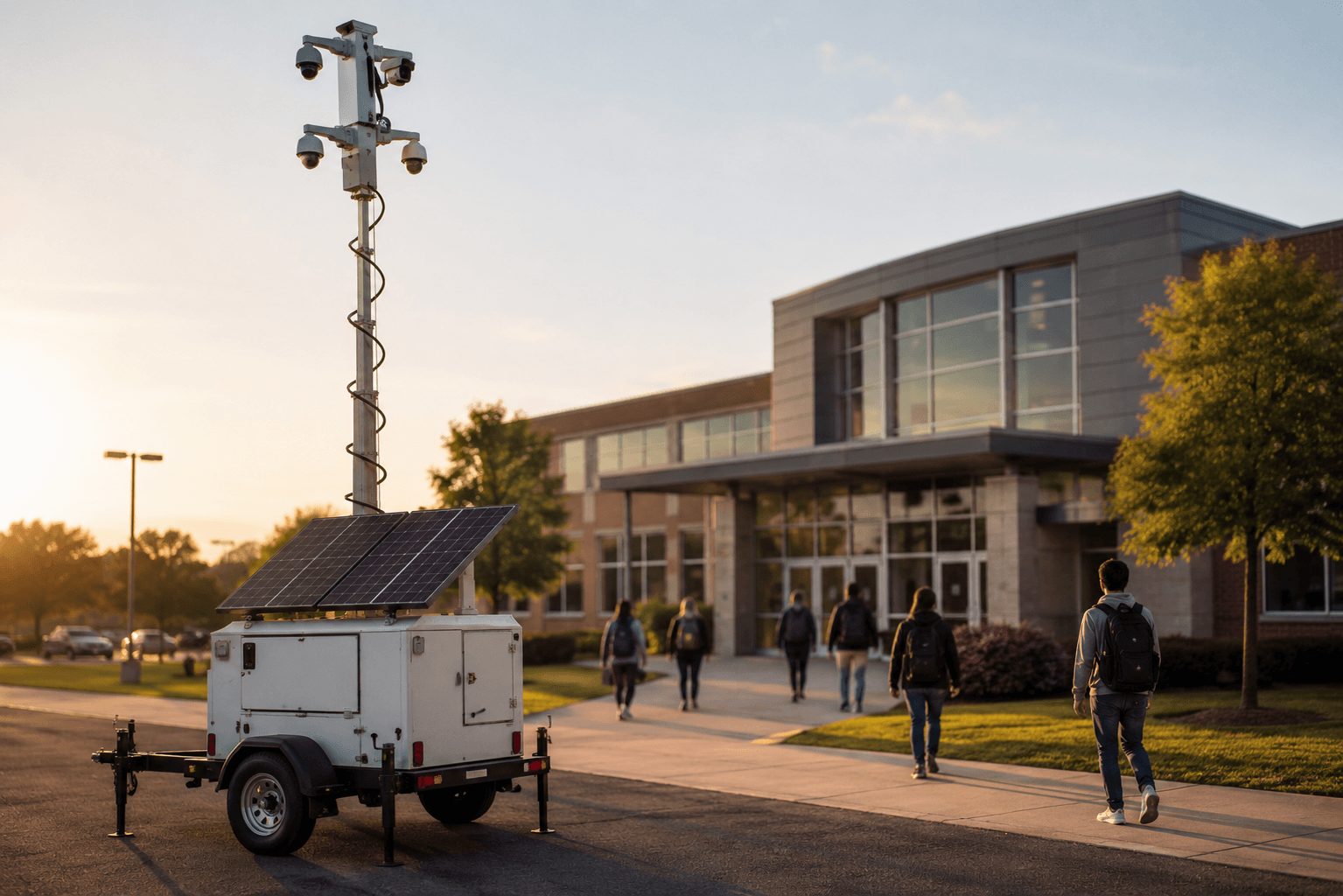
School safety camera trailers are becoming one of the newest visible security measures appearing on K–12 campuses, marking another evolution in how districts approach campus protection, deterrence, and emergency preparedness.
You may expect to see portable camera trailers positioned in mall parking lots, near concert venues, construction sites, or outside professional sporting events. Increasingly, however, these highly visible surveillance towers are beginning to appear on school grounds as districts search for additional ways to strengthen security and deter threats before they escalate.
In Ohio, the Ohio School Safety Center (OSSC) recently announced a new initiative providing mobile camera trailers to schools seeking additional safety precautions. Since launching the effort, the center reports that camera trailers have already been deployed at 13 school events statewide. According to the OSSC, the trailers provide elevated, wide-angle views of outdoor event spaces, allowing school officials and law enforcement to monitor crowd activity, identify potential safety concerns, and respond quickly to incidents.
Ohio schools interested in utilizing the trailers can request them directly through the state’s official program portal. Camera Tower Request Form
The initiative reflects a broader national trend: schools are increasingly adopting layered security strategies that combine physical infrastructure, technology, behavioral threat assessment, communication systems, and community awareness rather than relying on a single solution.
More Than Cameras: Ohio’s Broader School Safety Strategy
The camera trailer initiative is only one piece of Ohio’s larger statewide school safety infrastructure.
Established in 2019, the Ohio School Safety Center was created through a partnership between Ohio Homeland Security and the Ohio Department of Education and Workforce to help schools strengthen prevention, preparedness, response, and recovery efforts related to safety and security.
Since its creation, the OSSC has expanded its role far beyond traditional security planning. Today, the center provides districts with resources related to:
- Behavioral Threat Assessment & Management (BTAM)
- Anonymous reporting systems
- Emergency operations planning
- Safety training and exercises
- School climate initiatives
- Suicide prevention resources
- Emergency response coordination
- Violence prevention strategies
- Mental health awareness
- Safety grants and funding guidance
The camera trailer initiative represents another example of Ohio continuing to expand layered school safety strategies rather than relying solely on reactive approaches after incidents occur.
As school safety challenges continue evolving nationally, programs like Ohio’s may offer a framework other states could study when building coordinated statewide safety support systems for districts.
The Rise of Visible Security Measures
Unlike traditional fixed surveillance cameras mounted on buildings, portable camera trailers are intentionally designed to be seen.
Many feature elevated telescoping poles, multiple high-definition cameras, flashing lights, solar panels, loudspeakers, and live-feed monitoring capabilities. Their size and visibility are part of the strategy. In many cases, the goal is not only to capture evidence but to prevent incidents from happening in the first place.
Security experts often describe visible surveillance as a “deterrence multiplier.” The logic is straightforward: individuals considering theft, vandalism, violence, or unauthorized access may reconsider when they know their actions are highly visible and potentially being monitored in real time.
For schools, that visibility can be especially important during:
- Athletic events
- Graduation ceremonies
- After-school activities
- Summer programming
- Parking lot monitoring
- Temporary security situations
- Construction projects
- Campus renovations
- Outdoor gathering areas
- Remote athletic or practice fields
That last category may become increasingly important for districts during the summer months.
Many school campuses include baseball diamonds, practice fields, maintenance buildings, storage facilities, or remote athletic spaces located far from the main building and outside the visibility range of traditional parking lot cameras. Portable camera trailers can now be temporarily positioned in those locations to provide additional monitoring during summer break, construction periods, camps, or large outdoor events.
For districts managing sprawling campuses, flexibility may become one of the biggest advantages of mobile surveillance systems.

WBNS 10TV – Mobile camera trailers offered for free to schools looking to deter violence (Play video)
A Growing Connection to Behavioral Threat Assessment & Management
One of the most important conversations surrounding security technology today is how it connects to Behavioral Threat Assessment & Management (BTAM).
Behavioral Threat Assessment & Management is not about predicting violence based on stereotypes or appearances. Instead, BTAM focuses on identifying concerning behaviors, patterns, communications, or escalating actions that may indicate someone is moving toward a pathway to violence.
Many districts now use multidisciplinary threat assessment teams composed of administrators, school resource officers, counselors, psychologists, and other trained personnel to evaluate concerning situations before they become emergencies.
Visible security infrastructure, including portable camera trailers, can support these efforts in several ways.
First, camera systems may help document behavioral patterns or incidents occurring around campus entrances, parking lots, or gathering spaces. Second, they may provide additional situational awareness during an active investigation or safety concern. Third, their presence alone may discourage escalation by reinforcing that campuses are actively monitored environments.
Importantly, security professionals repeatedly emphasize that technology should never replace human relationships, student support systems, or mental health intervention. Instead, technology functions as one component within a larger safety ecosystem.
That distinction matters.
A camera trailer cannot identify a student in crisis on its own. It cannot replace a counselor, trusted teacher, or behavioral intervention specialist. But it can provide additional visibility during moments where rapid awareness becomes critical.
The Question Many Families Will Ask: Who Is Watching?
As schools adopt more visible security technologies, questions surrounding privacy and monitoring are inevitable.
Some parents and students may initially feel uncomfortable seeing surveillance towers positioned near school entrances or parking lots. Others may question who has access to footage, whether monitoring occurs in real time, and how long recordings are retained.
Those concerns are not unusual.
The reality is that most school campuses already operate extensive surveillance systems. Fixed cameras are now common in hallways, entrances, buses, cafeterias, athletic facilities, and parking lots across the country.
Portable camera trailers expand that visibility outward, particularly in areas where fixed infrastructure may not exist.
Still, transparency becomes essential.
District leaders implementing these systems will likely need clear communication strategies that explain:
- Why the technology is being used
- When the trailers will be deployed
- Who monitors the systems
- How footage is stored
- What policies govern access
- How long recordings are retained
- How student privacy protections are maintained
Without clear communication, schools risk creating confusion or distrust around safety initiatives that are intended to reassure communities.
Many districts may also need to establish policies clarifying whether trailers are monitored continuously in real time or used primarily for recording and investigative purposes.
That operational detail matters significantly.
A district with 24/7 active monitoring capabilities requires staffing, training, and clear response procedures. A district using trailers primarily as a deterrent and evidence collection tool faces a different set of operational considerations.
At the same time, school leaders may need to acknowledge a growing generational reality: today’s students are growing up in increasingly monitored environments. From smartphones and public venues to buses, retail stores, and digital platforms, surveillance technology has become deeply integrated into daily life.
For some families, visible camera towers may feel reassuring. For others, they may raise concerns about whether schools are beginning to resemble highly monitored public spaces rather than traditional learning environments.
How districts communicate intent, transparency, and policy may ultimately shape community perception more than the technology itself.
School Safety Is Increasingly About Layered Protection
One of the most important realities in modern school safety is that no single product, system, or strategy can fully secure a campus.
Experts increasingly describe effective school safety as “layered security,” where multiple systems work together to reduce vulnerabilities and improve response capabilities.
Those layers may include:
- Visitor management systems
- Controlled entry access
- Behavioral threat assessment teams
- Emergency communication systems
- School resource officers
- Mental health supports
- Anonymous reporting platforms
- Surveillance systems
- Safety drills and training
- AI-assisted monitoring tools
- Community partnerships
Portable camera trailers fit within that layered framework.
For some districts, they may provide flexible temporary coverage during events or construction. For others, they may serve as supplemental deterrence in areas with limited camera infrastructure. Rural districts, in particular, may find portable systems useful because they can be repositioned based on changing needs.
The mobility factor is significant.
Unlike permanent surveillance installations requiring major infrastructure investment, portable systems can often be deployed rapidly and moved as circumstances change.
The Future of School Surveillance May Be Smarter
As school safety technology evolves, portable camera systems may eventually become part of larger integrated safety ecosystems powered by artificial intelligence and advanced analytics.
Some modern surveillance systems are already capable of identifying unusual movement patterns, unauthorized access attempts, perimeter breaches, or abandoned objects. Other emerging technologies include audio detection systems capable of recognizing gunshots, aggressive behavior, or emergency keywords.
Some security platforms are also exploring integrations with:
- AI-assisted anomaly detection
- License plate recognition systems
- Emergency response coordination tools
- Automated alert systems
- Real-time mapping platforms
- Unified command centers
These developments also raise important ethical and operational questions.
How much monitoring is appropriate on school grounds? Who controls access to data? What role should AI play in interpreting student behavior? And how can districts balance safety innovation while maintaining trust and privacy?
Those conversations are likely to accelerate as technology becomes more advanced and more visible on campuses.
Other States and Districts Are Watching Closely
Ohio is not alone in exploring visible mobile surveillance technology for school environments.
Across the country, districts and municipalities are increasingly experimenting with portable security systems for public spaces, events, and educational settings. Security companies promoting these systems often highlight their ability to provide temporary coverage, improve visibility, and support emergency response coordination.
Some districts have already deployed similar systems during:
- Football games
- State tournaments
- School fairs and festivals
- Summer school operations
- Temporary campus expansions
- Security incidents requiring increased monitoring
As school safety conversations continue evolving, other states may watch Ohio’s rollout closely to evaluate effectiveness, community response, operational costs, and overall deterrence impact.
The visibility of the program itself may also influence adoption.
When communities begin seeing these trailers positioned outside schools, conversations around surveillance, campus protection, and proactive safety planning are likely to increase.
The Balance Between Security and School Climate
One of the ongoing challenges facing school leaders is balancing visible security with maintaining a welcoming educational environment.
Too little security can create concern among families who expect schools to proactively protect students and staff.
Too much visible security, however, can create fears that campuses feel overly hardened or institutionalized.
Districts must navigate that balance carefully.
How a trailer is deployed, communicated, and integrated into broader safety culture matters just as much as the technology itself.
Schools that frame security within a broader message of student well-being, preparedness, and community protection may find stronger public support than districts that rely solely on fear-based messaging.
Ultimately, the goal is not to make schools feel like fortified facilities.
The goal is to create environments where students, educators, and families feel safe enough to focus on learning.
The sight of camera trailers on school campuses may once have seemed unimaginable, but for many districts navigating modern safety challenges, visible deterrence is quickly becoming part of the new educational landscape.
Subscribe to edCircuit to stay up to date on all of our shows, podcasts, news, and thought leadership articles.
Related reading
More on School Safety
 EdCircuit Staff: AuthorView all posts
edCircuit is a mission-based organization entirely focused on the K-20 EdTech Industry and emPowering the voices that can provide guidance and expertise in facilitating the appropriate usage of digital technology in education. Our goal is to elevate the voices of today’s innovative thought leaders and edtech experts. Subscribe to receive notifications in your inbox