 EdCircuit Staff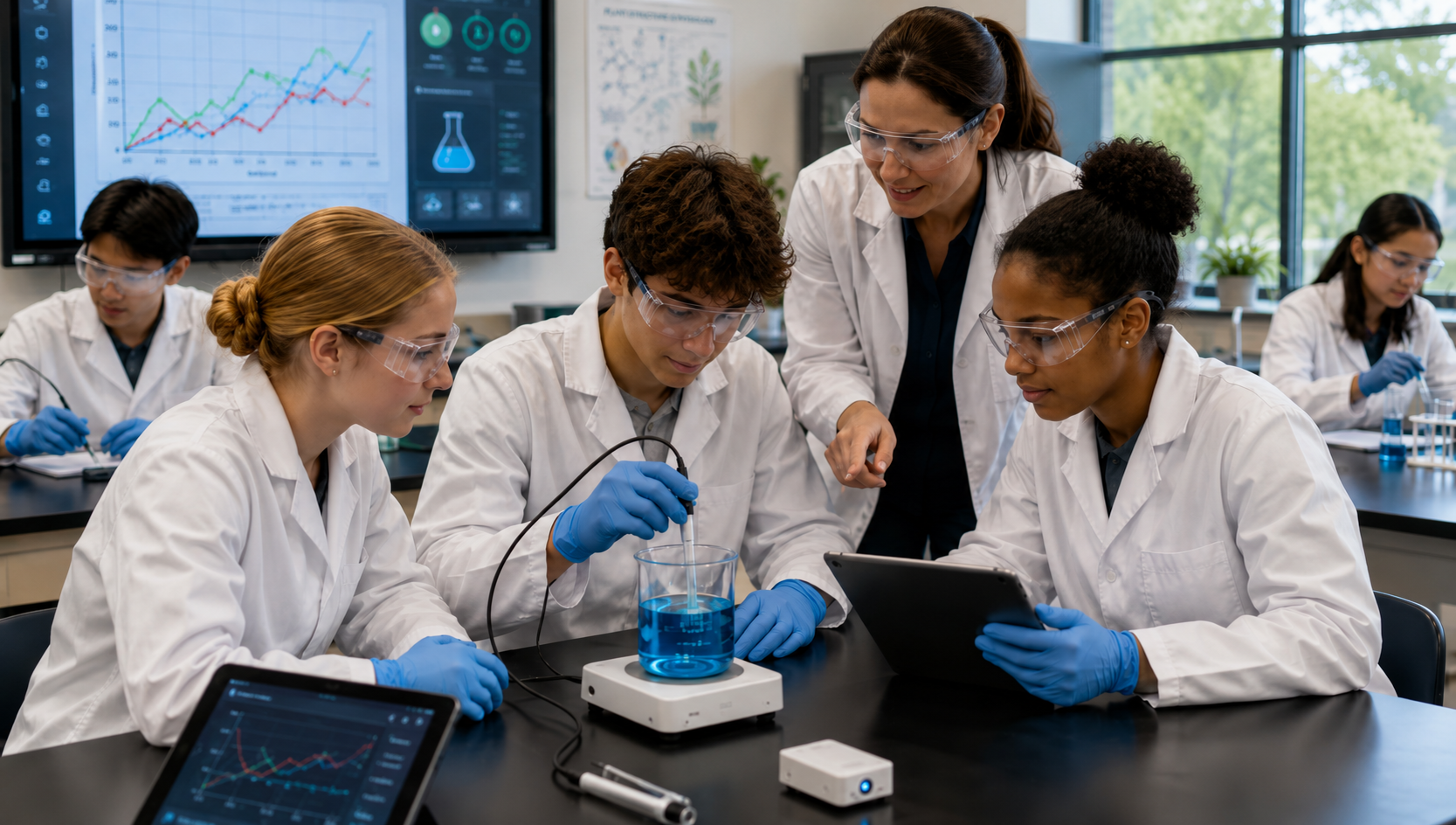
Science classrooms are becoming more technology-driven, and the transformation is reshaping nearly every aspect of teaching, learning, laboratory safety, and student preparation for future careers.
A student walks into chemistry class in 2026. Before touching a beaker, she has already completed a digital safety assessment through the school’s learning management system. She watched a laboratory demonstration video the night before, reviewed an interactive simulation of the experiment, and received AI-generated feedback on her pre-lab questions.
As she begins collecting data, wireless sensors automatically record temperature changes and transmit information to her tablet. Her lab group collaborates on a shared digital notebook while an AI assistant helps identify patterns in their results.
For many schools, this is no longer a vision of the future.
It is becoming the new normal.
The modern science classroom is evolving rapidly, driven by technologies that improve safety, increase engagement, personalize learning, streamline teacher workloads, and prepare students for careers that increasingly depend on digital tools and scientific innovation.
The science classroom of today looks dramatically different from the science classroom of a decade ago—and that change is accelerating.
The Science Classroom Then and Now
The shift becomes even more apparent when educators compare how science instruction was commonly delivered fifteen years ago.
The Science Classroom of 2010
- Paper safety contracts
- Printed lab manuals
- Handwritten lab reports
- Physical binders containing safety information
- Manual chemical inventories
- Traditional lectures before experiments
- Limited access to simulations
- One-size-fits-all instruction
The Science Classroom of 2026
- Digital safety training and assessments
- Interactive learning management systems
- AI-assisted learning tools
- Electronic laboratory notebooks
- Digital chemical inventory systems
- Virtual and augmented reality experiences
- Real-time data collection sensors
- Personalized learning pathways
The goal of science education has not changed. Students still need to develop curiosity, problem-solving skills, scientific reasoning, and a deep understanding of the natural world.
The tools used to achieve those goals, however, have changed dramatically.
Schools that embrace these innovations are creating learning experiences that more closely resemble how science is practiced in universities, research institutions, hospitals, engineering firms, and laboratories around the world.
Technology Is Making Science Labs Safer Than Ever
One of the most important drivers behind technology adoption in science education is safety.
Laboratory safety has always been a cornerstone of quality science instruction, but many schools still rely on processes that have remained largely unchanged for decades.
Paper contracts become lost.
Training records become difficult to locate.
Chemical inventories become outdated.
Inspection reports sit in filing cabinets.
Technology is changing that reality.
Today’s science programs increasingly utilize:
- Digital safety contracts
- Online laboratory safety training
- Electronic chemical inventories
- QR code access to Safety Data Sheets (SDS)
- Digital inspection platforms
- Incident reporting software
- Equipment tracking systems
- Laboratory compliance dashboards
The result is greater accountability, stronger documentation, and improved oversight.
Teachers can quickly verify student training records. Administrators can review compliance documentation. Safety information becomes accessible within seconds rather than minutes.
More importantly, technology helps districts demonstrate their commitment to duty of care.
As expectations surrounding laboratory safety continue to grow, digital systems provide a level of transparency and consistency that traditional paper-based systems struggle to match.
The smart science laboratory is no longer a luxury.
It is becoming an expectation.
Learning Management Systems Are Transforming Lab Preparation
One of the most significant changes occurring in science education happens before students ever enter the laboratory.
Traditionally, lab preparation occurred during class. Teachers would spend valuable instructional time reviewing procedures, explaining hazards, and discussing expectations.
Today, learning management systems have changed the process entirely.
Students can prepare before class through:
- Instructional videos
- Interactive modules
- Digital safety training
- Pre-laboratory assessments
- Virtual demonstrations
- Guided review activities
This approach creates a more efficient and effective laboratory experience.
Students arrive prepared.
Teachers spend less time explaining procedures.
Class time can focus on inquiry, analysis, problem-solving, and discussion.
Schools are discovering that students who complete digital pre-lab preparation often demonstrate stronger understanding, improved confidence, and safer laboratory behaviors.
In many ways, the laboratory period itself has become more productive because preparation occurs before students walk through the door.
Artificial Intelligence Is Becoming the New Science Assistant
Few technologies have generated as much attention in education as artificial intelligence.
While much of the public conversation focuses on concerns about cheating, science educators are increasingly discovering productive ways to leverage AI to improve learning.
AI can support students by:
- Explaining difficult concepts
- Generating study materials
- Providing personalized tutoring
- Assisting with scientific writing
- Offering feedback on laboratory reports
- Supporting multilingual learners
Science teachers are using AI to:
- Create differentiated assignments
- Develop laboratory scenarios
- Generate discussion questions
- Build assessments
- Create review materials
- Support individualized instruction
Perhaps most importantly, AI allows educators to spend less time creating resources and more time engaging directly with students.
The most effective schools are not using AI to replace scientific thinking.
They are using AI to enhance it.
Students still need to evaluate evidence, analyze results, identify bias, question assumptions, and develop conclusions.
Those skills remain uniquely human.
AI simply provides another tool within the scientific toolkit.
Technology Is Giving Science Teachers Their Time Back
Teacher workload remains one of the greatest challenges facing education.
Science teachers face unique demands.
Beyond lesson planning and grading, they often manage laboratories, chemical inventories, safety documentation, equipment maintenance, and regulatory compliance.
Technology is helping alleviate some of these burdens.
Automation now supports:
- Assessment grading
- Assignment collection
- Attendance tracking
- Safety documentation
- Inventory management
- Student progress monitoring
- Communication with families
Instead of spending hours managing paperwork, educators can devote more time to instructional design, student support, and laboratory experiences.
This shift matters.
When teachers spend less time on administrative tasks, students benefit.
Technology is not replacing teachers.
It is helping them focus on the work that matters most.
Real-Time Data Collection Is Making Science More Authentic
Modern science relies heavily on data.
Fortunately, today’s classrooms increasingly mirror that reality.
Digital sensors and probes allow students to collect and analyze data in real time.
Students can measure:
- Temperature
- pH
- Motion
- Light intensity
- Dissolved oxygen
- Force
- Pressure
- Environmental conditions
Wireless technologies instantly display results and generate graphs.
Students spend less time recording measurements and more time interpreting information.
The learning becomes deeper.
The analysis becomes richer.
Most importantly, students begin thinking like scientists rather than simply following laboratory procedures.
Virtual Labs and Simulations Are Expanding Opportunity
Not every scientific experience can occur safely or affordably within a traditional classroom.
Technology helps bridge that gap.
Virtual laboratories allow students to:
- Conduct chemistry experiments safely
- Explore molecular structures
- Model ecosystems
- Simulate engineering challenges
- Investigate genetics
- Explore astronomical events
These experiences do not replace hands-on learning.
They enhance it.
Students can practice procedures, repeat experiments, test variables, and explore scenarios that would otherwise be impossible.
For rural districts, small schools, and budget-conscious programs, virtual labs provide access to learning opportunities that previously may have been unavailable.
Technology Is Preparing Students for Modern Safer STEM Careers
The future workforce will be built on technology.
Students pursuing careers in healthcare, biotechnology, engineering, environmental science, research, computer science, and manufacturing will enter environments rich with digital tools.
Employers increasingly seek graduates who can:
- Analyze data
- Collaborate digitally
- Utilize technology effectively
- Solve complex problems
- Communicate findings
- Adapt to new innovations
Science classrooms have become one of the most important places where these skills are developed.
Technology integration is no longer simply about engagement.
It is about readiness.
Students who learn within technology-rich science environments gain experiences that mirror the realities of modern STEM professions.
Why School Leaders Must Act Now
The transformation of science education is not solely the responsibility of classroom teachers.
District leaders, principals, curriculum directors, and school boards all play critical roles.
The question facing educational leaders is increasingly straightforward:
Can schools prepare students for careers in biotechnology, engineering, medicine, environmental science, artificial intelligence, and advanced manufacturing while relying on systems designed before smartphones existed?
For many districts, the answer is becoming clear.
Investments in science technology are no longer optional enhancements.
They are strategic necessities.
That means supporting:
- Professional development
- Infrastructure improvements
- Laboratory modernization
- Digital safety systems
- AI literacy initiatives
- Long-term technology planning
Schools that fail to evolve risk creating a growing gap between classroom experiences and workplace realities.
The Future Smart Science Classroom
The next generation of science classrooms may include augmented reality, virtual reality, AI-powered tutoring, predictive analytics, digital twins, wearable sensors, and immersive simulations that make today’s technologies seem basic by comparison.
Yet despite all these innovations, the purpose of science education remains unchanged.
Science is still about curiosity.
It is still about asking questions.
It is still about investigating the unknown.
Technology does not replace those principles.
It amplifies them.
The most successful science classrooms of the future will not be defined by the devices they contain. They will be defined by how effectively those tools help students think critically, solve problems, conduct investigations, and understand the world around them.
Science classrooms are becoming more technology-driven, and the shift represents far more than modernization. It represents an opportunity to create safer laboratories, more engaging learning experiences, stronger Safer STEM pathways, and a generation of students better prepared for the challenges and opportunities that await them.
For science educators and school leaders alike, the message is clear:
The future of science education is already here. The question is whether schools are ready to embrace it.
Subscribe to edCircuit to stay up to date on all of our shows, podcasts, news, and thought leadership articles.