 EdCircuit Staff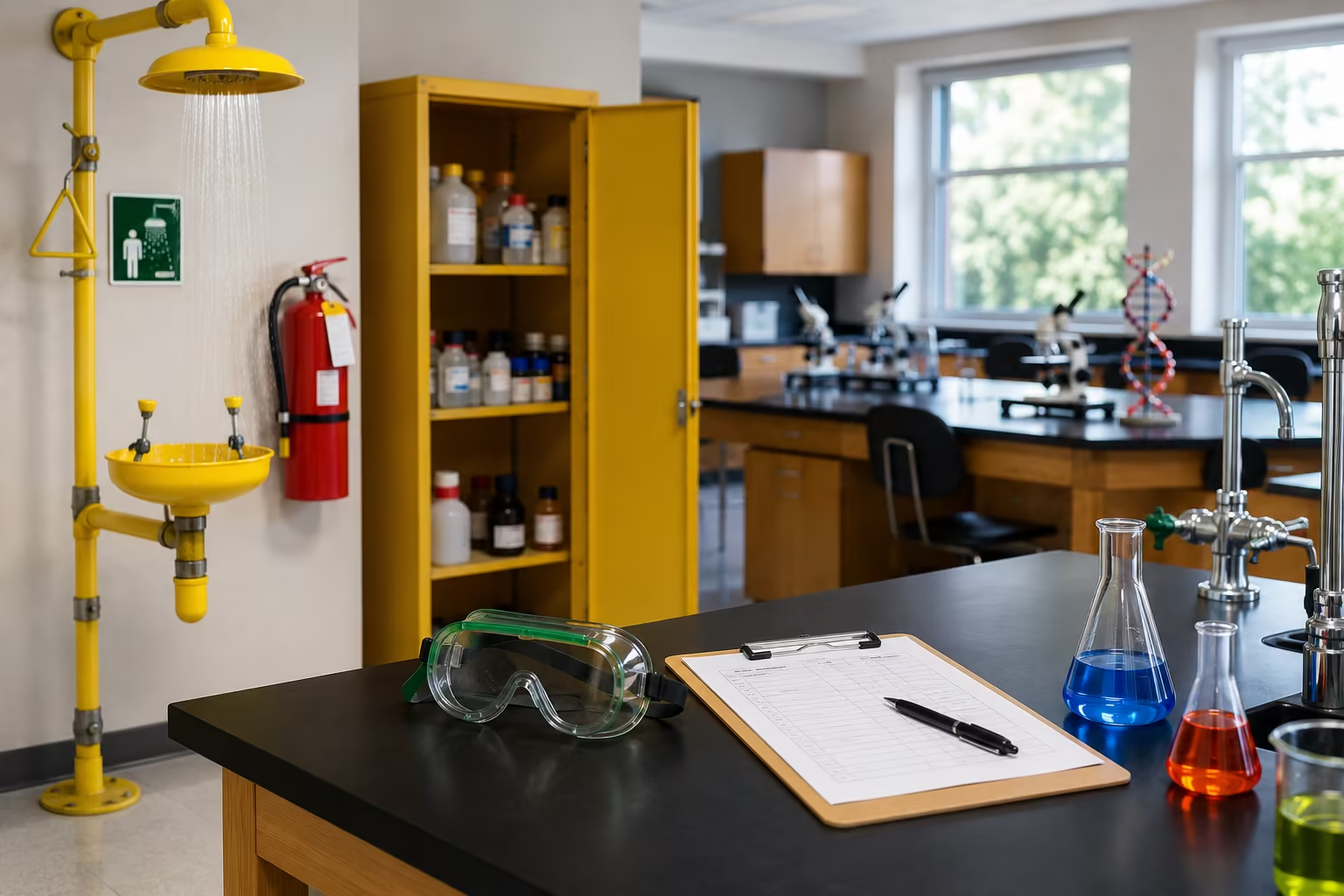
Science lab safety inspections are among the most important yet overlooked responsibilities in K–12 education. Every day, students enter science classrooms to explore, investigate, and discover. They conduct experiments, handle laboratory equipment, work with chemicals, and engage in hands-on learning experiences that bring science to life. These opportunities are essential to a well-rounded education, but they also create responsibilities that cannot be ignored.
While educators devote significant time to curriculum, instruction, assessment, and student achievement, the physical learning environment often receives less attention than it deserves. Yet the condition of a laboratory can directly impact student safety, staff well-being, district liability, and the overall success of a science program.
The reality is simple: science laboratories are dynamic environments. Conditions change over time. Equipment ages. Chemical inventories grow. New staff members arrive. Procedures evolve. Storage areas become crowded. Small issues develop gradually and often go unnoticed until an inspection reveals them.
That is why annual science lab safety inspections are not merely recommended. They are essential.
The safest laboratories are not necessarily the newest facilities or those with the largest budgets. They are the laboratories where safety is intentionally evaluated, documented, discussed, and improved year after year.
The Risks Most Schools Never See Coming
One of the greatest challenges in laboratory safety is that hazards rarely announce themselves.
Major incidents are often preceded by a series of small problems that seemed insignificant at the time.
A bottle label becomes difficult to read.
A chemical cabinet becomes overcrowded.
An eyewash station is partially blocked by stored materials.
A teacher inherits chemicals from a predecessor and assumes they are still safe to use.
A fire extinguisher becomes inaccessible behind classroom equipment.
None of these situations appears dramatic. None creates immediate concern. Yet collectively they increase risk.
During laboratory inspections, safety professionals routinely discover conditions that have existed for months—or even years—without anyone realizing the potential consequences.
Many of these findings are not the result of negligence. They are the result of familiarity.
When educators work in the same laboratory every day, conditions become normal. Small concerns blend into the background. What would immediately stand out to an outside inspector may go unnoticed by someone who sees the room daily.
Annual inspections provide something invaluable: a fresh set of eyes.
They challenge schools to evaluate their laboratories objectively rather than through the lens of routine.
Safety Is Not a One-Time Achievement
Some schools approach safety as a project.
They conduct a cleanup, purchase new equipment, update documentation, and feel confident that the laboratory is safe.
The problem with this approach is that safety is not a destination.
It is a process.
A laboratory that met every expectation last year may not meet those same expectations today.
Eyewash stations require regular maintenance. Safety showers must remain accessible and functional. Fume hoods require evaluation. Chemical inventories change. Emergency plans evolve. Personal protective equipment wears out. The new curriculum introduces new materials and procedures.
Safety systems naturally drift over time.
Annual inspections help schools identify that drift before it creates problems.
Rather than waiting for an accident, near miss, or compliance issue, inspections allow educators to evaluate the effectiveness of their safety systems proactively.
This shift from reaction to prevention is one of the most valuable outcomes of a comprehensive inspection program.
When Small Problems Become Big Incidents
History has repeatedly demonstrated that a single failure rarely causes major incidents.
Instead, they occur when multiple small deficiencies align.
Imagine a chemical splash incident.
A student accidentally exposes their eyes to a hazardous material. The teacher immediately directs the student to the eyewash station. Unfortunately, the unit has not been tested in years. Water pressure is inadequate. Valuable seconds are lost.
Or consider a minor fire.
A teacher reaches for a fire extinguisher only to discover that stored materials partially block access.
Perhaps a chemical spill occurs involving incompatible materials that should never have been stored together.
Each of these scenarios begins long before the emergency itself.
The true cause is not the incident.
The true cause is the unnoticed condition that existed beforehand.
Annual inspections help schools identify those conditions before they contribute to a larger problem.
This is why inspections save lives.
They uncover risks before those risks have an opportunity to cause harm.
More Than Compliance
When many educators hear the word “inspection,” they immediately think about compliance.
Documentation.
Regulations.
Checklists.
Requirements.
While compliance certainly matters, the most effective safety programs understand that inspections are about far more than satisfying regulations.
Compliance asks whether a requirement has been met.
Safety asks whether people are protected.
Those are not always the same thing.
A school may possess safety equipment that technically satisfies a requirement. However, if staff members do not know how to use the equipment, or if access is obstructed during an emergency, the practical value is significantly reduced.
Effective inspections move beyond paperwork.
They evaluate whether safety systems are truly functioning as intended.
They ask whether students and staff would be protected if an emergency occurred tomorrow.
That perspective transforms inspections from administrative tasks into meaningful risk-management tools.
The Critical Role of Chemical Management
If there is one area where inspections consistently uncover concerns, it is chemical management.
Over time, science departments naturally accumulate chemicals.
Some materials remain from previous instructors. Others were purchased for curriculum units that no longer exist. Some may have exceeded their recommended shelf life years ago.
Without routine review, inventories can quickly become difficult to manage.
Inspectors frequently encounter:
- Unlabeled containers
- Deteriorating labels
- Unknown substances
- Overcrowded storage cabinets
- Improper segregation of incompatible chemicals
- Expired materials
- Outdated inventory records
What makes these issues particularly concerning is that they often remain hidden behind closed cabinet doors.
To the casual observer, the laboratory appears organized.
Yet the greatest risks may be sitting quietly on a shelf.
Comprehensive inspections help schools understand exactly what materials they possess, where those materials are stored, and whether storage practices support current safety standards.
Why Every School Needs a Safety Champion
The most successful inspection programs rarely depend on a single annual review.
Instead, they are supported by individuals who take ownership of safety throughout the year.
In many organizations, that responsibility falls to a Chemical Hygiene Officer (CHO), laboratory manager, science supervisor, or designated safety leader.
These individuals help bridge the gap between annual inspections and daily operations.
They coordinate training.
Monitor corrective actions.
Review inventories.
Support documentation efforts.
And ensure that safety remains visible throughout the school year.
Without a designated safety champion, even well-intentioned programs can struggle to maintain momentum.
Safety improves when someone owns the process.
The annual inspection becomes significantly more effective when it is part of a broader commitment to continuous improvement.
Safety Is a Leadership Responsibility
Science laboratory safety is often viewed as a teacher’s responsibility.
In reality, it is a leadership responsibility.
Principals, district leaders, facilities personnel, risk managers, and school boards all play important roles in supporting safe laboratory environments.
Leadership determines priorities.
Leadership allocates resources.
Leadership establishes expectations.
And leadership ultimately decides whether safety is viewed as an investment or an expense.
Schools that prioritize safety inspections send a powerful message to staff, students, and families. They demonstrate that safety is not something addressed only after problems arise.
It is something that receives attention before problems occur.
Strong leaders understand that prevention is always less costly than response.
The investment required for inspections, training, maintenance, and corrective actions is small compared to the financial, legal, and human consequences of a serious incident.
Building a Culture of Safety
Perhaps the most important outcome of annual inspections is cultural.
The best inspections do more than identify deficiencies.
They start conversations.
Teachers begin discussing safety procedures.
Administrators gain greater visibility into laboratory conditions.
Facilities teams become more aware of science-specific needs.
Corrective actions create opportunities for improvement.
Over time, these interactions contribute to a stronger culture of safety.
In healthy safety cultures, inspections are not viewed as interruptions or evaluations designed to assign blame.
They are viewed as opportunities to learn.
Opportunities to improve.
Opportunities to protect people.
That mindset changes everything.
Safety becomes part of daily decision-making rather than an annual event.
The Future of Science Education Depends on Safe Laboratories
Science education continues to evolve at an extraordinary pace. Modern classrooms increasingly incorporate biotechnology, engineering design, robotics, advanced chemistry, environmental science, and innovative STEM experiences.
These opportunities prepare students for careers that will shape the future.
They also introduce new safety considerations.
As science programs become more sophisticated, laboratory safety systems must evolve alongside them.
Annual science lab safety inspections provide the foundation for that growth. They help schools identify emerging risks, strengthen existing safeguards, improve preparedness, and support environments where innovation and safety work together.
Every student who enters a science laboratory deserves a safe environment in which to explore, question, investigate, and discover.
Annual science lab safety inspections help ensure that curiosity is supported by preparation, innovation is supported by protection, and learning is supported by a culture that values safety as much as achievement.
The safest laboratories are not necessarily the newest or most expensive.
They are the laboratories where safety is examined, evaluated, and improved year after year.
Because when schools commit to inspection, prevention, and continuous improvement, they are doing far more than checking boxes.
They are protecting lives.
Subscribe to edCircuit to stay up to date on all of our shows, podcasts, news, and thought leadership articles.