 EdCircuit Staff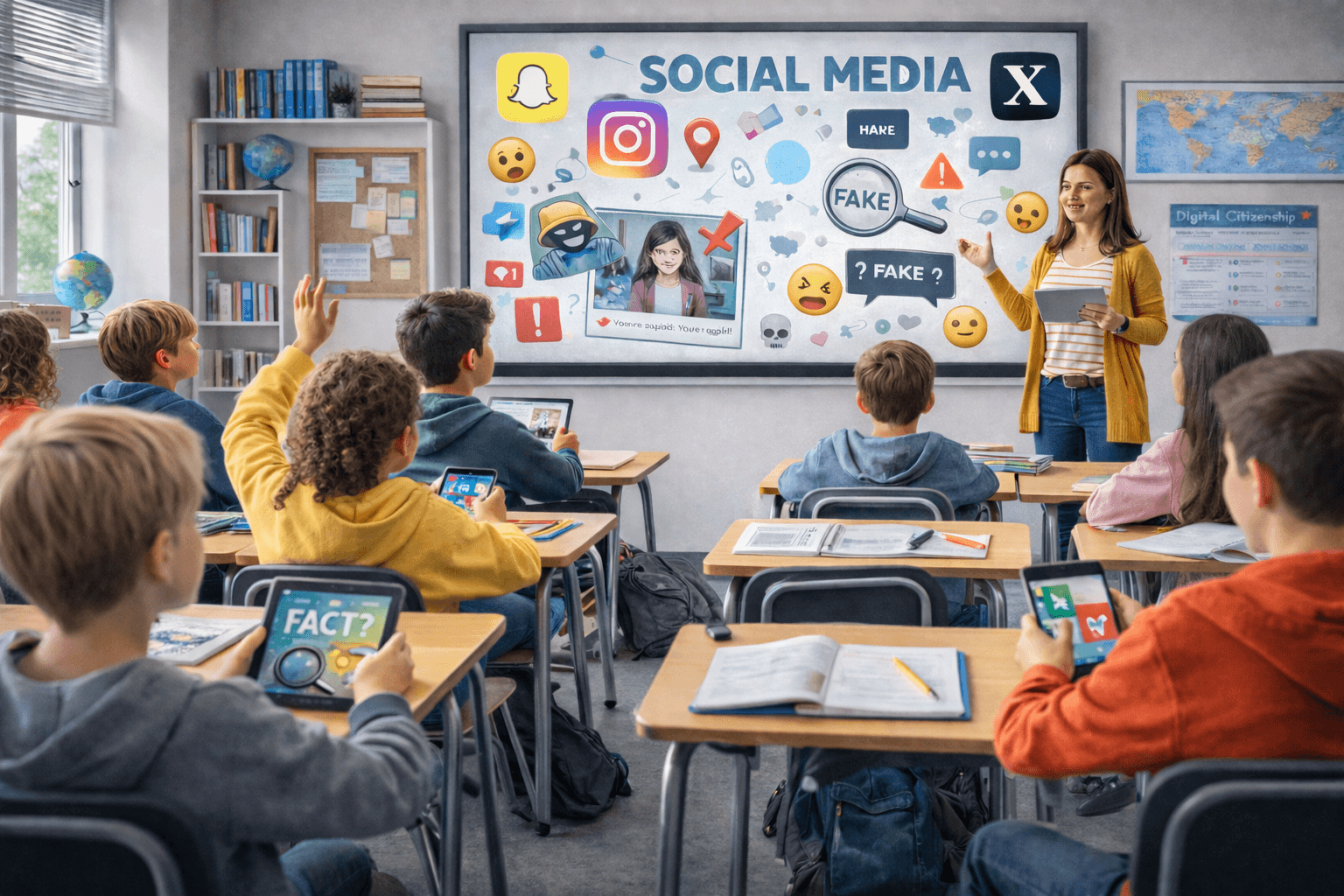
Table of Contents
Social media education in middle school is emerging as a cornerstone of student well-being, teaching adolescents how to prevent cyberbullying, question viral content, and think before sharing, before online behavior becomes entrenched.
Middle school is often the moment when students receive their first personal devices, create early social media accounts, and begin navigating online communities with far less adult supervision than in elementary school. At the same time, developmental changes accelerate—peer relationships intensify, impulsivity rises, and the desire for social validation becomes a powerful force in decision-making.
For district leaders, this convergence presents both urgency and opportunity. Rather than waiting until harmful patterns appear in high school, many systems are introducing structured instruction in digital citizenship earlier, framing social media literacy not as a one-time safety talk but as an ongoing developmental process that evolves across grades.
Why Middle School Is the Critical Starting Point
Educators frequently describe middle school as the “practice field” for online behavior. Students experiment with humor, sarcasm, identity, and social positioning—often without fully understanding how tone, permanence, or public visibility change the meaning of what they share.
District curricula increasingly emphasize that this stage is not about perfection, but about habit formation. Students are taught to slow down before posting, to think about audience and intent, and to recognize that online interactions are extensions of in-person relationships rather than separate worlds.
Administrators say these early lessons can prevent escalation later. When students enter high school already familiar with concepts such as consent, verification, and bystander responsibility, schools spend less time reacting to viral incidents and more time reinforcing established norms.
Defining Cyberbullying in Digital Spaces
Middle school students often recognize overt cruelty—direct insults, threats, or public humiliation—but struggle to identify subtler behaviors that still cause harm. Reposting embarrassing clips, piling onto comment threads, creating parody accounts, or excluding classmates from group chats may feel playful or inconsequential in the moment.
Instruction at this level focuses on helping students unpack these gray areas. Teachers guide conversations about intent versus impact, explaining how jokes can land differently when broadcast to wide audiences and how repetition transforms teasing into targeting.
District programs frequently incorporate:
-
Guided scenario analysis drawn from realistic school situations.
-
Role-playing exercises that allow students to step into different perspectives.
-
Discussions about emotional well-being and reporting systems.
-
Clear explanations of school policies and available supports.
Rather than centering punishment, these approaches emphasize responsibility and empathy. Students learn that choosing not to forward a post, refusing to comment on humiliating content, or alerting an adult can interrupt harm just as powerfully as confronting a bully directly.
Introducing Media Manipulation and Deepfakes Early
Although middle schoolers may not yet be creating sophisticated AI-generated videos, they encounter manipulated images, voice filters, memes, and misleading clips daily through gaming platforms, video feeds, and messaging apps. Without instruction, many assume viral content is authentic simply because it appears popular.
District leaders are responding by embedding early lessons on media literacy and verification. Students learn how photos can be altered, how audio can be fabricated, and how algorithms reward sensationalism over accuracy.
Teachers often frame these discussions through inquiry rather than fear:
Who created this?
Why might someone want it shared?
What evidence supports the claim?
What information is missing?
The objective is not technical mastery but skepticism and pause—habits that become increasingly important as tools grow more sophisticated in later grades.
Recording, Sharing, and the Question of Consent
Phones and tablets make recording effortless, and for many middle schoolers, capturing moments in hallways or cafeterias feels routine rather than intrusive. Yet educators note that students rarely consider how quickly videos can travel beyond their intended audience—or how it feels to be filmed without permission.
Curricula now devote significant attention to consent and boundaries. Students discuss when it is appropriate to record, how to ask permission respectfully, and why private moments should remain private. Teachers also address scenarios in which filming could escalate a conflict rather than resolve it.
These conversations extend beyond technology use into social-emotional learning. Students explore empathy, perspective-taking, and the responsibilities that come with access to powerful tools.
Administrators report that when these topics are addressed early, students become more thoughtful about reaching for their devices during emotionally charged moments and more likely to seek adult help rather than broadcasting incidents online.
Modeling Positive Digital Participation in Classrooms
Some districts are moving beyond warnings about misuse and introducing carefully structured opportunities for students to practice responsible digital engagement. In moderated environments—such as classroom discussion boards, district-approved platforms, or teacher-managed accounts—students learn how online spaces can support collaboration rather than conflict.
Teachers model how to give constructive feedback, cite sources, respond respectfully to disagreement, and manage tone when communicating publicly. These lessons connect directly to writing instruction, research skills, and civic discourse.
When paired with reflection and explicit expectations, these experiences demystify social platforms and show students that technology can amplify learning as easily as it can spread harm.
Creating a Developmental Continuum
District leaders increasingly describe middle school instruction as the first stage in a multi-year approach to digital citizenship.
At this level, the emphasis is on:
-
Empathy and perspective-taking.
-
Consent and boundaries.
-
Verification and questioning sources.
-
Responsible sharing.
-
Knowing when and how to ask for help.
-
Understanding consequences in age-appropriate terms.
These foundations prepare students for the more complex conversations that await them in high school—about legal accountability, reputational risk, AI ethics, and civic participation in online spaces.
Partnering With Families for Consistency
Administrators consistently stress that middle school initiatives are most effective when families are involved. Students receive mixed messages when schools promote caution while home environments treat social media as entirely private or consequence-free.
To bridge that gap, districts are expanding outreach efforts through family workshops, digital guides, newsletters, and parent-teacher conversations. Many provide discussion prompts for home, explain reporting systems, and outline expectations around device use.
By aligning language across school and home, leaders say they reduce confusion and reinforce that digital citizenship is a shared responsibility rather than solely a school-based mandate.
From Reaction to Preparation
For years, many systems addressed social media only after incidents occurred—viral videos, online harassment, or community controversies. Increasingly, districts are working to shift from reaction to preparation.
When students learn early to pause before posting, verify what they encounter, and consider how their actions affect others, those habits carry over into later grades and adulthood.
In a world where publishing is effortless and audiences are unlimited, those skills are not optional.
They are foundational.
Subscribe to edCircuit to stay up to date on all of our shows, podcasts, news, and thought leadership articles.