
 EdCircuit Staff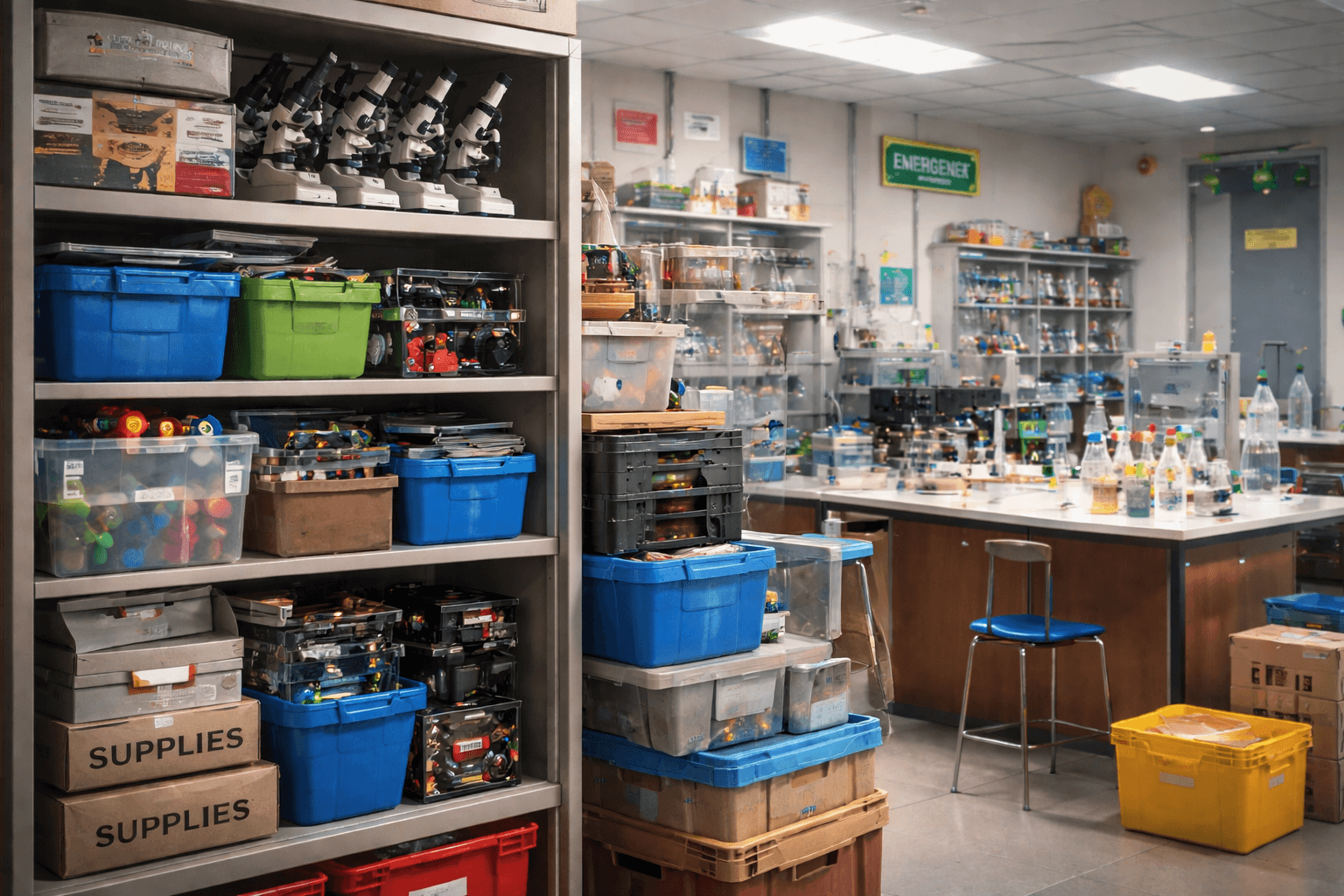
Table of Contents
Walk into almost any STEM lab, science classroom, or career and technical education space before students arrive, and the room typically looks organized and ready for learning. Cabinets are closed, materials appear neatly stored, and equipment sits exactly where it should be.
But stay in that room long enough and a different pattern begins to appear.
Microscopes stacked higher than intended. Robotics kits are placed on top of cabinets. Boxes of supplies are tucked into corners because there simply isn’t another place for them. None of these adjustments looks dangerous on its own. In fact, they often look like practical solutions created by teachers trying to make the most of the space they have.
Yet over time, those small decisions quietly change how the room functions.
Pathways narrow. Storage expands into workspaces. Equipment becomes harder to retrieve safely. What once felt like an open and flexible learning environment gradually begins operating closer to its limits.
That shift is why STEM lab storage safety deserves far more attention than it typically receives.
Safer Ed Podcast: When Storage Becomes Risk
This article accompanies the latest episode of the Safer Ed Podcast, where we examine how storage decisions quietly influence safety in STEM classrooms.
In the episode, we explore how equipment accumulation, vertical storage, and shrinking workspace capacity can affect supervision, movement, and emergency access in ways schools rarely recognize until a near miss occurs.
Listen to the full conversation below.
The Hidden Safety System in STEM Spaces
When schools think about safety in science labs or technical classrooms, the focus usually lands on the obvious elements—chemicals, tools, safety procedures, and personal protective equipment.
Those elements are critical, but they represent only part of the safety system.
The physical environment itself also plays a powerful role in determining whether a space operates safely. Storage decisions influence how people move through a room, how teachers supervise activities, and whether emergency equipment remains accessible when needed.
The challenge is that storage pressure rarely appears overnight. Instead, it develops gradually as programs evolve.
A school adds robotics. A new engineering course introduces additional equipment. A biotechnology unit requires specialized materials. Each addition supports meaningful learning opportunities for students.
But every new tool or device also needs a place to live.
When the program grows faster than the space designed to support it, classrooms begin adapting in subtle ways.
Cabinets fill beyond their intended capacity. Shelves hold more materials than originally planned. Equipment begins stacking vertically because horizontal space has disappeared.
At first, these changes feel temporary.
Eventually, they become permanent.
When Organization Becomes Capacity
Many educators understandably treat storage as an organizational issue—something that can be solved with better shelving, labeling, or rearranging.
But in many STEM classrooms, the deeper issue is capacity.
Every learning environment has a limit not only for students but also for materials, equipment, and movement. When that capacity is exceeded, the room compensates.
Teachers move carts closer to the walls. Materials occupy surfaces meant for experiments. Equipment is stacked higher to create room below.
None of these solutions is careless.
They are adaptations made by educators committed to providing students with hands-on learning experiences.
But collectively, they alter how the room functions.
The Movement Problem
One of the first places storage pressure appears is in the way people move through a classroom.
Active STEM learning environments depend on movement. Students gather supplies, share equipment, and collaborate across workstations. Teachers move continuously between groups, supervising activities and answering questions.
Clear pathways make this movement predictable and safe.
When storage expands into those pathways—even slightly—movement patterns change.
Students begin stepping around objects. Teachers reposition themselves to maintain visibility. Congestion forms around areas where materials are concentrated.
Those subtle shifts can influence everything from supervision to emergency response.
Vertical Storage and Near Misses
Another common signal of storage pressure is vertical stacking.
When cabinets and shelves reach capacity, the easiest solution is to place materials above them. Microscopes, robotics kits, engineering components, and other equipment often end up on the tops of cabinets.
While these stacks may appear stable, retrieving items from elevated positions introduces new risks.
Students stretch higher than intended. Equipment shifts when something beneath it is removed. Teachers lift heavier items from overhead storage.
These situations often produce what safety professionals call near misses—moments when something almost goes wrong but doesn’t.
Near misses are valuable signals.
They reveal when systems are operating closer to their limits than anyone realizes.
Emergency Access Must Remain Clear
Storage pressure can also influence emergency preparedness.
Safety showers, eyewash stations, fire extinguishers, and exit pathways must remain immediately accessible. However, when classrooms feel crowded, these areas sometimes become convenient temporary storage spots.
A cart may sit near a doorway. A box may be placed beside a safety station while materials are reorganized.
Individually, these adjustments may appear harmless.
But when multiple small decisions accumulate, the environment slowly changes.
What once was a clear emergency access point may become partially obstructed.
What School Leaders Should Notice
For administrators and district leaders, evaluating STEM lab storage safety requires a slightly different perspective during classroom visits.
In addition to observing instruction and engagement, leaders should also look at how space is being used.
Questions worth asking include:
-
Are cabinets operating within their intended capacity?
-
Are materials stacked above safe reach levels?
-
Are pathways wide enough for students carrying equipment?
-
Is emergency safety equipment fully accessible?
-
Does the room appear to be storing more materials than it was designed to support?
These observations often reveal whether a classroom is functioning comfortably within its limits—or quietly compensating for storage pressures.
Understanding Classroom Capacity
One of the most effective ways schools can address this issue is by understanding the true capacity of their learning spaces.
Tools like the Science Safety Occupancy Load Calculator help schools evaluate how room layout, class size, and equipment interact.
When leaders understand how much space is truly available for movement and supervision, they can make better decisions about scheduling, storage planning, and equipment placement.
Recognizing capacity limits early prevents small issues from growing into larger safety concerns.
Small Adjustments, Big Impact
The good news is that storage challenges are often easier to address than major infrastructure issues.
Small changes—redistributing equipment, adjusting shelving height, relocating storage areas, or rotating materials between classrooms—can dramatically improve how a room functions.
When storage systems are aligned with the program’s actual needs, movement improves, supervision becomes easier, and emergency access remains clear.
In other words, the entire safety system becomes stronger.
A Conversation Worth Sharing
Safer STEM programs continue to expand as schools embrace hands-on, project-based learning. That growth brings incredible opportunities for students, but it also requires thoughtful planning around the physical environments where learning happens.
Because in Safer STEM and Safer CTE classrooms, safety isn’t determined only by rules or equipment.
It is also shaped by the quiet decisions about where things are placed, how much space remains, and whether the room still functions as intended.
That is why Safer STEM lab storage safety deserves attention—not just from teachers, but from school leaders, facilities teams, and safety professionals across the education community.
Subscribe to edCircuit to stay up to date on all of our shows, podcasts, news, and thought leadership articles.