Jessica Cavallaro wrote in 2023 that Agile pull-based teaching could ease teacher burnout by shifting responsibility for learning to students. A new section after Cavallaro’s article checks that argument against the 2026 teacher burnout data and the research on student-centered teaching.
There is a teacher energy crisis happening in education now. The crisis is impacting millions of young learners each day in schools across the country and much of the world. The crisis sees empty classrooms across the US, and it sees thousands of highly skilled educators seeking refuge outside the profession. Agility may help solve these issues.
Unlike other energy crises, this one is not reliant on anything other than how we teachers walk into a classroom and structure our classroom time. This energy crisis isn’t expensive to fix, nor does it take a long time to address. It does take a shift in practice and perspective, one that is decades overdue.
Teachers whose energy is being drained by the chaos of recent years are finding deep wells of energy and student engagement when they begin to pull new ways of learning that are profoundly student-centered and fundamentally adaptive in the sorts of ways all parents want their kids to be adaptive.
The Burnout Problem
A teacher’s role is vital to the success of happy and healthy students, but in recent times we have witnessed teachers expressing that the amount of work that they are asked to complete by their supervisors is beyond what they can handle. Teachers fleeing the field of education is not a new phenomenon but one that has exploded in the past few years. Teachers feel that there is not enough time in the day to complete all of the work that has landed on their shoulders, often arriving before the first bell and staying far after the last buses have pulled away.
This overwhelming feeling of work causes the kinds of burnout that are prevalent in education. The traditional systems of learning, built around antiquated ideas from the late 19th century by manufacturing consultants like Frederick Taylor, have set the culture and mindset of PUSH. In a push system, almost all of the responsibility lies squarely on the teachers. They have to read the learning standards, interpret them for their students, create and modify content, plan the pacing of content for 30 different minds, find ways to deliver content to all students at the same time, and finally assess the content.
This is all before they deal with classroom management, meetings, differentiation, paperwork, guidance, advisory, and administration. The roots of this system and the problems wrapped around those roots are described in detail by Todd Rose’ excellent book, The End of Average.
Push and Pull-Based Models and Agility
Push-based education models are based on an adult-centric culture. Historically, this model worked well in education because the teachers specialized in content areas and helped their students memorize and learn the information that they would need to carry with them throughout their lives. Outside of school, students and adults could read to access new information, but new knowledge was hard to access, and work was based on the production of mass-produced goods. A teacher’s job was, like a foreman in a factory, to push as much information as they could into their students, the ‘workers,’ before they left the classroom because knowledge was scarce and time in school was limited.
With the existential crisis of teacher shortages looming in every state, thought leaders and policymakers in education need to re-evaluate the culture and models that are being implemented in classrooms around the country. Instead of relying on traditional PUSH-based systems, we must listen to what the stakeholders in education need.
What are the needs of our current teachers and students?
The most efficient, effective, and empathic way to move forward in all educational spaces is to transition our mental models and our instructional models from PUSH based to PULL-based. This means removing the responsibility of all learning from the teacher and placing it on the main stakeholder, the student. In Agile PULL-based systems, teachers are respected with the autonomy to create their own units that reflect the standards they work with.
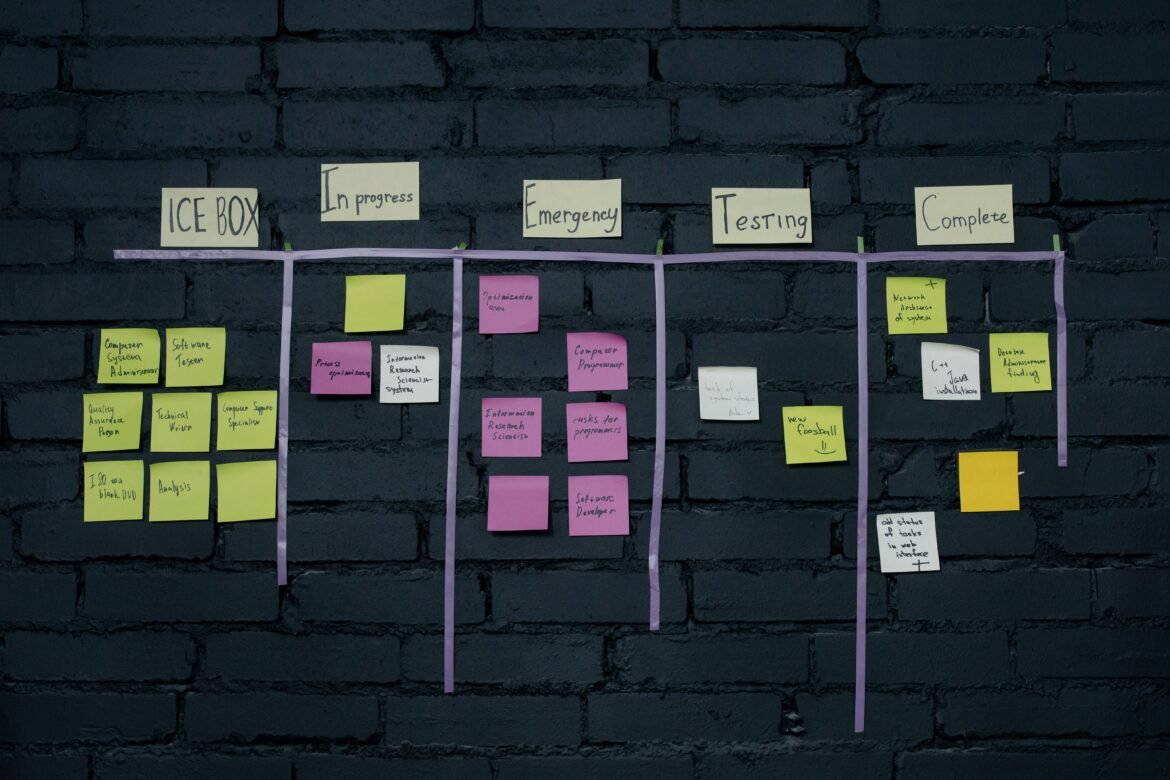
Teachers begin with developing Wide-Open Questions which captures students attention through the use of compelling and complex issues tied to real life situations. Teachers then create a backlog, or list of assignments, resources, and opportunities for hands-on learning that students can PULL from. This means that teachers can mandate the use of content and skills, but students have real choice and autonomy in their daily learning.
Finally, teachers work as learning guides instead of “sage on the stage” style leaders. In Agile PULL-based classrooms, students must use the knowledge they learned from completing the teacher’s learning backlog to find a solution to the Wide-Open Question. The students are responsible for building connections, researching and finding new information, and working together to solve complex real life problems while the teacher is free to move between small groups asking questions and having the opportunity to personalize the learning experience.
How Agility Addresses the Issues of Teachers
This solves two critical issues education is facing.
- Teacher burnout due to overwork and lack of autonomy.
- Student apathy due to lack of purpose and the passive role in PUSH-based classrooms.
An Agile PULL-based classroom is different from a PUSH-based traditional classroom in several critically important and consequential ways. In PUSH-based classrooms, students are often seated at desks, facing forward with the teacher in leading a lesson from the front of the room. The conversation is often in one direction, with the teacher responsible for over 80% of the speaking while students sit quietly, taking notes. We can visualize this by thinking of the teacher pushing content like water flowing from a hose into a bucket. The hose is doing all of the work while the bucket sits, retaining whatever water does not splash out the sides but is not active in helping collect more water.
Making Teaching Easier
PUSH-based classrooms are hard for teachers to manage. In modern classrooms, teachers often work with at least 30 students at a time, all with different needs, levels of maturity, interests, and hobbies. For the teacher, this turns a simple lecture into a performance. They must keep the attention of 30 different brains that all function in different ways while continuously pouring new knowledge out.
It is a full-out exercise of stamina and showmanship if the teacher is able and willing to put out that much energy every day for months on end. Teachers not only need to know their content but put on a show that keeps students engaged. Otherwise, behavioral problems arise from all sides of the room. At the end of the day, teachers are exhausted from repeating the same lesson 5 times, performing, pivoting, and in their free time planning and assessing.
A Different Kind of Energy in the Classroom
In Agile PULL-based classrooms, there is an entirely different type of energy. Students are arranged in self-selected groups, where the diversity of learning styles and interests is highlighted and celebrated.
Student teams are largely independent, all working to solve the same Wide-Open Question but provided the autonomy to navigate their own learning path. Students sit where they can work, focused on each other instead of where the teacher is in the room. The teams talk, share, and brainstorm. Often an Agile PULL-based room is buzzing with hive-like energy.
Work is being PULLed from the teacher-created backlog by each team at their own pace. The responsibility of learning has shifted to the students. They are now active in their learning, having to engage with each new piece of knowledge and find ways to apply it. Through trial, failure, and reflection, they are held responsible for their own outcomes.
Transforming the Role of Teacher Using Agility Models
The role of the teacher is transformed as well. They are no longer responsible for putting on a three-ring circus, forcing content delivery, and desperately trying to reach all children at the same time. Teaching becomes fun again. The passion returns. Teachers have put in the work creating the unit, crafting the right Wide-Open Question, and curating sources of information that opportunities for hands-on application.
When the students begin working, teachers get to do the part of the job they truly enjoy; building authentic relationships with each student, having genuine conversations, and helping kids push and grow their curiosity.
Teachers shift from the role of PUSHER of content to a facilitator of learning. In Agile PULL-based classrooms, teachers are free to meet with each student group, discuss what they are learning and prompt them with questions that will challenge their understanding of content. Students that are struggling will get one-to-one time with a learning professional, while those that need a challenge get personalized attention.
Individualizing Teaching Using Agility
Instead of running through a script of lecture accompanied by slides, teachers get to engage with students, helping students learn how to communicate with each other, scaffolding learning experiences unique to each group, and truly getting to know each student.
At the end of the day, instead of dragging themselves home with an empty battery, Agile PULL-based teachers are recharged and energized. This is a result of the fundamental rebalancing of responsibility in the classroom. Teachers are treated like the professionals they are, given the autonomy and creativity to work with students while truly participating in their learning journeys.
The people most vulnerable to our current energy crisis in education are those least able to defend or insulate themselves from it: our students. Luckily human ingenuity and imagination are more than sufficient to change this situation and address this crisis. It’s time for folks in education who want to improve how it works for all involved to consider a change in direction: less push, more pull.
Stay connected with edCircuit. Subscribe here.
Agile in the classroom in 2026: what teacher burnout data and research say about push and pull teaching
Jessica Cavallaro’s article above, published in 2023, proposes agile in the classroom as a response to teacher burnout. Cavallaro’s argument is that a push system, in which the teacher carries nearly all responsibility for delivering content, drains teachers, and that a pull system, in which students draw on a teacher-built list of resources to answer a large question, restores energy and student engagement. This section looks at what has been measured since 2023 about teacher burnout and about the kind of student-centered teaching Cavallaro describes.
What the latest data show about teacher burnout
The RAND Corporation’s State of the American Teacher survey continues to find high strain. RAND’s own report could not be opened for this section, so the figures below are as K-12 Dive reported in June 2026, 57 percent of teachers reported burnout, compared with 54 percent in 2021. Frequent job-related stress was reported by 55 percent of teachers, down from 78 percent in 2021, and by 34 percent of similar working adults in other fields. Eighteen percent of teachers said they intended to leave their job by the end of the 2025-26 school year, down from 23 percent in 2022-23. The article does not state the sample size or survey methods, so readers who rely on the figures should check RAND’s report directly.
These numbers back up the problem Cavallaro describes, which is a profession under pressure that has eased only partly. They also show that burnout has more than one cause. The same article reports that similar working adults had an average base salary of $105,000, compared with $75,599 for teachers. A change in classroom structure can address workload and autonomy, which Cavallaro emphasizes, and it cannot address pay.
What push and pull mean in practice
Cavallaro describes push teaching as the teacher interpreting standards, creating content, pacing it and delivering it to every student at the same time. In pull teaching, the teacher begins with what Cavallaro calls a wide-open question tied to real life, builds a backlog of assignments, resources and hands-on opportunities, and lets student teams pull from that list at their own pace while the teacher moves among groups. edCircuit’s earlier article Agile for Learning, Part 1: Wide-Open Questions explains the first of those steps in more detail.
The approach has a family resemblance to project-based learning, which has more research behind it than agile classrooms under that name. Cavallaro’s article does not cite studies of outcomes, and the sources reviewed for this section do not include a controlled study of classrooms labeled agile, so the claims about teacher energy and student engagement are, for now, a practitioner’s argument.
What research on project-based learning shows
The strongest evidence on the neighboring approach comes from a cluster randomized controlled trial of project-based learning with 48 second-grade teachers in low-income school districts, published in the American Educational Research Journal in 2021 by Nell Duke and colleagues. Teachers were randomly assigned within pairs of schools. Students in the project-based classrooms, who took part in four units, grew more in social studies and informational reading than students taught social studies as usual. There was no difference in writing or motivation. Teachers who followed the session plans more closely saw greater growth in writing, motivation and reading.
That trial is promising and it has limits. It covers one grade level, one set of units and districts of a particular kind, and the units came with detailed session plans. The finding about teachers who followed the plans closely suggests that this kind of teaching works best with structure and support, which fits the work Cavallaro says teachers must do to build the backlog and the opening question. It also means that handing teachers a new model without time and materials could add to their workload before it lowers it.
The other side of the debate is the evidence for direct teaching. Barak Rosenshine’s Principles of Instruction, published in American Educator in 2012, summarizes research showing that the more effective teachers Rosenshine reviewed spent time presenting new material in small steps, guiding practice and checking student understanding. Much of the teacher research Rosenshine draws on is observational, and it focuses on teachers who direct the lesson. A fair reading is that explicit teaching and student-led inquiry each work under conditions, and that many teachers use both in the same week.
If you want to try a pull approach
- Start small, with one unit and one wide-open question, instead of redesigning a full year.
- Build the backlog with a clear list of required skills and content, so that student choice is about order and pace and not about whether the standards are covered.
- Keep direct teaching for the skills students cannot discover on their own, and check understanding often.
- Count the planning hours honestly. A first unit may cost more time than a lecture-based one, and a principal can protect that time.
- Collect your own evidence, such as student work, the share of students finishing tasks and your own account of workload, before spreading the approach further.