https://vimeo.com/293469168
Devising innovations to reach across borders and cultural boundaries 
Dr. Matt Harris is the Owner and Chief Consultant for International EdTech, and is a real globetrotter. When I recently talked to him, he was in Singapore after returning from Kuwait, Indonesia, and Hong Kong. He is a presenter for eight different sessions at the 2019 Future of Education Technology Conference (FETC) at the Orange County Convention Center in Orlando, Florida from January 27th through the 30th, including as leader of the day-long Blueprint for Technology in Education summit on the 27th.
Matt presented at FETC last year, as well, and found the entire experience globally important. “We had people from four different continents speaking three or four different languages,” Matt remembers. “We talked about technology as this unifying force across the board, which was just fascinating.” Matt is thankful that FETC continues to maintain a commitment to a widely inclusive edtech blueprint and to globalizing the approach to teaching and learning.
FETC 2018 established panels of experts to talk about the current state of education from a theoretical level and Matt is excited that this year, they’re mixing the theoretical panels with more practical applications. “We’re doing some workshops and presentations where people can delve deep into the content,” Matt says. “We’re going to have more of these experts back to talk about what life is like in the real world.”
At last year’s conference, Matt and his colleagues discussed creating an edtech blueprint to reach across borders and cultural boundaries. “I continued to have conversations with the panelists and people I had talked to,” Matt says. “We started having real in-depth fundamental discussions and conversations about what technology looks like in a classroom or a district regardless of location. How do we focus on basic infrastructure and education and leadership?”
All the key concepts of the edtech blueprint brought forward are things that Matt has discovered around the world. “We’re finding them in every institution that I visit whether it’s an individual school or classroom, even large ministries that are trying to create digital transformation within their schools,” he says. He mentioned a conversation he had a couple of weeks ago with a group in Botswana in Southern Africa and they are having the same discussions he’s been having with educators working with schools in Florida. The issues, problems, and even solutions are surprisingly common across borders and cultures.
The one barrier Matt sees to getting everyone on the same page is the lack of a common terminology or vocabulary when it comes to edtech. “We’re taking a real calculated approach bringing expert advisors from around the world to make sure that the language that we develop around technology for schools is something that’s accessible and usable by everybody,” Matt says. “The global market for edtech far exceeds the market within the United States, so it’s important that people working on the same thing in other countries have a collaborative way by using the same language and terms, which is the potential and the promise of the technology anyway.”
 Despite the prevailing view in America that we set the pace and standards for the rest of the world, from Matt’s global perspective, the rest of the world is exploding with innovation while the U.S. is advancing the education agenda slowly and methodically.
“Looking at the growth of edtech in Dubai or the advances in Northern Africa from one month to the next,” Matt points out, “things have changed drastically, while the U.S. has a regular steady, mature growth that isn’t amazing anymore. We’re not ‘exploding’ the world like we used to.” Matt warns that to keep up, we need to embrace the fourth industrial revolution model that’s transforming the international business community and bring it into the education space to continue to help it grow into the unified global view of what educational technology really can be.
Has edtech changed education as much as technology has transformed the world of healthcare and medicine? Technology should have an equal if not greater impact on education, but it hasn’t. Matt places some of the blame on some administrators who have been promoted through the ranks. He points out that in their teacher and administrative training they haven’t had a discussion about the data, messaging or using systems to their full potential. Matt says this lack of understanding is the key element in the failure of edtech implementation.
“Our job as educators is to teach students to use the tools of information for purpose, for health, for career growth, for knowledge about society, and for critical thinking,” Matt says. “We have those clear outcomes that we’re aiming at because that’s what educators do.”
About Dr. Matt Harris
 Matt Harris, Ed.D. is the Owner and Chief Consultant for International EdTech. In his role, he works as an educational consultant for schools and Ministries of Education in the Middle East, Africa, North America, Australia, and Asia. His work also expands the use of libraries, Digital Citizenship, information literacy, STEM, and other digital resources across all grade levels. Dr. Harris is also known for his conference speaking, written works, and consulting practice in educational technology, data systems, and school leadership.

Dr. Matt Harris will a be presenter for eight sessions at the 2019 Future of Education Technology Conference (FETC) from January 27th-30th in Orlando, Florida. The conference will bring together thousands of educators and technology leaders for an intensive, highly collaborative exploration of new technologies, best practices and pressing issues. Registration is now open.
Matt will be presenting or participating on the panels in the following sessions:
- C041 | Realizing Technology’s Promise to Enhance Global Engagement and Equitable Access
- BTES1 | The Global Landscape of Educational Technology — Trends and Successes
- BTES2 | Advancing a Global Blueprint for Technology in Education
- BTES3 | Put the Learning Before the Technology
- BTES5 | What Does Tech-Savvy Educational Leadership Look Like?
- BTES6 | Crafting Your Action Plan: Leveraging Technology in Our Schools
- BTES19 | The Blueprint for Technology in Education Summit
- BTES4 | Making the Right Decisions Around Data System and Technology Tools
AuthorDr. Berger is a former school administrator and educator. He often hosts education panel discussions and develops strategic content. As an academic Dr. Berger is a guest lecturer at Vanderbilt University’s Owen Graduate School of Management. A former assistant principal, he has been an adjunct undergraduate professor and developer of online college courses. He is a passionate Detroit sports fan who has also adopted Nashville sports teams as his own.
.
Further Reading
- Tech Advocate – How EdTech Companies Can Sell on the Int’l Market
- Forbes – Global EdTech Investments And Outlook
- Wamda – Today’s EdTech for Tomorrow’s Innovators

 I was having a conversation with a fellow educator the other day and she was commenting on how teaching has changed in the last fifteen years. I thought about it for a minute and asked her, “how has it changed?” Her response what the easy, go-to change that society, in general, has gone through in the last twenty years; the breakneck pace of new technology. Now instead of blackboards, we have SMART boards, instead of overheads we have LCD projectors, instead of going to the library or getting a set of encyclopedias, students can access the internet. These are indeed changes to teaching, but are they really? Each of those new pieces of technology basically do the same thing their predecessor did before them, it just might be faster, or more easy to manipulate, or cooler, but it is the same basic premise.
  from parents to teachers to politicians, want our current crop of kids to have the same education they had when they were in school. What that means is we want our children to have a twenty year old education. This always amazes me considering how people have to have the most up-to-date cell phone that is available, and yet they want this traditional, outdated education.
  They use grades as the carrot and assume that by dangling the promise of good ones, it will entice everyone to move forward. The problem is that it does not work for everyone. There are kids who are not motivated or enticed by grades. In fact, because they are unwilling to play the game of school, they place very little value in grades. The major problem with this is that in order to try them to get their grades up, what do teachers use but grades as a motivator. Or worse yet, schools believe the threat of bad grades will motivate these students. You can see the problem with this. If you are a student who doesn’t care about grades, why are grades going to make you care?
 We talked about the seismic changes he’s seen in his over three decades in education, from his 20 years as a teacher to the last 12 years as a leading edtech consultant. We also discussed the digital strategies and technological tactics that work in implementing a successful edtech solution not just in the classroom, but in the school’s culture itself.
 One of the biggest issues Alex sees in the edtech field right now is the hesitation of school districts to spend their hard-fought budgets on an edtech solution that’s going to continually change and upgrade. So many administrations and decision-making boards and committees still envision a technology that will be a one-time purchase and be in place for at least a decade or more, when recent history teaches us that upgrades to devices are a constant routine. Edtech is the same, Alex warns. No product or device can stay in business if they’re not constantly updating both the software and the hardware to meet security and user needs. That simple fact is now forcing schools to start thinking about how they are creating systems from the ground up, as well as affecting their decisions on purchases, professional development, implementation, evaluation, and budgeting to accommodate the constant evolution.
 Alex Inman is the founder of
 Secondly, as caring adults – educators, parents, and youth leaders – we must have the necessary conversations with our kids. That means there is an exchange of thoughts and words, not a monologue from the adult. Kids need to know that they are not alone. By assuring them that we are on their side, we become a safe place for them to share their ideas, questions, and concerns.
 Mark Gura went to public school in New York City in the ‘50s, and he says it was very much about compliance and conformity with very little tolerance for kids exploring and using their imaginations. “Kids like me tended to explore our creativity under the desks, so to speak,” Mark says. I recently sat down with him to talk about teaching creativity to students, the subject of his new book Make, Learn, Succeed.
 Mark developed a course of various creative exercises through visual arts to spontaneously create a unique response to a confrontation or critical comment as opposed to merely reaching into their little manual of two or three stock responses. While not 100 percent successful, Mark saw a large percentage of his troubled students broaden their horizons and learn to use their creativity to find emotional outlets to safely channel their anger and frustrations in a healthy way.
 Mark Gura taught visual art in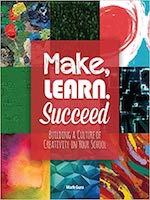

 Dr. Michelle Zimmerman has more than 18 years of classroom teaching experience, and is currently on the rise as a recognized expert in teaching STEM in K-12. I sat down with her recently to talk about the current state of STEM education, a subject she will be discussing in depth in a handful of sessions at the 2019
 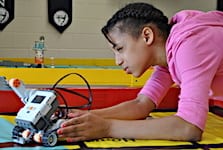 Training educators is a daunting task under the best of circumstances. They need to have a broad field of experience to make a cross-discipline approach to STEM work, either through university or training. One of the first obstacles to overcome is the way the subject itself is taught. “If we get so locked into saying, ‘This is the one and only way of doing or approaching the subject or topic,’ we miss the opportunities to practice looking across multiple domains and finding those connections that help solve problems.”
 Michelle Zimmerman, Ph.D., has taught all grades from Pre-K through 10th with a focus on middle and high school since 2009. She has presented her research across the US and Canada since 2007, FETC, ISTE, TCEA, NCCE, CRESST, BLC, NNSTOY, The Learning Counsel, SXSWedu, New York Academy of Sciences, UCLA, NYU, and AERA among others The evidence of her original research and theory into practice can be seen in designing