Personalized Learning: Changing the Way Students Learn
Jeff McCoy's account of how Greenville County Schools relaunched its 1:1 device program around teaching, updated with the district's 2026 screen-time limits.


A 1:1 device program in practice: Greenville County Schools' 2017 relaunch, its 2026 screen-time limits, and lessons for other districts.
edCircuit note: Jeff McCoy, then associate superintendent of academics at Greenville County Schools in South Carolina, wrote this account in 2017 of how the district relaunched its 1:1 device program around teaching rather than devices. His account is unchanged below. An update after it follows the program to 2026, when the district set new limits on screen use, and draws out lessons for other districts.
Personalized Learning is impacting the way students Live and Learn.
Greenville County Schools is located in the upstate of South Carolina and frequently makes the list as one of the best places to live. Greenville County is fortunate to be home to some of the country’s largest businesses like BMW, Michelin, Bosch and a host of others. The district boasts high test scores and typically outperforms the state and nation in most categories. The district is home to nearly 77,000 students and covers over 800 square miles.


Creating a Strong Vision
The first thing we did was establish a district technology committee to design a vision for what personalized learning should look like. This committee was made up of teachers, principals, and district staff. Through many hours of discussion and conversations, a vision was developed. This vision encompassed the present and also the future. We have strong vision for what we want personalized learning to look like five years from now and we have a plan to get us there.
Create buy-in from all levels
Greenville is fortunate because our Superintendent, Dr. Burke Royster, is an innovator. He has the vision to see where we could be and knows how to gather the staff around him to make that vision a reality. He was recently named as one of Education Week’s 2017 Leaders to Learn From. His vision for learning and innovative leadership has been the result of many successful initiatives in Greenville County. Having strong leadership from the top down is key to success for any initiative.

We started the re-boot of our personalized learning initiative by getting everyone on board. The leadership for personalized learning lives in the academics department. The technology department is critical in making personalized learning a success. However, personalized learning is not about a device. It is about the teaching and learning that take place because all students have access to a device. It is about the classroom instruction that changes because learning is able to be personalized and differentiated to new levels. The leadership for personalized learning must come from the Academics Division for the focus of the initiative to be on what we are all about — teaching and learning! It is critical that the academics and technology departments have a strong working relationship. Personalized Learning will not be successful if those two departments are unable to work together to accomplish the vision.
All members of the executive team in Greenville County and the Board of Trustees understand the vision for personalized learning and where we are going. It is critical for all departments to understand where the district is going and what role their department plays in getting there. If all departments are not working together, the journey will be difficult and filled with obstacles! In Greenville, the Academics and Technology Departments work closely together to ensure the personalized learning initiative is successful. The talents in the Technology Department keep the technology operating smoothly, the networks open and students safe while interacting with the web. The Academics Department is key in helping teachers understand how to use these tools in their classroom to personalize learning and actively engage students in the learning process.

Investing in Professional Development

In addition to the Discovery Leader Corp, the GCS Instructional Technology Department is a key component of the Personalized Learning initiative. Unlike many districts, the Instructional Technology team reports to the Associate Superintendent of Academics. Their primary role is to support the schools daily as they implement personalized learning. They do not provide technical support, but rather instructional support which is why it is critical they report to the Academics side of the house. They also hold Personalized Learning Academies with schools one year prior to the school receiving devices. This academy focuses on the school planning necessary to implement personalized learning. School leadership teams (including teacher leaders) spend two days creating a plan for their initiative. They then spend the next year refining that plan and implementing various sections of that plan before receiving the devices. This up-front planning allows the schools time to consider all obstacles and discover solutions for them, well ahead of them becoming issues.
Embarking on the Journey

Greenville’s 1:1 device program in 2026: what changed and what districts can learn
When McCoy wrote about Greenville’s 1:1 device program, giving every student a school-issued computer was still a choice that set a district apart. The pandemic made it ordinary. In EdWeek Research Center surveys reported by Education Week in 2022, about two-thirds of district leaders recalled providing a device for every middle and high school student before the pandemic, and about 40 percent said the same for elementary students. By March 2021, 90 percent said they provided a device for every middle and high school student and 84 percent for every elementary student. The same report noted growing concern about screen time and about tech fatigue among students and teachers.
Greenville’s new limits
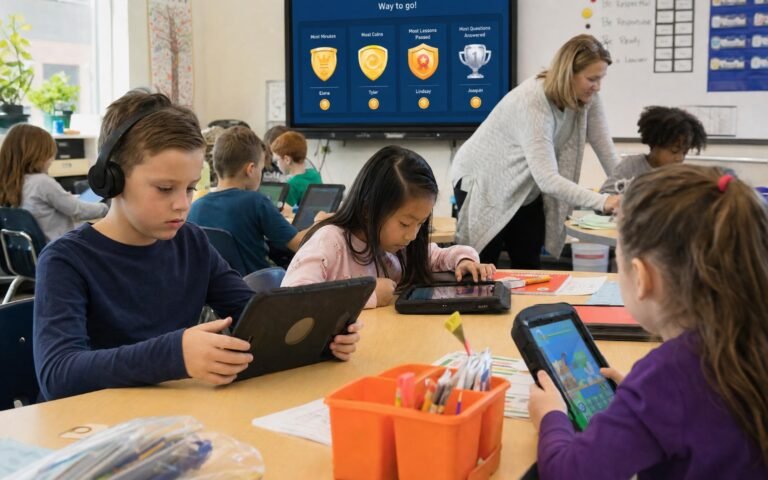
Greenville County Schools has kept its 1:1 program but narrowed how devices are used for the 2026-27 school year. Two local television reports, from FOX Carolina in June 2026 and FOX Carolina in August 2026, agree on the main changes: kindergarten and first-grade classrooms move from one device per child to three to five shared devices per classroom for small-group work, students in grades 2 through 5 keep their own devices but only for district-approved apps, and the district is capping how much class time is spent on screens. The two reports describe that cap differently, and the district’s own rule could not be found, so the exact grades and limits are not given here. The June report quotes the district’s aim as balanced technology use, and the August report cites student privacy and age-appropriate use.
The change is consistent with the argument McCoy makes above, that the initiative is about the teaching and learning a device makes possible rather than the device itself. A decade later the district is deciding, grade by grade, how much screen time serves that teaching.
What the evidence says about personalizing with devices
Research on technology-based personalized learning supports cautious expectations. A RAND Corporation study of 40 schools in the Gates Foundation-funded Next Generation Learning Challenges initiative, covered by Education Week in July 2017, found that students gained about 3 percentile points in math compared with similar students elsewhere, while the gain in reading was positive but not statistically significant. The schools used 62 different digital curricula and assessments, only eight of them in more than one school, and teachers reported that many students fell behind when allowed to move at their own pace. The schools were mostly urban charters, so the results may not carry over to a large county district.
International data point the same way. In the 2022 Programme for International Student Assessment (PISA), the OECD’s test of 15-year-olds, about two-thirds of U.S. students said they were distracted by their own device use in at least some math lessons, Education Week reported in December 2023. Across OECD countries, students distracted by other students’ devices scored 15 points lower in math than students who rarely were. These are correlations from student self-reports, not proof that devices cause lower scores, but they explain why districts like Greenville are setting limits.
Lessons for a district planning or revising a 1:1 program
- Put academics in charge. McCoy’s point that the initiative should be led by the academic division, with technology as a close partner, has held up as districts shift from buying devices to deciding how they are used.
- Plan before devices arrive. Greenville’s year of school planning ahead of each rollout gave schools time to solve problems before they became issues.
- Invest in teacher leaders. A corps of trained teachers who open their classrooms gives colleagues a working example to learn from, which is how Greenville’s Digital Leader Corps was designed.
- Vet every app. Privacy, security and rostering checks belong in the program from the start rather than as a later cleanup.
- Set screen-time expectations by age. Rules that differ for early grades, upper elementary and secondary school let a district match device use to what students at each age are learning.
- Budget for the whole life of the device. As McCoy notes, finance has to understand the initiative to sustain it, including repair and replacement cycles.
Related reading
More on Personalized Learning