There is no consensus on how math works in the brain by Betsy Hill
 In the first article in this series, we provided an overview of cognitive skills, the mental processes our brains use to take in, comprehend, organize, store, retrieve and use information. In the second article, we examined the cognitive skills that are mostly closely associated with reading. In this article we will explore the connection between cognitive skills and math.
As the foundation for learning, cognitive skills are essential across the curriculum, including math and other STEM fields. However, math comprises so many different topics and levels of complexity that it is a challenge to address comprehensively, and indeed there is much that continues to elude scientific consensus in characterizing how math works in the brain. It may seem like a stretch to say that the same mental processes are involved in basic math concepts like counting, and more advanced topics like algebra and calculus. In fact, most of us can’t remember learning to count, but most of us will remember learning long division, or geometry, or algebra or calculus.
What, then, are the important underlying cognitive processes that support or impair our learning of math? While there are undoubtedly many ways of dividing up math topics, the following illustration groups math skills into an order that seems to fit with our understanding of key findings from scientific and educational research.
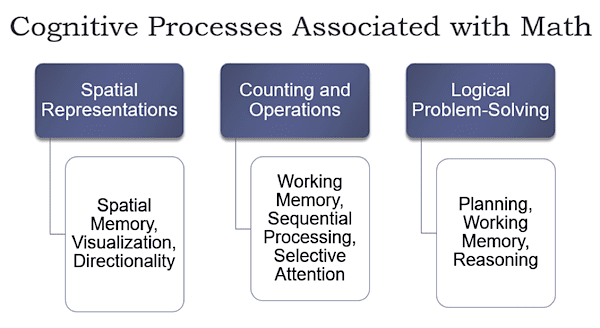 The relationship of math success to visual-spatial abilities is strongly supported by research, and the correlation actually appears to increase as the complexity of the mathematical task increases. The important aspect of visual-spatial processing is not just remembering the shape, size, color and number of objects, but their relationships to each other in space. It turns out that visual memory by itself (what things are) is somewhat error-prone, but spatial memory (where things are) is associated with correct answers, and is thus an important aspect of mathematical problem-solving. Within visual-spatial processing, we can distinguish cognitive skills such as the following:
- Spatial Memory. This refers to our ability to remember where we are in space and where we are related to other objects in space. This understanding provides the foundation on which problems (changes in the space) can be solved.
- Visualization. Our ability to visualize a problem we are considering or to visualize alternative solutions contributes substantially to our understanding of the problem. When we learn transformations in geometry, for example, interpreting the difference between a translation (sliding an object along a straight line), a rotation (turning an object around a point) and a reflection (mirror image) is greatly aided by our visualization skills.
- Directionality. The ability to distinguish left and right, of course, is more than about math. It comes in handy when tying shoes, reading a map or a chart, and in executing a football or basketball play. It is critical in chemistry (where two molecules may differ only in the orientation of the atoms (the technical term is “enantiomer”), but have two completely different uses (like one drug used to treat tuberculosis whose enantiomer causes blindness). While we don’t all deal with chemistry on a daily basis, we do often have to navigate unfamiliar territory. Imagine someone just handed you a map with a route traced on it. Do you have to keep turning the map around to figure out what direction to turn next? If so, your directionality skills are not as strong as they might be.
When it comes to counting and numerical operations, we are again dependent for math success on some foundational cognitive skills, such as sequential processing and selective attention, and on executive functions (the directive capacities of our minds) such as working memory.
- Working Memory – As explained in our previous article, working memory refers to our ability to hold information in our minds while we manipulate it. Working memory capacity is highly correlated with reading comprehension, with math performance, and with many other academic and non-academic outcomes. Working memory serves math processes from the very simple (for example, keeping track of which applies in the basket we’ve counted and which we haven’t) to the most complex reasoning and mental simulations we perform when calculating statistics or contemplating string theory or manipulating derivatives in calculus.
- Sequential Processing – Counting, of course, is all about sequences, so once again, cognitive skills contribute crucially at even the most elementary stages of math. As we start to manipulate and calculate, the sequence of steps to solve a problem must be observed. A concrete example is the concept of order of operations and the different result that comes from (6 + 5) X 2 and from 6 + (5 X 2).
- Selective Attention – When we have good selective attention, we can more easily screen out the irrelevant parts of a complex problem and isolate the pertinent facts that we need to concentrate on. If Mary, who is wearing a red dress, is 3 years older than John, who is wearing a blue shirt and jeans and just celebrated his 10th birthday, we don’t need to know the color of their clothes to determine how hold Mary is.
 Finally, math is problem-solving. There are other types of problem-solving, of course, but problems with numbers almost always call for mathematical thinking and logic. In the discussion above, we have already highlighted some of the cognitive skills we use for problem-solving, but higher-order cognitive processes are often required to be successful in math. And here we can start with Planning:
- Planning – When giving examples of cognitive skills at work, I often head to the most basic example I can think of. In this vein, a vivid memory of elementary school comes to mind; perhaps you have had a similar one. I am learning long division. I am supposed to carry out my solution to some number of decimal places. I write the problem on my paper and then, halfway through, I realize that I wrote the problem too far to the right on the piece of paper. That was a lack of planning. Good planning is in evidence when we consider alternative approaches to a problem, map out the sequence of steps in advance, and then carry them out efficiently and accurately.
- Working Memory – Here again, I think of a basic example. A fourth-grade girl in a school we were working struggled with finishing her math assignments. She understood the core concepts of the computations she was being asked to do, but she had limited working memory capacity. When she needed to copy a problem from her math book onto her assignment paper, say,
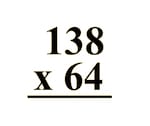 she would have to copy each number by itself, first the 1, then the 3, and so on. She could not remember 138, much less the entire problem. (I am happy to report, that after she started a cognitive training program, she got to the point where she could remember the entire problem accurately – she and her mother celebrated with ice cream.) It should be obvious by now that working memory is essential to hold the elements of any problem in mind, consider different approaches, and keep track of where we are in a sequence of steps to solve a multi-step math problem.
 - Reasoning – Ultimately math is logical and will put demands on our reasoning skills, as well as help us develop our reasoning skills. As we learn to derive theorems or explain how we draw conclusions (deductively or inferentially), we have to recognize patterns, analyze cause and effect, test hypotheses and determine whether to include or exclude items from sets. For all of these, logic is essential.
As is the case with reading, our cognitive skills must work together in complex and integrated ways. An article in Misunderstood Minds summarizes the process clearly,
“For children to succeed in mathematics, a number of brain functions need to work together. Children must be able to use memory to recall rules and formulas and recognize patterns; use language to understand vocabulary, instructions, and explain their thinking; and use sequential ordering to solve multi-step problems. In addition, children must use spatial ordering to recognize symbols and deal with geometric forms…. Often several of these brain functions need to operate simultaneously.”
 As we observed in the previous article on reading, there is significant overlap in the cognitive skills needed for reading and math. It bears repeating that we don’t have two brains; we just have one, of course, and we use it for reading and math and everything else we do. As we acknowledge how critical these skills are to learning, it raises the question of how we can support our students in developing these skills so that they can be effective learners. In the next article in our series, we will look at how cognitive skills develop and how they can be strengthened in ways that contribute to improved academic performance.
Author
 Betsy Hill is President of BrainWare Learning Company, a company that fosters the practical application of neuroscience to learning and teaching.
She is an experienced educator and has studied the connection between neuroscience and education with Dr. Patricia Wolfe (author of Brain Matters) and other experts. She is a former chair of the board of trustees at Chicago State University and teaches strategic thinking in the MBA program at Lake Forest Graduate School of Management.
She holds a Master of Arts in Teaching and an MBA from Northwestern University.
Further Reading
- Teach Hub – Top Cognitive Skills Essential to Student Learning
- Ed Week – Pre-K, Plus a Little Extra, Can Help Close Math Gaps for Children in Poverty
- Washington Post – The inappropriate focus on math and reading hurts students











 Danny Wagner is Senior Editor, Education Reviews at
 As someone who did not grow up with English as my first language, I always found it particularly difficult to read science articles and textbooks. Usually, the text included so much technical vocabulary and jargon that I was overwhelmed by the number of new words I had to stop and look up; oftentimes I would have trouble understanding entire sentences if they contained multiple unknown words or phrases. Looking back, reading would have been much easier if I had the skills to break down sentence structures in order to identify the key nouns and verbs. Sentence diagramming is a pedagogical approach that guides students through complex sentences, breaking them up into more manageable pieces that help students understand the meaning of specific words. In science courses, much of the vocabulary is unfamiliar as most people do not encounter it in their day-to-day interactions, which could lead to higher levels of confusion and misunderstanding, especially for English Language Learners (ELL).
 In order for students in Texas to graduate, they are required to pass a biology end-of-course exam. Throughout this course, students study living organisms which includes subjects like anatomy, behavior, and interaction. The amount of reading required to learn this information is staggering, and test questions are often long sentences describing different scenarios the students would have to navigate through to provide a correct answer. For students not yet proficient in the English language or content, this can act as a roadblock and hinder their success.
 Students encounter similar comprehension issues in other science courses, including physics, geology, aquatic science, and astronomy. Upon learning a long list of new vocabulary words, they must read and understand articles using these new terms. Too often, students give up as soon as they see test questions in paragraph form because the process of making sense of it all is too discouraging. If we were to teach them how to break down each question in order to get to the main point, it would make the process more tolerable for those who struggle with the English language and could lead to higher success rates. As previously stated, sentence diagramming is an approach to teaching and learning that helps readers overcome literacy challenges by understanding the main point each sentence is trying to convey, especially in vocabulary-riddled text.
 Joy Lin attended the
 Something I recommend in my work with schools and districts is to leverage social media to their advantage as a professional development tool. When I ask a group of educators how many are using Twitter, either personally or professionally, I am frequently saddened by the lack of hands I see raised. Many teachers think of Twitter as a waste of time – something with no value in the education realm. After all, how much content can you receive in 280 characters. Just the opposite is true.
 Once you get involved in Twitter as a way to grow professionally, the possibilities are almost limitless. Gather research for an article or blog post by posting questions to your PLN. Receive constructive criticism on a lesson plan, presentation, or idea from other educators. Share tips and get advice on things like parent/teacher conferences and open houses. Collaborate with others to solve a specific issue at your school. Once you get started, you just might become an evangelist. I know I did.
 There are challenges facing colleges and universities in adopting and implementing game-based learning into the higher ed environment. Three of the industry leaders, Karl Kapp,
 Jim Kiggens has over two decades of experience in producing and developing game-based learning for higher education, middle and secondary school, and corporate training. In addition to shipping 24 Serious Game titles at Course Games, Jim also has over 20 years of experience in instructional design, program development, and teaching digital animation and game development at several colleges and universities.
 Karl Kapp, Gamification, is an analyst, published author and assistant director and faculty member at Bloomsburg University’s Institute for Interactive Technologies (IIT).
 André Thomas has over 20 years experience in CGI production, he has worked around the world on legendary video games, live action feature films and gripping commercials. He served as Head of Graphics for EA Sports Football (including NCAA, Head Coach, NFL Tour and Madden, the longest running and most successful sports franchise in this history of the games industry.)
 Series Synopsis
 “When we think we’re multitasking we’re actually multi-switching. That is what the brain is very good at doing – quickly diverting its attention from one place to the next. We think we’re being productive. We are, indeed, being busy. But in reality, we’re simply giving ourselves extra work.”
  With the digital generations, this multitasking all happens much faster. The digital generations are sending text messages, watching Internet videos, listening to downloaded playlists of music, talking on smartphones, looking at brightly colored flashing websites, sending instant messages, and generally counting on the Internet as their external brain. As a result, their minds must continually skim and skip between tasks to keep up. This butterfly brain effect can be a real challenge when educators are trying to get students to focus on important tasks or employers are trying to get workers to focus on their jobs.
 Compare that approach and traditional mindset to the way that the digital generations function today. How many of you have walked into a kid’s bedroom recently? They are, working on a tablet, earbuds dangling around their neck cranking out the music of some band you’ve never heard of before called Brain Enema or Baby Metal, their hand reflexively tapping to the backbeat of the song. Meanwhile, they’re also doing their homework, watching a YouTube video, tweeting a friend, downloading some music and an image from Google, and cybershopping, while they’re simultaneously carrying on two conversations on Instagram about last night’s episode of the Walking Dead. And if you ask them, they’ll tell you they’re still bored! They’ll also tell you they have to play their music loud because it helps them concentrate—something that many of the older generations simply can’t fathom.
 In Brain Rules, Medina (2008) says that educators need to acknowledge that multimedia multitasking is an everyday reality of life—that students do not suffer notable cognitive shortcomings as they multitask; rather, they are learning more, and they are more adept at finding answers to deep questions, in part because they can search effectively and access collective intelligence. And Medina cautions that the solution to the challenges of multitasking is not just to remove technology and other distractions because they are too intricately woven into the digital generations’ lives.
 As a professor, author, blogger, consultant, and keynote speaker, Ryan L. Schaaf wants to help educators reach the learners of the digital generations.