
 Ian Egan
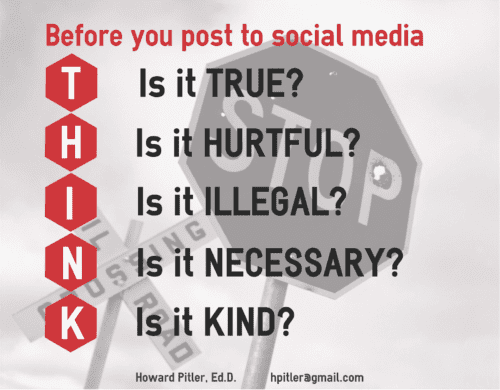
Educators, more than anyone else, have to stop and THINK by Howard Pitler, Ed.D.
 Social media poses specific challenges for educators. I have thousands of followers on Twitter, almost all of them educators. I also come across many more educators when I participate in Twitter chats and on Facebook. Looking across this fairly large sample of social media sites created by educators, I think it might be useful to provide a few tips that just might help keep someone from doing something that will cost them their job.
1.) Your professional Twitter and/or Facebook sites should be separate from any personal sites you have. Students, administrators, parents, and community WILL use Google to try to learn more about you. I only use Twitter for education-related posts. I avoid taking a stance on politics. I may post something purely factual but stop short of making judgments. I leave that to the reader. My Facebook account is for family and friends only. While you might find a picture of my wife and I toasting with a glass of wine, you won’t find anything I wouldn’t want my clergy or my mother to see. Even if your settings are set to “friends only” there is nothing that would prevent a friend from retweeting or sharing your post to his or her wider network. Once a post is out there, it is out there forever. This short PSA from the Ad Council brings home that point nicely.
 2.) Know your school and district’s policies regarding social media. It is likely there are policies regarding student images and even mentioning your school or district on social media. While your district may allow you to post pictures of students working in your classroom – don’t do it. Parent will have their own personal thoughts on seeing their child’s face on a class blog, and some will not like it one bit. Just because you can do something doesn’t mean you should do it.
3.) Never complain about your job, parents of students, or students on social media. NEVER! A comment like, “I can’t believe what my principal did today” or “I met so-and-so’s parents at conferences last night and now I see where he/she gets it from” will always come back to bite you. According to the National Education Association, “to date, there have been only three court cases involving teachers who claimed that their First Amendment rights were violated by being punished because of their postings on social networking sites. The teachers LOST every case.”
4.) Do NOT friend or follow students. Just don’t do it. Head this off at the beginning of the year by telling all students that your personal policy is not to friend any students until after they have graduated from high school. The appearance of impropriety is enough to raise questions even though you or the student have done nothing wrong.
5.) Do not geo-tag your posts with your school location. Geo-tagging will allow students and parents to search by location and lead them to your account.
 Social media can be a wonderful thing. It allows people to stay in touch with family around the country and the world. It brings news to your desktop as it is happening. As a former classroom teacher and building principal, I love seeing how my former students have grown into wonderful adults and parents. It is gratifying to think I might have played some small part in their development. The key is that these are former students and they, for the most part, reached out to connect with me.
I have a downloadable poster on my website you might want to have in your classroom. My rule of thumb regarding social media is THINK.
Author
Howard Pitler is a dynamic facilitator, speaker, and instructional coach with a proven record of success spanning four decades
Pitler is an ASCD Faculty member and the author of several ASCD publications including Classroom Instruction That Works, 2nd edition, Using Technology with Classroom Instruction That Works, and A Handbook for Classroom Instruction That Works, 2nd edition. Contact Pitler at hpitler@gmail.com or on his website. Follow Howard on Twitter.
Further Reading
- EdSurge – How Social Media Can Help Teach Good Writing
- TeachThought – 10 Social Media Sites For Education
- WBUR – Why Facebook, Twitter And Instagram Belong In The Classroom