
 EdCircuit Staff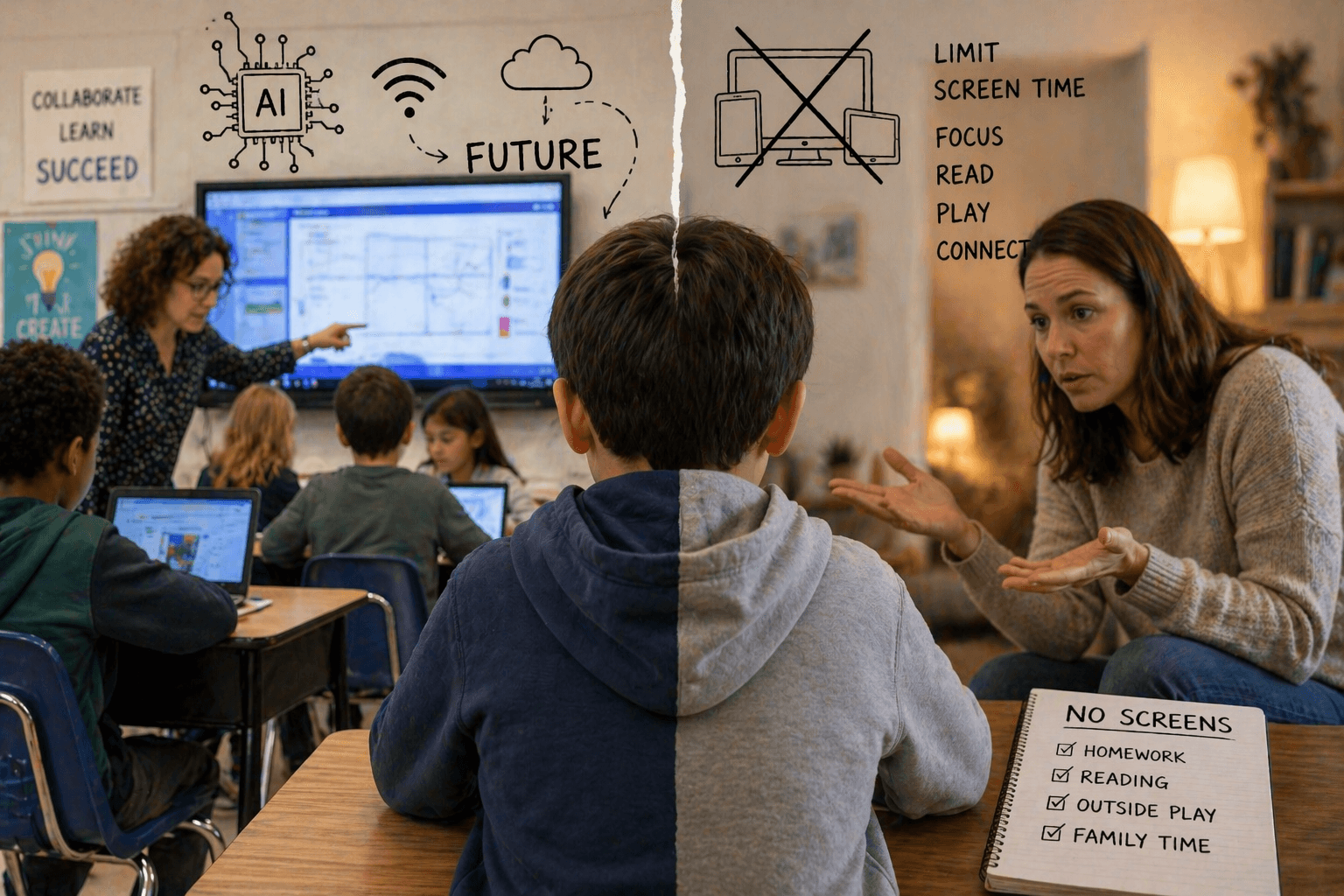
The parent-school divide on screen time and AI is no longer subtle—it is growing in real time, and students are caught in the middle.
In classrooms, students are engaging with digital platforms, interactive tools, and increasingly, artificial intelligence. These technologies are being introduced to enhance learning, personalize instruction, and prepare students for a rapidly changing future.
At home, however, a different conversation is taking place.
Parents are limiting screen time. Monitoring device use. Raising concerns about attention, behavior, and development. They are asking whether children are spending too much time on devices—and not enough time thinking, interacting, and engaging in the real world.
And in the middle of these two environments is the student.
Navigating two very different expectations about how learning should happen.
Two Environments, Two Philosophies
For schools, technology represents opportunity.
It offers:
- Access to resources
- Personalized learning pathways
- New ways to engage students
- Tools to prepare learners for a digital future
Districts are making intentional decisions to integrate technology and AI into instruction—not as an add-on, but as a core component of modern learning.
For parents, technology often represents concern.
They are observing:
- Increased device dependency
- Shorter attention spans
- Changes in behavior and social interaction
- A growing reliance on screens for both learning and entertainment
These observations are not unfounded.
But they are often disconnected from how schools are framing technology use.
What schools see as innovation, families may see as overexposure.
The Mismatch Students Are Living In
The tension between school and home is not theoretical—it is lived out by students every day.
The same student being told to limit screen time at home is often required to depend on it at school.
A child may be:
- Encouraged to use digital tools throughout the school day
- Asked to limit or avoid those same tools at home
At school, speed and efficiency are often emphasized through technology.
At home, parents may encourage slower, more deliberate activities.
At school, AI may support writing and problem-solving.
At home, parents may want their child to develop those skills independently.
In some households, parents are asking children to complete homework without digital assistance—only to find that the assignment itself was designed to be completed on a device.
These differences are not just philosophical.
They are shaping how students understand effort, independence, and learning itself.
And when expectations are not aligned, confusion follows.
This divide is no longer theoretical—it is playing out in real districts across the country.
In the video below, parents are asking schools to limit the use of AI and classroom technology, while district leaders explain their approach—highlighting the growing gap in expectations around how students should learn.

Why This Divide Matters More Than Ever
The parent-school divide is not just about screen time.
It is about alignment.
When families and schools are not aligned:
- Communication begins to break down
- Policies are questioned
- Trust becomes harder to sustain
And in a time when schools are asking communities to support decisions around AI, device use, and digital learning strategies, that trust is essential.
This is not simply a communication issue.
It is a leadership issue.
The Silence Around Purpose
One of the most significant gaps in this conversation is not disagreement—it is clarity.
Many districts have implemented technology effectively.
Fewer have clearly communicated:
- The purpose behind its use
- The expected outcomes
- The boundaries in place to protect student development
Parents are often left to interpret what they see:
- Devices coming home
- Increased screen time
- New tools they may not fully understand
Without context, concern fills the gap.
Because when purpose is not clearly defined, technology can feel excessive—even when it is being used thoughtfully.
Moving From Assumption to Alignment
Closing the gap between schools and families does not require eliminating technology.
It requires alignment.
And alignment begins with transparency.
Schools must move from assuming understanding to actively building it.
This means:
- Clearly explaining how and why technology is used
- Defining what productive screen time looks like
- Communicating where limits and boundaries exist
- Involving families in the conversation—not just the outcome
Parents do not need to agree with every decision.
But they do need to understand it.
Because understanding builds trust.
Reframing the Role of Technology
Part of this alignment requires a shift in how technology is positioned.
It cannot simply be presented as necessary.
It must be presented as intentional.
Technology in elementary classrooms should be framed as:
- A tool to support thinking—not replace it
- A resource used at specific moments—not constantly
- A component of learning—not the entire experience
This distinction changes the conversation.
It moves from:
- “Why are students on screens so much?”
To:
- “How is this supporting learning?”
And that shift matters.
The Role of AI in the Divide
AI introduces a new level of complexity.
Unlike traditional digital tools, it does more than deliver content.
It can:
- Generate responses
- Guide thinking
- Complete parts of the learning process
For schools, this represents opportunity.
For parents, it often raises concern.
Questions around:
- Academic independence
- Skill development
- Over-reliance on technology
Are becoming more common.
And in many cases, families are asking these questions before schools have fully answered them themselves.
This is where proactive leadership becomes critical.
Because if schools do not clearly define the role of AI, families will define it for themselves—and often with caution.
A Shared Responsibility
Neither schools nor families can solve this alone.
Students do not experience learning in isolation.
Their habits, expectations, and behaviors are shaped across environments.
Which means alignment is not optional.
It is necessary.
Schools must:
- Lead with clarity
- Communicate with purpose
- Design learning with intention
Families must:
- Engage in the conversation
- Seek understanding
- Partner in supporting student development
Because the goal is not full agreement.
It is a shared direction.
A Defining Moment for Trust
The parent-school divide on screen time, and AI is not just about technology.
It is about trust in how learning is being shaped.
The decisions being made today—about how students use technology, how they engage with AI, and how learning is structured—will have long-term implications.
And those decisions cannot exist in isolation.
They must be understood, supported, and aligned across the environments students move through every day.
Because when schools and families are not aligned, students don’t just experience different expectations.
They experience different definitions of what learning is supposed to be.
And in the end, the future of education will not be defined solely by what happens in classrooms.
It will be defined by whether schools and families can come together around a shared vision of how students learn—and what they truly need to succeed.
Subscribe to edCircuit to stay up to date on all of our shows, podcasts, news, and thought leadership articles.