 EdCircuit Staff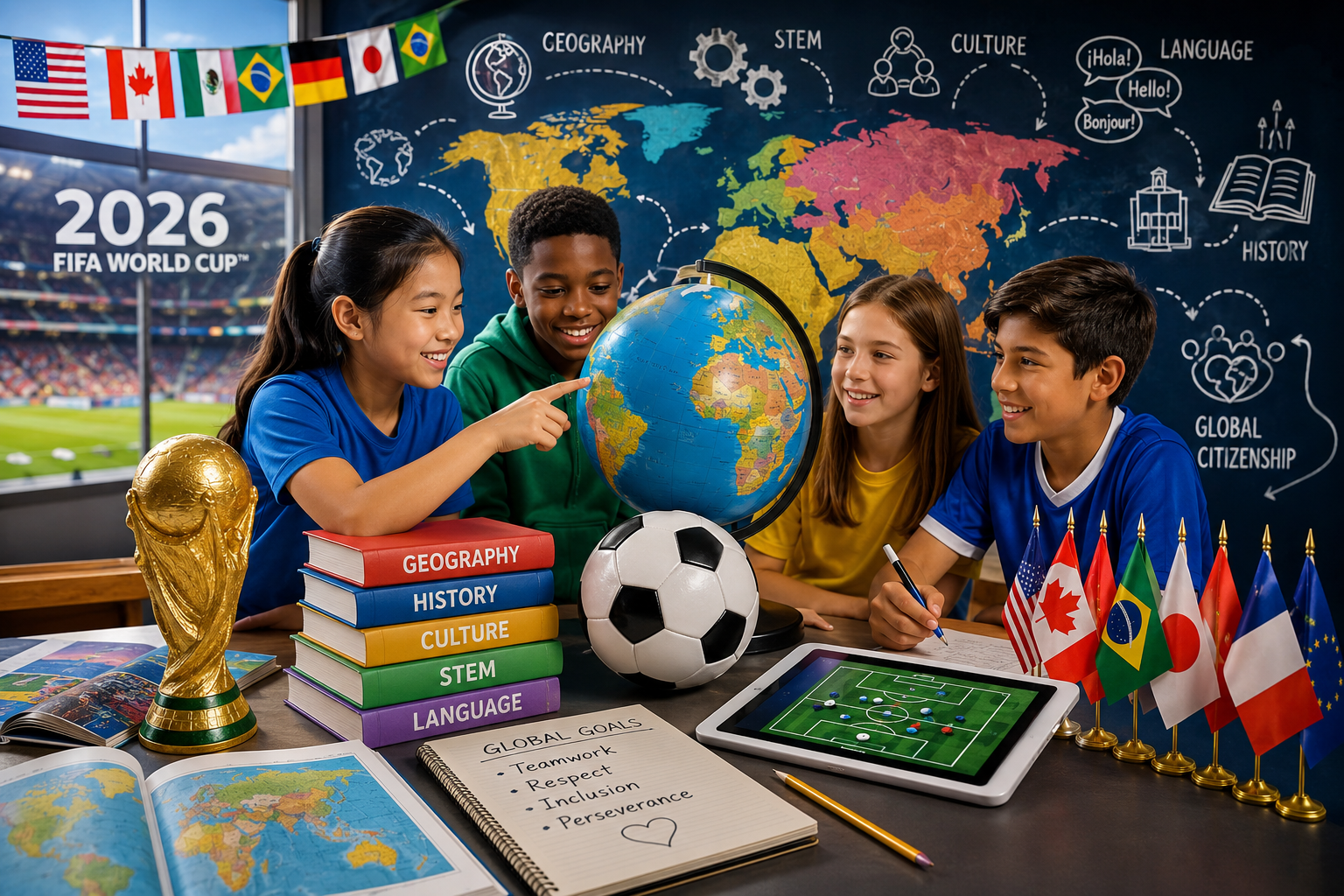
World Cup education opportunities extend far beyond the excitement on the pitch, offering schools and families meaningful ways to connect students with the people, places, cultures, and ideas that shape our increasingly interconnected world. As the United States, Canada, and Mexico welcome the world in 2026, the tournament presents a rare opportunity to transform one of the planet’s most celebrated sporting events into a powerful educational experience.
For billions of people, the FIFA World Cup represents passion, pride, and unforgettable moments. For educators, however, it represents something even greater: one of the world’s largest classrooms.
From geography and history to STEM, languages, culture, and global citizenship, the tournament provides authentic opportunities to engage students in learning that feels relevant, meaningful, and alive. At a time when educators are searching for ways to connect classroom instruction with real-world experiences, few events offer as many possibilities as the World Cup.
The World’s Biggest Sporting Event Becomes the World’s Biggest Classroom
Every four years, the World Cup brings together nations from every corner of the globe. Fans may focus on the matches, but educators can focus on something equally important—the stories behind the teams.
Students naturally become curious about countries they may have never studied before. They want to know where players come from, what languages they speak, what traditions they celebrate, and what makes their cultures unique.
That curiosity is powerful.
Research has long shown that students learn best when they are engaged and emotionally invested. The World Cup creates that engagement naturally. Learning no longer feels disconnected from the world around them. Instead, students begin to understand that geography, history, mathematics, science, and culture are all connected.
In many ways, the tournament transforms the entire world into a classroom.
Geography Comes Alive
Maps become more than decorations on the wall when students are cheering for teams from around the world.
The World Cup provides countless opportunities to explore continents, countries, capitals, populations, climates, and natural landmarks. Students can compare host cities, calculate distances traveled by teams, and investigate how geography influences culture and daily life.
Rather than memorizing locations, students begin asking questions.
Why are certain nations so passionate about soccer? How do climate and geography affect lifestyles? What similarities exist between countries separated by thousands of miles?
Those questions encourage exploration and critical thinking.
More importantly, they help students recognize the incredible diversity that exists across our planet while reinforcing the idea that people everywhere share common hopes, dreams, and experiences.
Mathematics With Real Meaning
For many students, mathematics becomes far more interesting when it is connected to something they enjoy.
Goals scored, possession percentages, player statistics, tournament brackets, rankings, and probabilities all provide opportunities for authentic mathematical learning.
Students can analyze scoring averages, graph team performance, calculate percentages, and make predictions throughout the tournament. Concepts such as probability, statistics, and data analysis suddenly become relevant because they are being applied to events unfolding in real time.
Instead of asking, “When will I ever use this?” students can immediately see the answer.
Real-world data creates real-world learning.
STEM Is Everywhere in the Beautiful Game
Behind every World Cup match lies an incredible story of science, engineering, and innovation.
Students can explore the physics behind ball movement and investigate how speed, force, and spin affect performance. They can examine the engineering and architecture required to construct modern stadiums capable of safely hosting tens of thousands of spectators.
Technology has transformed the game itself.
Goal-line technology, video assistant referees (VAR), wearable sensors, artificial intelligence, performance analytics, and advanced sports science are now central components of elite competition.
These innovations provide students with valuable insights into careers in engineering, computer science, robotics, sports medicine, and data analytics.
The World Cup reminds young people that STEM is not confined to laboratories or textbooks. It exists everywhere—even in the games they love.
Culture, Language, and Global Understanding
Perhaps no sporting event better illustrates the richness of human diversity than the World Cup.
Countries with different histories, traditions, and languages come together to celebrate a shared passion. For students, this provides a unique opportunity to expand their understanding of the world.
Teachers can introduce customs, music, food, holidays, and traditions associated with participating nations. Language classes can explore greetings and common phrases while helping students appreciate the importance of communication across cultures.
Schools might organize international festivals, classroom projects, or cultural celebrations that allow students to showcase countries participating in the tournament.
These experiences foster empathy, curiosity, and respect—qualities that are essential in a world that grows more connected each year.
History Through the Stories of Nations
Every team competing in the World Cup carries a history that extends far beyond soccer.
Students can examine the events, leaders, and movements that shaped nations throughout history. They can explore how sports have influenced societies, united communities, and even served as symbols of hope during difficult times.
History becomes more than dates and timelines.
It becomes the story of people.
Through the lens of the World Cup, students gain a deeper appreciation for the experiences that have shaped countries and cultures across generations.
Learning Doesn’t End When the Bell Rings
The educational opportunities created by the World Cup extend well beyond school walls.
Families can watch matches together and use them as springboards for meaningful conversations. Parents can encourage children to research countries before kickoff, prepare meals inspired by participating nations, or explore books, documentaries, and museums that bring global cultures to life.
Communities may host watch parties, cultural festivals, and public events that expose young people to experiences and perspectives beyond their immediate surroundings.
Some of the most meaningful learning experiences happen not in classrooms, but around dinner tables and in conversations shared between generations.
Preparing Students for a Global Future
Today’s students will inherit a world that demands collaboration, communication, and cultural understanding.
Success in the future workplace will require more than academic knowledge. Young people must learn to appreciate different perspectives, work alongside diverse communities, and understand how interconnected the world has become.
The World Cup offers an opportunity to develop those qualities.
For a few weeks, billions of people from different countries, cultures, and backgrounds come together around a common passion. They celebrate together, mourn together, and experience moments that transcend borders and languages.
That may be the tournament’s greatest lesson.
Understanding one another matters far more than understanding the score.
Beyond the Trophy
When the final whistle blows and a champion lifts the trophy, the memories will remain.
But perhaps the greatest legacy of the 2026 FIFA World Cup will not be measured in goals, championships, or highlight reels.
It may be found in a student discovering a new country.
In a classroom discussion about culture and history.
In a family exploring the world together.
And in young people, realizing that the differences that make humanity unique are also what bring us together.
Because the world’s most popular sport offers something far greater than competition.
It offers an opportunity to learn from one another—and that lesson extends far beyond the game.
Subscribe to edCircuit to stay up to date on all of our shows, podcasts, news, and thought leadership articles.