
 Barbara R. Blackburn
Table of Contents
Multi-Tiered System of Supports (MTSS program) is an approach to identifying students with learning disabilities by providing research-supported interventions to students who struggle. Even though it focuses on students with learning disabilities, it is designed to impact students at multiple levels, from core content to secondary and intensive interventions. There are 3 critical elements of an effective MTSS program: evidence-based instruction as prevention, collaboration, and an assessment system that drives decisions.
Evidence-Based Instruction as Prevention
At the heart of every successful MTSS is a focus on improved Tier 1 or Core instruction before moving to specialized intervention strategies. In other words, we want to prevent issues through effective core instruction—prevention rather than remediation.
Oftentimes, we have focused so much on students’ deficits, that it is counterproductive. As one teacher told Barbara, “There’s just so much wrong with my students, I can’t do anything about it.” Ken Howell notes that in MTSS, there is a shift in thinking. “The central question is not: ‘What about the students is causing the performance discrepancy?’ But rather ‘What about the interaction of the curriculum, instruction, learners, and learning environment should be altered so that the students will learn?’” (Dorman, Wheeler, & Diamond, 2010, p. 1).
There is a sharp difference in these two comments. One focuses on what the student is doing wrong, and one focuses on what we can adjust to help him or her improve. In Tier One, we are saying that we will start with the highest expectations and do what we can to help students be successful. Then, if that doesn’t work, we’ll move to more intensive options. Older deficit models have a different approach: start with what students cannot do and hope they will improve. Within MTSS, in Tier One, we plan for prevention of deficits before we use interventions.
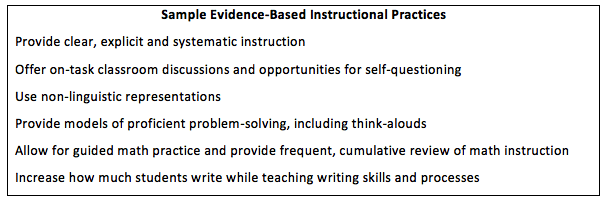
We focus on prevention by offering instruction that is evidence-based. For all tiers of instruction, from core to intervention, it is critical to use rigorous, evidence-based instructional strategies within the MTSS framework. Too often, we simply implement the latest program, or jump on the newest bandwagon, without considering whether or not they are effective or rigorous. There are many evidence-based strategies, but particularly good sources include the work of John Hattie, Robert Marzano, and Russell Gersten.
 Collaboration
 Collaboration
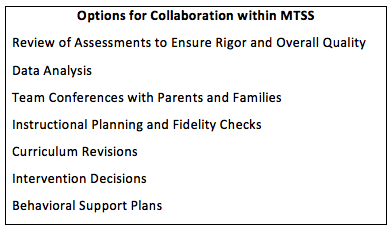
Student achievement is a shared responsibility among all staff, both administrators and teachers alike. The effectiveness of your MTSS program will be enhanced if you have teachers and leaders working together. Isolated attempts to meet students’ needs do not work in the MTSS program; it is simply too much work and responsibility for any one person.
Teams can make better decisions because of the variety of perspectives, and student achievement improves due to those improved decisions. However, there are other benefits to collaboration within a MTSS program, including increased job satisfaction and morale, a heightened sense of empowerment, and greater ownership of goals and priorities due to the shared decision-making.
 Assessment System that Drives Decisions
 Assessment System that Drives Decisions
Data-based decision making is central to MTSS at all levels of instruction and intervention. Use of data allows teams to make informed decisions regarding to instructional approaches, intervention selection, student placements in tiers, and even disability identification, when appropriate per state law.
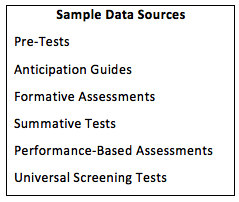
Data-driven decision-making should begin at the teacher level. First, teachers should collect data on an ongoing basis. Data should include items such as test scores, formative assessment, and observations. Then, analyze the data looking for strengths and weaknesses, with a particular eye toward any potential skill deficits. Finally, instruction should be modified to address any deficits.
 A Final Note
 A Final Note
Many districts are implementing MTSS in their schools and classrooms. However, if you want your program to have the most impact on your students, incorporate three critical elements: evidence-based instruction as prevention, collaboration, and an assessment system that drives decisions.
Research-supported interventions to help students who struggle by Barbara R. Blackburn with Bradley S. Witzel
Blackburn, B. & Witzel, B. (2018). Rigor in the RTI and MTSS Classroom. New York: Routledge.
- PBS News Hour – These military families say public schools aren’t supporting their special-needs kids
- Courthouse News Service – Panel Hears Dispute Over Special-Needs Education
- edCircuit – 6 Technology Ideas to Increase Rigor in Your Classroom
Subscribe to edCircuit to stay up to date on all of our shows, podcasts, news, and thought leadership articles.