
 EdCircuit Staff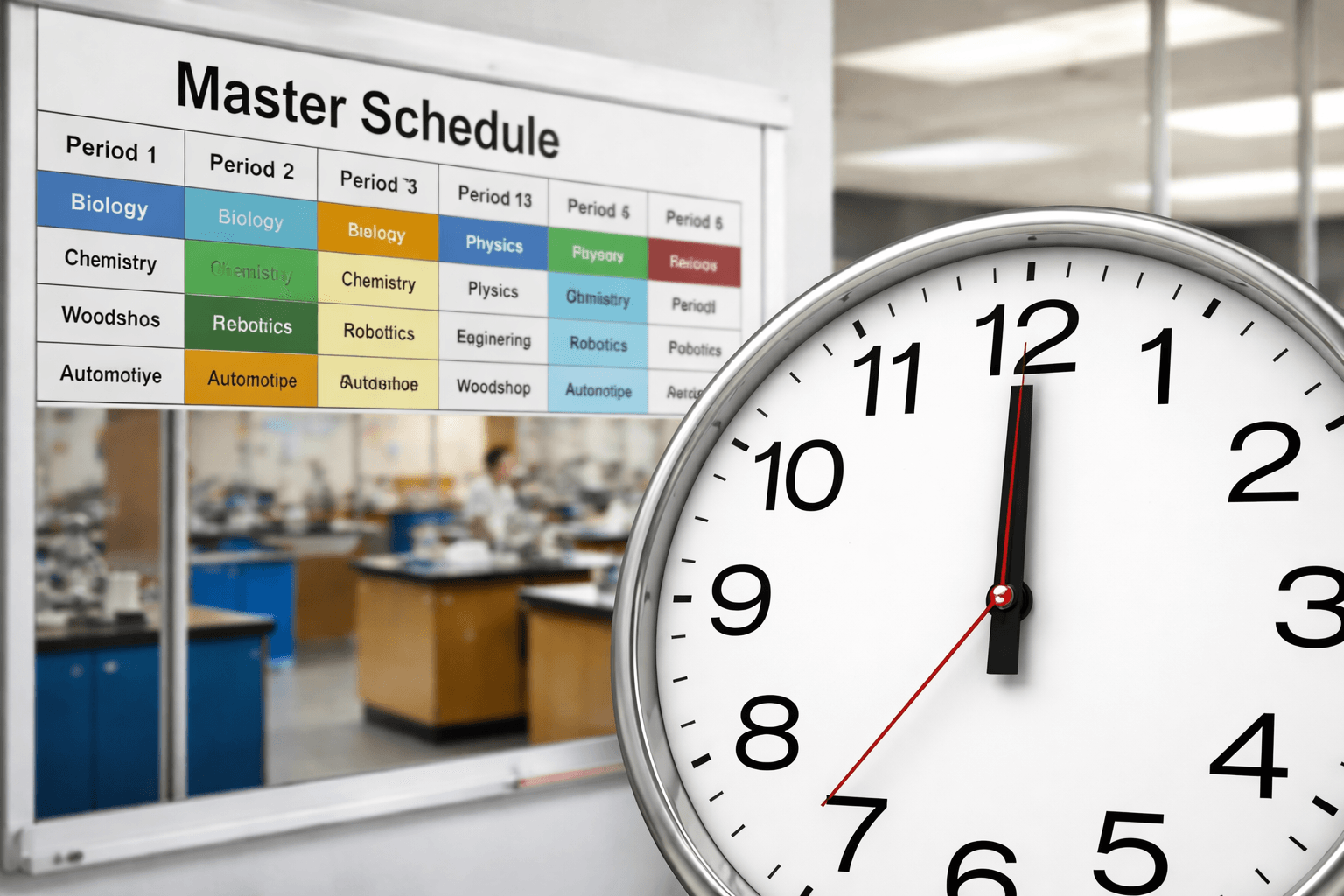
Table of Contents
Master schedule safety is one of the most powerful—and least recognized—risk controls in a school.
Long before a lab activity begins, before PPE is distributed, before equipment is turned on, the bell schedule has already determined whether safe procedures will happen consistently or be forced into rushed workarounds.
Time controls movement.
Time controls supervision.
Time controls whether a space resets properly or carries the residue of the previous class into the next.
That is the central message of the newest episode of the Safer Ed Podcast, Scheduling Is a Safety System: How Time, Transitions, and Movement Shape Risk—and it reframes the master schedule as a daily safety document.
The Most Dangerous Minutes in the School Day
Ask most educators when safety risk is highest and they will point to complex lab activities, power equipment, or chemical handling.
But in real schools, many near misses occur somewhere else entirely:
-
during passing periods
-
during shared-room transitions
-
during rushed cleanup
-
during early entry into spaces that are not reset
These are the moments when:
-
supervision is divided
-
expectations are unclear
-
pathways are congested
-
materials are still out
-
time pressure drives behavior
Nothing dramatic happens—until it does.
Because the system is operating with no margin for error.
Time Is Not Neutral
Schools traditionally treat the master schedule as an academic and logistical structure:
-
minutes of instruction
-
staffing
-
transportation
-
lunch periods
-
course sequencing
Safety is expected to fit inside that structure.
But in STEM labs, CTE programs, and active learning environments, time is not just a container—it is a control.
If a schedule allows five minutes for a safe shutdown, it becomes routine.
If a schedule allows two minutes, safety becomes dependent on speed, improvisation, and personal decision-making.
That is not a classroom issue.
That is a system design issue.
When Efficiency Reduces Resilience
Compressed transitions often appear efficient on paper. More classes fit into the day. More rooms are used continuously. Instructional minutes increase.
But efficiency without reset time creates strain:
-
cleanup is rushed
-
equipment is stored wherever there is space
-
emergency access narrows
-
teachers supervise two groups at once
-
students enter active work zones
Every day the system operates this way, the margin for error shrinks.
And when a system loses its margin, a single disruption can shut down instruction far longer than the minutes that were saved.
This is the paradox of time and safety:
Short-term efficiency can produce long-term instructional loss.
The Supervision Gap Leaders Don’t See
On a schedule, classes start and end at clear times.
In reality:
-
students arrive early
-
others leave late
-
hallways surge
-
rooms overlap
That creates a predictable condition where one adult is responsible for:
-
monitoring existing students
-
preparing the next lesson
-
preventing early entry
-
resetting equipment and materials
At that moment, supervision is diluted.
Not because the teacher is unprepared—but because the schedule requires simultaneous responsibilities that cannot be done safely at once.
Shared Spaces and the Accumulation Effect
Multi-use STEM and CTE rooms are a hallmark of modern schools.
Lab one period.
Makerspace is the next.
General instructions after that.
Flexibility increases access—but without a scheduled reset time, transformation never fully occurs.
Instead, materials accumulate:
-
carts parked in temporary locations
-
tools left at stations
-
storage pushed higher
-
power sources multiplied
The room remains “in use,” but it is no longer operating as designed.
Scheduling Is an Equity Issue
Not all programs receive the same time structures.
Some have:
-
longer blocks
-
protected transition time
-
consistent room assignments
Others run in:
-
compressed periods
-
shared spaces
-
back-to-back high-risk sequences
That means safety conditions vary—not because of staff commitment, but because of how time is allocated.
Master schedule safety is also about providing equitable operating conditions for every program and every student.
What Changes When Leaders See Time as a Safety Control
When time is treated as part of the safety system:
-
near misses are mapped to transition windows
-
high-risk activities are sequenced intentionally
-
reset time is protected
-
adult presence is aligned with movement patterns
-
shared spaces function as designed
Most importantly, teachers are no longer forced to choose between:
instructional pacing
and
safe shutdown.
Safe behavior becomes the natural outcome of the schedule—not an act of constant enforcement.
A Practical Starting Point for Districts
As schedules tighten and room use increases, understanding how many students can safely operate in a space becomes critical.
The Science Safety Occupancy Load Calculator provides a clear, immediate way to evaluate how:
-
class size
-
layout
-
program flow
-
storage density
intersect with supervision and emergency response.
It turns time, space, and movement into measurable planning data:
https://sciencesafety.com/free-occupancy-load-calculator-tool/
The Master Schedule Is a Safety Document
The safest schools are not the ones that react fastest.
They are the ones who design their daily rhythm so that safety procedures have time to take place without conflict.
Because every bell, every transition, and every reset window is shaping behavior—whether leaders intend it to or not.
Subscribe to edCircuit to stay up to date on all of our shows, podcasts, news, and thought leadership articles.