
 EdCircuit Staff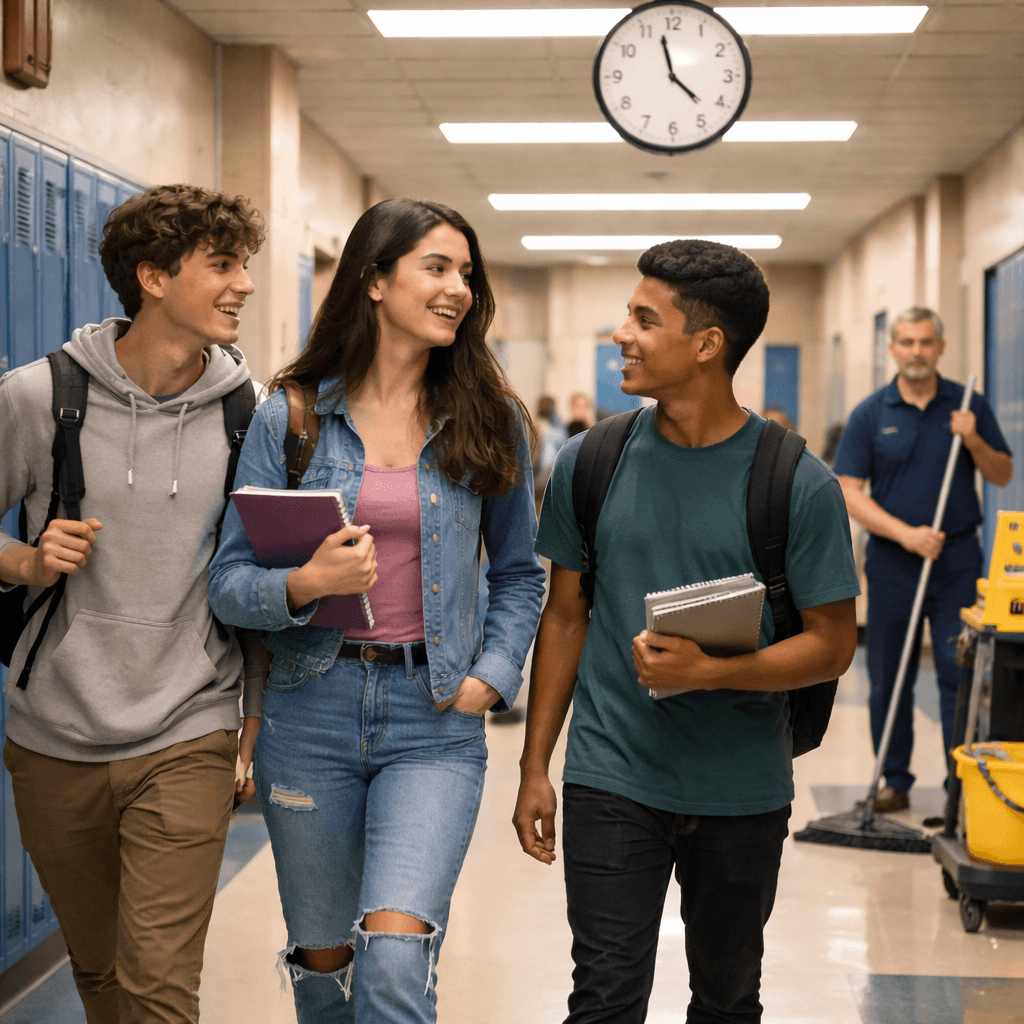
Table of Contents
After-hours school safety gaps leaders miss often exist in the quietest moments of the day—after the last bell rings, when staff begin to leave, and when the structure that defines the school day starts to fade.
The assumption is simple: the day is over.
But in reality, the building is still active.
Students remain in hallways. Athletic teams move between spaces. Clubs meet in classrooms. Doors open and close as groups enter and exit. A custodian walks the halls. A coach supervises a small group. A teacher finishes grading before heading out.
The activity hasn’t stopped.
The system has simply changed.
In the latest episode of the Safer Ed Podcast, “The Hidden Gaps: What Schools Think Is Safe (But Isn’t),” we examine how after-hours activity creates one of the most overlooked safety challenges in schools—an environment where students are present, but systems are no longer fully aligned to support them.
When the Day Ends—but Responsibility Doesn’t
During the school day, safety is structured and visible:
- Teachers supervise classrooms
- Administrators monitor hallways
- Movement is scheduled and controlled
- Communication is immediate and defined
Every part of the system works together to create a predictable, managed environment.
But after school, those structures begin to shift.
Not all at once—but gradually.
Teachers leave. Administrators wrap up their day. Support staff remain, but their roles are different. Students are still present, but no longer operating within the same level of oversight.
And yet, the building itself hasn’t changed.
The same classrooms exist.
The same labs are accessible.
The same equipment and materials are in place.
This creates a critical question that many schools don’t fully answer:
Who is responsible for students still in the building after hours?
The Illusion of Supervision
One of the most common misconceptions in after-hours environments is the belief that “someone is there.”
A custodian may be working down the hallway. A coach may be supervising practice. A club advisor may be in a classroom.
From a distance, it appears that supervision exists.
But supervision is not the same as coverage.
Custodial staff are not responsible for student oversight. Coaches are focused on their teams. Advisors are responsible for their specific groups—not the building as a whole.
So while adults are present, system-wide supervision is often fragmented or undefined.
Students move between spaces. Hallways are used informally. Entry points are less controlled. And in many cases, no single individual has full awareness of who is in the building or where they are.
This is not a failure of people—it is a gap in system design.
Students in Motion Without Structure
During the school day, student movement is controlled:
- Passing periods are timed
- Hallway presence is monitored
- Entry and exit points are limited
After hours, that structure disappears.
Students move independently. They enter and exit through different doors. They walk between spaces without consistent supervision. They may arrive late, leave early, or return to areas they used earlier in the day.
This shift creates unpredictability.
And unpredictability makes it difficult to maintain awareness.
A student walking down a hallway after school may not raise concern. But multiply that by multiple students, multiple entry points, and overlapping activities—and the building begins to function very differently.
The question is no longer “Is someone in the building?”
It becomes: “Does anyone know who is in the building—and where?”
Locked Doors Don’t Eliminate Risk
It’s easy to assume that locked classrooms or secured labs reduce risk after hours.
And in some cases, they do.
But access in schools is rarely absolute.
Doors are opened temporarily. Rooms are used by different groups. Staff move between spaces. Students who are familiar with the building understand how to navigate it.
A science lab, for example, may be fully controlled during the school day. Materials are accounted for. Procedures are followed. Students are supervised.
After hours, that same space may be near an active classroom, a meeting area, or a hallway with student traffic. A door is opened briefly. A student steps inside out of curiosity or convenience.
Nothing happens.
And that’s exactly what makes it dangerous—because the system begins to trust an outcome that hasn’t actually been tested.
Safety isn’t defined by past outcomes—it’s defined by present conditions.
If access exists without supervision, risk exists—even if it hasn’t been realized.
The Role of Duty of Care
At the center of this issue is a concept that is often misunderstood or overlooked in after-hours environments: duty of care.
Duty of care is not tied to the school day schedule. It is tied to the environment.
If a school building is open and students are present, the responsibility to provide a safe environment remains.
Duty of care doesn’t fade with the day—it follows the student.
This includes:
- Ensuring appropriate supervision
- Maintaining safe access to spaces
- Managing movement within the building
- Providing clear communication in case of an issue
When systems are designed only for the school day, but the building continues to operate beyond those hours, a gap forms between responsibility and reality.
And that gap creates exposure—for students, staff, and the institution.
When “Normal” Becomes Risk
The most challenging part of after-hours safety is that nothing feels wrong.
Students staying late is normal.
Teams practicing is expected.
Clubs meeting is encouraged.
Even students walking through hallways after hours can feel routine.
But risk often develops not from abnormal behavior—but from normalized conditions that are no longer supported by a system.
A door propped open for convenience.
A student cutting through a hallway to save time.
A group entering through a side entrance.
Each action is small. Each one feels harmless.
But together, they create an environment where:
- access is less controlled
- supervision is less consistent
- awareness is reduced
And in that environment, small issues can escalate—not because people are careless, but because the system is not fully present.
What Strong Schools Do Differently
Schools that address after-hours safety effectively don’t eliminate activity—they align it.
They recognize that the building doesn’t stop operating—and they design systems that reflect that reality.
This includes:
- Clearly defining who is responsible for the building during after-hours periods
- Establishing expectations for student movement and access
- Identifying which areas are accessible and which are restricted
- Coordinating communication across groups using the building
- Evaluating how entry and exit points are managed
Most importantly, they shift the mindset from:
“The day is over”
to
“The environment is still active—and must still be supported.”
Final Thought
After-hours activity is not the problem.
Unaligned systems are.
Because when students are still in the building, responsibility is still in the building.
And the question every school leader should be asking is not:
“Is someone here?”
But:
“Is the system still working—or has it quietly stepped aside while the building stays open?”
Subscribe to edCircuit to stay up to date on all of our shows, podcasts, news, and thought leadership articles.