 EdCircuit Staff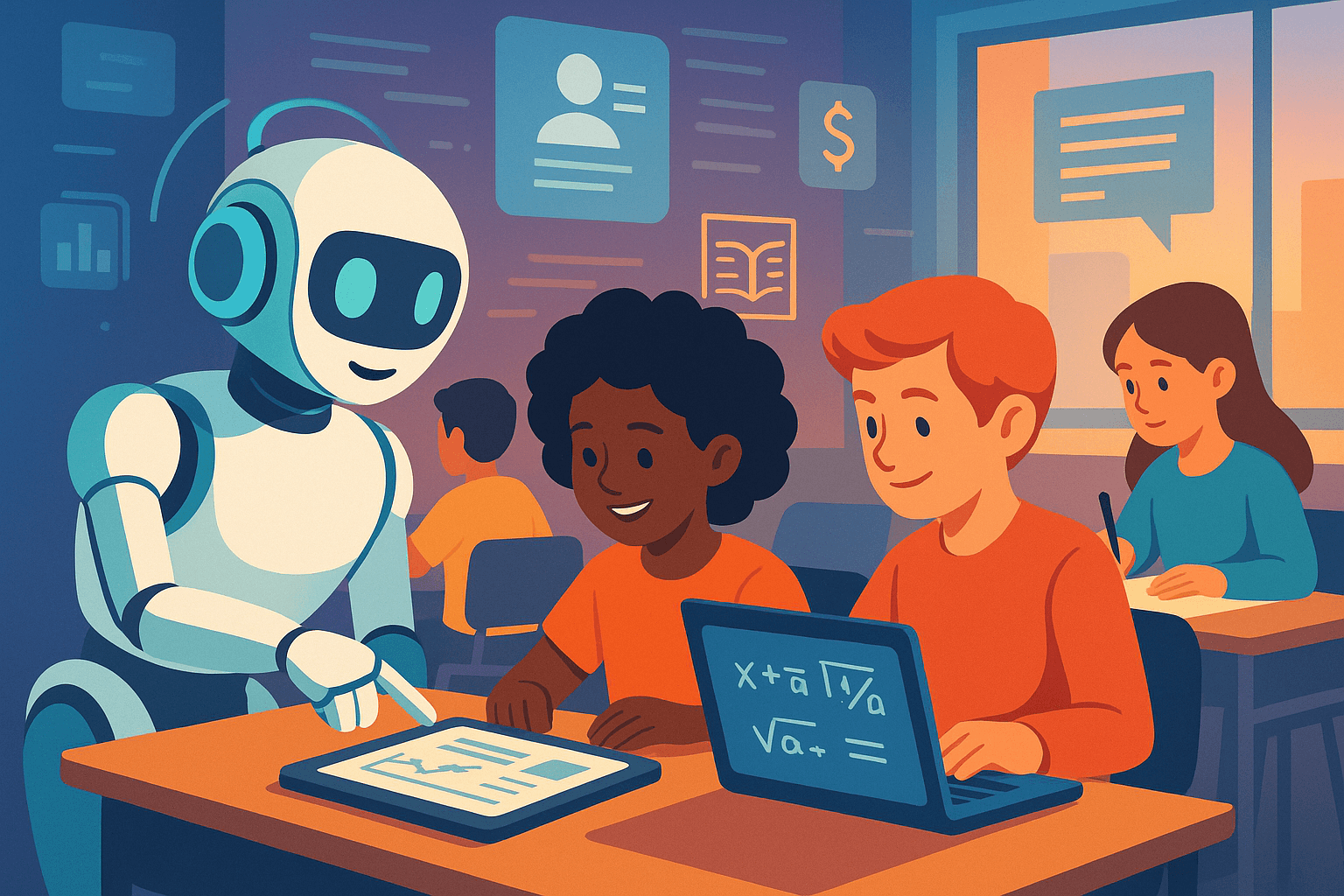
Table of Contents
AI in education enters 2026 with more traction and confidence than ever. What once felt experimental now feels essential. Students use AI to build literacy skills, tackle math with a deeper understanding, grow stronger in writing, explore financial literacy, and get tutoring that adapts on the spot. Teachers use AI to save time, refine instruction, personalize learning paths, and keep students engaged.
The real shift this year is not about new gadgets or flashy tools. It is about how naturally AI fits into daily learning. It is a partner that speeds up insight, clears confusion, and gives every student an entry point. Teachers remain at the heart of the classroom, but AI widens their reach and sharpens their impact.
AI in Tutoring: Instant Help That Feels Personal
AI-powered tutoring is becoming a standard support system rather than a backup plan. In 2026, tutoring systems are smarter about timing. They recognize struggle signals like hesitation, repeated errors, or slowing pace. They respond with short hints, not long lectures, guiding students to find answers through their own thinking.
Picture a seventh grader stuck on a science question at 9 PM. Instead of frustration building, the AI tutor offers a quick reminder about variables, gives a short example, and asks a question that nudges understanding forward.
Teachers benefit too. A tutoring dashboard tracks which skills students find tough, which concepts they skip, and where the class as a whole needs review. This gives teachers more control and clarity without adding hours to their workload.
Expect many districts to formalize AI tutoring as part of before-school, after-school, and at-home support, making personalized help accessible to every learner.
AI in Literacy: Smarter Insight and Personalized Reading Paths
Literacy gains a major advantage in 2026 as AI becomes better at reading how students read. These tools listen to fluency, identify mispronunciations, track decoding habits, and measure comprehension in real time. Instead of broad reading groups, instruction becomes individualized.
A student who hesitates on multisyllable words gets targeted practice. A student who reads fluently but misses deeper meaning gets prompts that stretch their comprehension and thinking.
Engagement grows because reading becomes personal. A student fascinated by the ocean can generate grade-level texts about marine life. Another student who loves mysteries can read custom stories that adjust difficulty based on their progress. Curiosity leads the way.
For teachers, AI provides clear daily insights instead of occasional benchmark snapshots. It makes early intervention timely and effective, strengthening literacy growth across classrooms.
AI in Math: Cleaner Logic, Faster Feedback
Math instruction continues to benefit from AI that analyzes the thinking behind student work. These systems do more than confirm correct answers. They look at each step, spot where reasoning goes off track, and offer a clear explanation that matches the student’s approach.
Imagine a student solving linear equations. They handle the first steps correctly, then miscombine terms. The AI points to the exact mistake, models the correct process in a short example, and gives the student a chance to retry with confidence. It feels like one-on-one support without the wait.
For teachers, AI-generated practice sets make differentiation easier. A class can work on the same concept at different entry points, and every student stays challenged at their own level. AI also scores open response explanations, giving teachers reliable feedback without adding grading time.
Support expands in algebra, geometry, statistics, and modeling, making math instruction more flexible and more precise.
AI in Financial Literacy: Real Life Choices, Real Learning
Financial literacy moves into the spotlight this year, and AI makes it practical. Instead of simplified textbook budgets, students explore real-world simulations that react to their decisions.
A student picks a job, receives a monthly income, and must manage housing, transportation, groceries, savings, and entertainment. The AI adjusts outcomes based on spending choices. Overspend on weekend plans, and the savings goal slips. Choose a healthier financial habit, and the simulation shows long-term growth.
Teachers can design custom scenarios tied to the local cost of living or a unit theme. As more schools implement financial literacy requirements, AI gives students hands-on practice that builds real confidence.
AI in Writing: More Clarity and More Creativity
Writing becomes easier and more enjoyable with AI as a writing coach. It does not write for students. Instead, it helps them build ideas, develop structure, and strengthen clarity.
Picture a student tackling an argumentative essay. They ask the AI for help refining a thesis, then test different angles until one feels strong. The AI highlights vague sections, suggests ways to tighten sentences, and shows how to improve transitions while keeping the student’s voice intact.
Students learn to revise with purpose, not frustration. Teachers win time back because basic mechanical feedback happens instantly, freeing them to focus on deeper thinking and creativity.
Writing in 2026 becomes more approachable, more expressive, and less intimidating.
What the New Year Brings: A More Confident and Connected Classroom
The story of AI in education this year is not about replacing teachers. It is about unlocking more meaningful learning. AI gives students clear, immediate feedback. It offers teachers stronger tools and more margin for the work only they can do. It gives families better insight into progress. It creates space for curiosity and confidence.
In 2026, expect classrooms to feel more personal. Expect students to take bigger risks in literacy, math, writing, and financial learning because they know help is there when they need it. Expect teachers to have smoother planning, clearer data, and more room for creativity.
AI in education is not a shortcut. It is a support system that lifts everyone. And this year, it is ready to bring more clarity, energy, and opportunity to learning than ever before.
Subscribe to edCircuit to stay up to date on all of our shows, podcasts, news, and thought leadership articles.