



Career and Technical Education jobs are transforming how schools prepare students for successful, debt-free careers after graduation. Across the country, educators are witnessing a major shift in how students and families view life after high school. For decades, the traditional message was simple: attend a four-year university, earn a degree, and begin a career. But rising tuition costs, growing student loan debt, and increasing demand for skilled workers are changing that conversation in powerful ways.
Today, many students are discovering that success can begin immediately after high school through skilled trades, technical certifications, apprenticeships, and workforce partnerships that lead directly to stable, meaningful careers. More importantly, schools are helping students understand that choosing a technical pathway is not settling for less. In many cases, it is opening the door to opportunity, financial independence, entrepreneurship, and long-term success.
This movement is about more than workforce development. It is about changing lives.
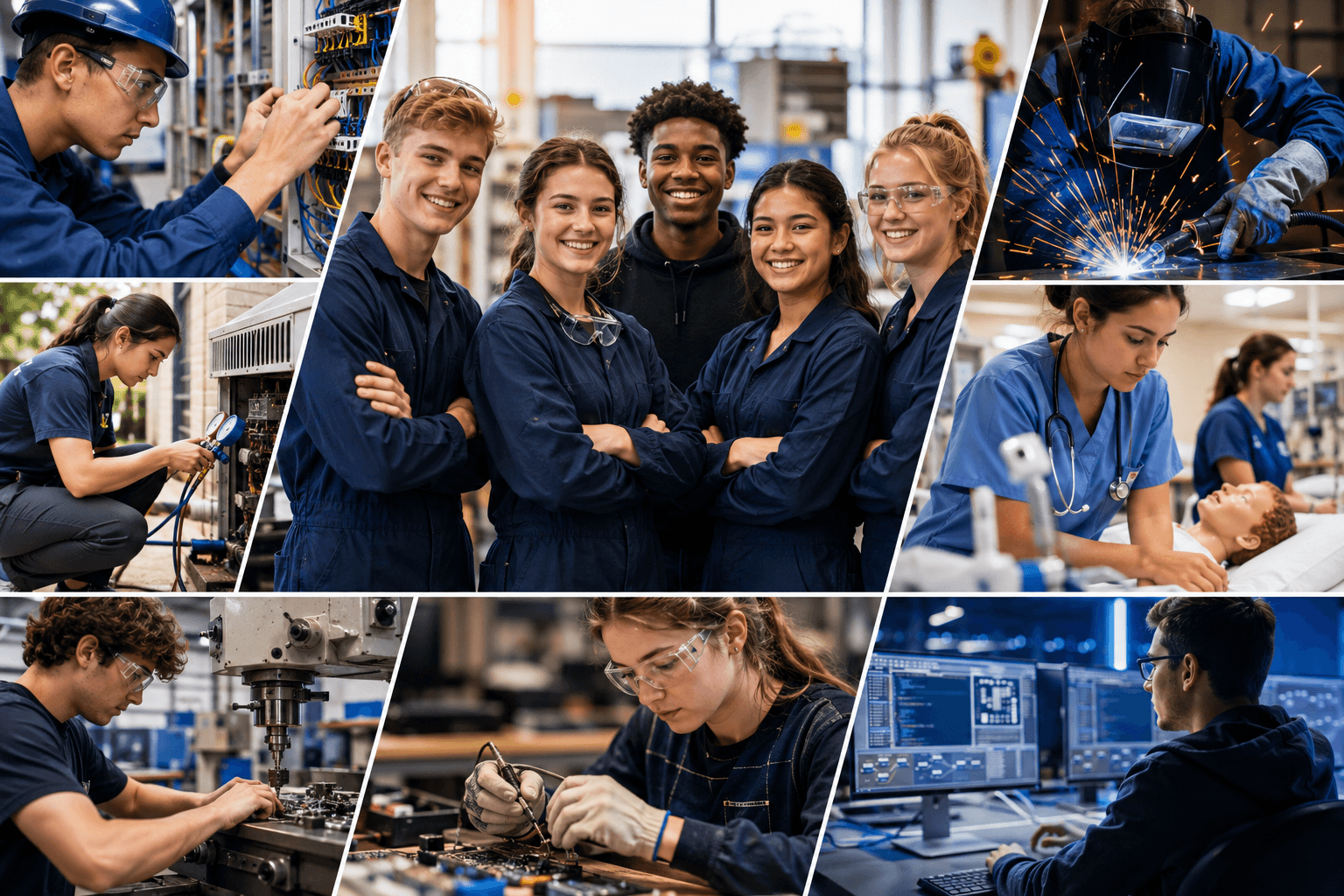
Across America, high schools are redesigning learning spaces, modernizing Career and Technical Education (CTE) programs, and building stronger partnerships with community colleges, trade organizations, healthcare systems, unions, and local businesses. Welding labs now resemble advanced manufacturing facilities. Healthcare classrooms feature patient simulation mannequins and emergency response equipment. Cybersecurity labs mimic real-world network environments. Students are no longer simply learning about careers. They are experiencing them firsthand.
For many students, these programs provide something traditional classrooms sometimes struggle to offer: a direct connection between education and purpose.
A New Definition of Success
The conversation around postsecondary success is evolving rapidly. Families who once believed a four-year university was the only respectable path are increasingly recognizing the value of skilled trades and technical careers. Parents are seeing graduates enter the workforce with strong salaries, retirement benefits, job security, and little to no college debt.
At the same time, industries across the country are facing workforce shortages in construction, manufacturing, healthcare, information technology, and infrastructure. Schools are responding by creating pathways that prepare students to fill those critical roles while giving them a head start financially and professionally.
Counselors and educators are also helping students understand a critical truth: success looks different for every learner.
Some students thrive in lecture halls and academic research environments. Others thrive when working with their hands, solving technical problems, building systems, repairing equipment, or learning through real-world application. Career and Technical Education allows schools to honor those different strengths while helping students build confidence in their future.
The result is a generation of students beginning to realize they have options.
1. Electricians and Electrical Technology
Electrical technology has quickly become one of the most sought-after CTE pathways in the country. As communities expand infrastructure, modernize buildings, and adopt renewable energy systems, electricians are becoming increasingly valuable.
Today’s high school electrical programs are far more advanced than many people realize. Students often work in fully equipped training labs where they learn circuitry, wiring, blueprint reading, motor controls, safety procedures, and electrical diagnostics. Some graduate with OSHA certifications or apprenticeship hours already completed.
What makes this pathway especially attractive is the combination of strong earning potential and limited educational debt. Many apprenticeships allow students to earn income while continuing their training, helping them build careers without the financial burden many college graduates face.
One student in a Midwest CTE program recently completed his electrical certification pathway before graduation and immediately entered a paid apprenticeship with a local contractor. By age 20, he had already purchased his first truck, avoided student loans entirely, and was mentoring younger students interested in the trade.
Stories like these are becoming more common across the country.
High schools are increasingly partnering with unions, construction firms, and workforce development agencies to ensure students transition smoothly from the classroom into real employment opportunities. These partnerships are helping students see that technical careers can offer stability, pride, and long-term growth.
2. HVAC and Climate Control Technology
Heating, ventilation, air conditioning, and refrigeration careers are also experiencing enormous demand. Every school, hospital, office building, home, and commercial facility depends on climate control systems operating safely and efficiently.
Modern HVAC careers combine technical skill with advanced technology. Students learn how to troubleshoot digital systems, improve energy efficiency, analyze airflow systems, and maintain complex environmental controls. In many programs, students work directly on training units identical to the equipment used in the field.
For students who enjoy problem-solving and hands-on learning, HVAC programs can become life-changing opportunities.
Many school districts now partner directly with local HVAC companies to provide internships, job-shadowing experiences, and mentorship opportunities. These community relationships help students build professional connections before they even graduate.
What also makes HVAC appealing is job security. Climate systems require ongoing installation, maintenance, upgrades, and emergency repairs year-round. Skilled technicians remain in demand regardless of economic conditions.
For educators, HVAC programs also represent something larger: proof that skilled trades now require advanced technical thinking, digital literacy, communication skills, and professionalism.
These are highly skilled careers shaping the future of infrastructure and sustainability.
3. Healthcare Support Careers
Healthcare continues to be one of the fastest-growing employment sectors in America, and high schools are helping students enter the field earlier than ever before.
CTE healthcare programs now offer pathways in nursing assistance, sports medicine, emergency medical response, medical assisting, phlebotomy, and patient care. Many students graduate with certifications that allow them to begin working immediately while continuing their education if they choose.
Inside these classrooms, students often practice patient care techniques using healthcare simulation equipment designed to replicate real medical environments. Some programs partner directly with hospitals and healthcare providers, allowing students to complete clinical experiences before graduation.
These experiences are transformative.
Students not only learn technical healthcare skills, but they also develop empathy, communication, teamwork, and responsibility. Many discover a sense of purpose that shapes their future career decisions.
In one district, a student enrolled in a healthcare pathway after helping care for a grandparent during an illness. Through clinical experiences and mentorship opportunities, she discovered a passion for nursing and became the first member of her family to pursue a healthcare career.
Career and Technical Education programs often do more than prepare students for jobs. They help students discover who they are.
4. Welding and Advanced Manufacturing
Manufacturing has evolved dramatically over the past two decades. Today’s advanced manufacturing environments rely heavily on robotics, automation, engineering technology, computer-assisted design, and precision systems.
High school welding and manufacturing programs are evolving alongside those changes.
Students now learn fabrication, robotic welding, CNC machining, blueprint interpretation, and advanced safety procedures using industry-grade equipment. Many schools have transformed outdated shop classrooms into modern innovation labs filled with digital fabrication systems and advanced manufacturing tools.
Community partnerships are driving much of this transformation. Local manufacturers increasingly recognize that workforce development must begin before graduation. As a result, many companies are donating equipment, funding training programs, sponsoring student competitions, and offering paid internships to students.
This connection between schools and industry creates enormous opportunity.
Students who once felt disconnected from traditional academic environments are discovering confidence through technical mastery and hands-on achievement. Educators are watching students who struggled in conventional classrooms become leaders in welding labs, engineering teams, and robotics competitions.
These programs are helping students understand that skilled trades require intelligence, precision, creativity, and discipline.
5. Cybersecurity and Information Technology
One of the fastest-growing CTE pathways today is cybersecurity and information technology. As schools, businesses, healthcare systems, and government agencies face growing digital threats, the demand for skilled IT professionals continues to rise.
High schools are responding by building cybersecurity labs, networking academies, coding programs, and IT certification pathways that prepare students for immediate employment opportunities after graduation.
Students may graduate with certifications in networking, cybersecurity fundamentals, cloud systems, or hardware support while gaining real-world troubleshooting experience in simulated technology environments.
This pathway also reflects how modern Career and Technical Education has evolved far beyond outdated stereotypes.
Today’s CTE programs include highly sophisticated technology fields that blend analytical thinking, problem-solving, communication, and innovation. Students interested in technology can now begin building professional careers directly from high school while continuing to grow their skills over time.
Partnerships with local technology companies, colleges, and workforce organizations are helping students understand that cybersecurity is not just a future career pathway. It is one of the most critical industries shaping the future of society.
How Schools Are Changing Lives
The most inspiring part of the Career and Technical Education movement may be the renewed sense of purpose many students are discovering.
Educators frequently talk about the moment a student realizes they are good at something meaningful. Sometimes that moment happens in a welding lab. Sometimes it happens during a healthcare clinical rotation. Sometimes it happens while troubleshooting a network issue or wiring a circuit board.
Those moments matter.
Students who may have once doubted themselves begin to see a future filled with possibility. Families begin viewing technical careers with pride and excitement. Communities benefit from stronger local workforce pipelines. Employers gain access to motivated young professionals ready to contribute.
Schools are no longer simply preparing students for tests. Increasingly, they are preparing students for life.
Career and Technical Education programs are helping students understand that there are many pathways to success, and every pathway deserves respect.
That message may be one of the most important lessons education can offer today.
At a time when many families are questioning the cost of higher education, and students are searching for purpose, CTE programs are providing something incredibly powerful: hope, direction, and opportunity.
And for countless students across America, that opportunity is changing lives forever.
Subscribe to edCircuit to stay up to date on all of our shows, podcasts, news, and thought leadership articles.
Related reading
More on Career and Technical Education (CTE)