 EdCircuit Staff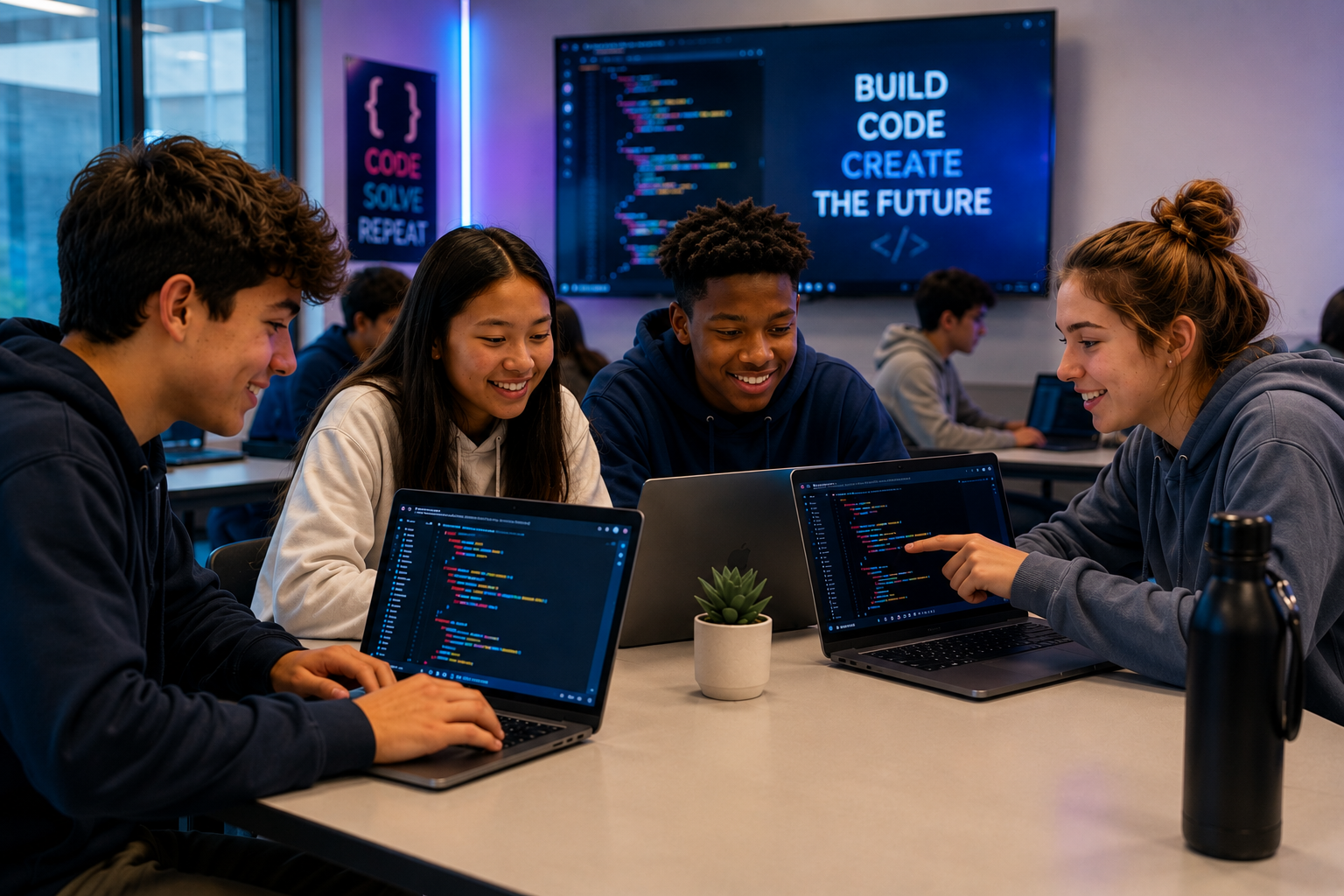
Coding clubs in schools are helping students develop programming skills, computational thinking, and artificial intelligence literacy while preparing them to become the creators, innovators, and problem-solvers of tomorrow’s digital economy.
A high school student launches an app that helps classmates organize assignments.
Another designs a website for a local nonprofit.
A group of students creates a game that attracts hundreds of downloads from friends and family.
A middle school student develops a chatbot that answers frequently asked questions about school events.
These are not stories from Silicon Valley startups.
They are examples of projects being created by students across America through coding clubs.
While previous generations grew up learning how to use technology, today’s students have an opportunity to learn how to build it.
That distinction matters.
As artificial intelligence, automation, cloud computing, and digital technologies continue transforming nearly every industry, coding clubs are becoming one of the most valuable opportunities schools can offer. They provide students with the skills to move beyond being consumers of technology and become creators of technology instead.
For educators, administrators, and parents looking to prepare students for a rapidly changing future, coding clubs represent much more than an after-school activity.
They represent a pathway to innovation.
From Consumers to Creators
Today’s students live in a digital world.
They communicate through apps.
They watch videos online.
They play games.
They use artificial intelligence tools.
They interact with technology from the moment they wake up until they go to bed.
Yet most students have little understanding of how those technologies are created.
Coding clubs change that.
Students begin learning that every application, website, game, software platform, and AI tool started as an idea.
Someone identified a problem.
Someone designed a solution.
Someone wrote the code.
That realization can be transformational.
Students stop seeing technology as something created by others and begin understanding that they have the ability to create technology themselves.
The confidence that comes from building something from nothing often becomes one of the most powerful outcomes of coding education.
A student who successfully develops a simple app or game begins to think differently about what is possible.
That confidence frequently extends into academics, leadership opportunities, and future career aspirations.
Coding Is Becoming a New Literacy
For generations, schools have focused on reading, writing, and mathematics as foundational skills.
Those subjects remain essential.
However, many educators now view computational thinking as another critical literacy for the modern world.
Students do not need to become software engineers to benefit from coding.
Just as not every student becomes a professional writer, understanding how digital systems operate provides value regardless of career choice.
Healthcare professionals rely on software systems.
Farmers use precision agriculture technologies.
Manufacturers operate automated equipment.
Financial institutions depend on data analytics.
Architects use advanced design software.
Scientists analyze enormous datasets.
Business leaders increasingly rely on artificial intelligence tools.
Technology touches nearly every profession.
Coding clubs help students understand the systems that are shaping the world around them.
Why Coding Matters in the Age of Artificial Intelligence
No conversation about education today is complete without discussing artificial intelligence.
AI is changing how people work, communicate, create content, conduct research, and solve problems.
Students are already using AI tools in their daily lives.
The challenge facing schools is ensuring students understand these technologies rather than simply interacting with them.
Coding clubs provide an ideal environment for that learning.
Students can explore machine learning concepts, automation, prompt engineering, data analysis, and AI ethics in ways that are both practical and engaging.
More importantly, they learn that AI is not magic.
It is technology designed and developed by people.
As AI becomes integrated into virtually every industry, students who understand how these systems work will possess a significant advantage.
Coding clubs help schools move beyond conversations about AI and into meaningful exploration of its possibilities and limitations.
Students Are Building Real Solutions
One misconception about coding clubs is that students spend their time memorizing programming syntax.
The reality is much more exciting.
Students build things.
They create mobile applications.
They design websites.
They develop games.
They automate repetitive tasks.
They build databases.
They create AI-powered tools.
They develop software that solves real-world problems.
Some students create solutions for challenges within their own schools.
Others develop projects focused on community needs.
Many discover that coding provides a creative outlet similar to art, music, or writing.
The computer simply becomes the canvas.
The ability to transform ideas into working solutions is one of the reasons coding clubs are so engaging for students.
The results are visible.
The impact is real.
The learning feels meaningful.
National Competitions and Organizations Support Student Success
Schools considering a coding club do not have to build a program from the ground up.
A strong network of organizations already exists to support educators and students.
Among the most influential is Code.org, which has helped expand computer science access for millions of students through free curriculum resources and educator support.
The Computer Science Teachers Association provides professional learning opportunities, networking, and resources for schools expanding computer science programs.
Students can participate in the Congressional App Challenge, where they develop applications and compete with peers across congressional districts.
Additional opportunities exist through the American Computer Science League, Technology Student Association, and SkillsUSA.
Hackathons, coding competitions, game design contests, and AI innovation challenges continue expanding nationwide.
Just as athletics provide opportunities for students to compete and grow, coding competitions create environments where students can showcase creativity, technical skill, and innovation.
Coding Clubs Create Entrepreneurs
Perhaps one of the most overlooked benefits of coding clubs is entrepreneurship.
A student with coding skills can build a business.
That possibility did not exist for previous generations in quite the same way.
Today’s students can create applications, websites, software tools, digital products, and AI solutions from virtually anywhere.
Many successful technology companies began with a simple idea and a willingness to solve a problem.
Coding clubs introduce students to that mindset.
They learn to identify challenges.
They learn to design solutions.
They learn to test, improve, and refine their work.
In many ways, coding clubs teach innovation as much as they teach programming.
Students begin seeing opportunities where others see obstacles.
That perspective can influence their futures long after they leave school.
Teachers Do Not Need to Be Expert Programmers
One of the biggest barriers preventing schools from starting coding clubs is a misconception.
Many educators believe they must be expert programmers before they can lead a coding club.
That simply is not true.
Across the country, successful coding clubs are being facilitated by teachers who began with little or no coding experience.
The advisor’s role is not necessarily to provide every answer.
The advisor’s role is to create opportunities.
Students often become researchers and problem-solvers themselves.
Online learning resources, tutorials, professional organizations, AI-assisted learning tools, and industry mentors make it easier than ever to support student learning.
Many clubs become environments where educators and students learn together.
That collaborative approach can be incredibly empowering.
The most important requirement is not technical expertise.
It is a willingness to help students explore.
Partnering With Local Businesses
One of the greatest opportunities for coding clubs lies in community partnerships.
Unlike some STEM activities that rely heavily on specialized industries, coding connects to nearly every sector of the economy.
Hospitals rely on software.
Banks depend on technology platforms.
Manufacturers use automation systems.
Insurance companies analyze data.
Universities conduct technology research.
Government agencies maintain digital infrastructure.
Technology touches everything.
That creates partnership opportunities for schools in almost every community.
Local organizations can provide guest speakers, mentorship opportunities, internships, project challenges, job-shadowing experiences, and sponsorship support.
Students gain exposure to real-world careers.
Employers gain opportunities to engage future talent.
Schools gain valuable community connections.
These partnerships often become some of the most meaningful aspects of a coding program.
Preparing Students for Careers That Do Not Yet Exist
Perhaps the most compelling reason to start a coding club is simple.
The future is difficult to predict.
Many of today’s students will eventually work in careers that have not yet been invented.
Schools cannot anticipate every future job title.
What they can do is help students develop skills that remain valuable regardless of how technology evolves.
Problem-solving.
Creativity.
Communication.
Adaptability.
Collaboration.
Innovation.
Computational thinking.
Coding clubs develop all of these qualities while helping students understand the technologies driving economic and societal change.
Building More Than Software
At first glance, coding clubs appear to focus on programming.
Look closer, however, and something much more important is happening.
Students are learning how to think.
They are learning how to create.
They are learning how to solve problems.
They are learning how to innovate.
They are learning how to turn ideas into reality.
Most importantly, they are learning that they can shape the future rather than simply react to it.
As schools continue searching for meaningful ways to prepare students for an increasingly digital world, coding clubs stand out as one of the most accessible, impactful, and future-focused opportunities available.
Students may join because they want to learn how to code.
What they often discover is something much larger.
They discover the power to create.
And in a world increasingly defined by technology, that may be one of the most important lessons a school can teach.

Hack Club – Inside a High School Coding Club
Subscribe to edCircuit to stay up to date on all of our shows, podcasts, news, and thought leadership articles.